
How do you integrate SEO into your content?

If you’re just starting out with content marketing (or you’ve been writing but want to get more out of it) learning how to integrate SEO into your content can make a huge difference. With a clear and practical approach, you can create content that ranks better, reaches the right audience, and builds long-term value. Below is a friendly, step-by-step guide to help you get started.
TL;DR
- Start by building a simple content plan around well-chosen keywords and user intent.
- Structure each page for clarity, optimize technical and on-page elements, build topical clusters, and monitor performance.
- Use tools (including NEURONwriter) to streamline the process.
Why SEO and content go hand in hand
Content marketing and SEO complement each other: content marketing produces valuable material; SEO ensures that material is discoverable by search engines and your audience.
Without SEO, even good content risks being invisible. Search engines need clear signals (structure, relevance, metadata) to index and surface your pages.
With both aligned — content that’s useful and optimized — you improve your chance of reaching and helping real readers, not just generating traffic.
So if you want to integrate SEO into your content in a meaningful way, you’re really combining two powerful practices: thoughtful content creation and smart optimization.
Step 1: Start with a data-driven content plan
Do keyword research with intent in mind
- First, pick topics and terms that people actually search for → but also that match what you offer. A good content plan begins with:
- Choosing keywords that match user intent (informational, transactional, navigational) rather than just chasing high search volume. This gives you a foundation for developing search-friendly content and helps search engines understand what you want to rank for.
- Considering long-tail keywords or specific, niche queries. These often have lower competition, higher relevance, and make it easier for readers to find your content on search engine results pages.
- Mixing short-form and long-form ideas: some keywords might work for quick blog posts, others demand deeper guides. Matching length to intent is an aspect of SEO that improves SEO performance and supports a more successful SEO strategy.
Example: If you run a SaaS blog, instead of targeting “content marketing,” you might aim for “content marketing strategy for SaaS startups” — fewer searches, but more qualified readers and content that resonates. This level of precision makes it easier to incorporate SEO into your content and craft content that aligns with how people search.
Build a mapping of topics
Organize your content plan around themes or “pillars.” A simple method:
- Identify 3–5 core areas your audience cares about (e.g. “SaaS onboarding,” “UX design,” “Accessibility,” “Scaling apps”). These pillars make content development easier and guide how you shape the content on your website.
- For each area, brainstorm a set of related subtopics or questions. These naturally become content clusters, which help search engines understand your content and improve your search engine ranking over time.
- Use that as a launching point for content creation → this builds authority and context. It also keeps every piece of content aligned with what your audience actually wants, not random ideas.
This approach helps build a robust SEO content strategy rather than ad-hoc blog posts, especially when content marketing work together with data from tools like Google Keyword Planner or insights from embedded analytics tools.
When you group content around clear themes, you produce content that naturally attracts readers, supports optimizing content for search engines, and strengthens overall SEO without forcing keywords into your content.
Avoid duplication and aim for unique value
Duplicate content or slight rewrites of what’s already online seldom help.
Instead, aim for content that provides something new:
- your own examples,
- updated data,
- or a clearer explanation.
Unique work improves user experience and search, strengthens authority, and supports SEO optimization in a way that lifts long-term visibility. This is where content gap analysis becomes useful: it helps you spot what competitors missed so you can develop content that addresses actual needs.
Good practice:
Create engaging content that answers questions with fresh insights, original examples, or practical steps. Use tools like Google Analytics 4 and Google Search Console to see what readers respond to and identify gaps.

When you produce content for SEO that goes beyond what’s already ranking, you improve your SEO, build trust, and increase the effectiveness of your SEO over time. This approach aligns the content of the page with intent and supports higher SEO rankings.
Bad practice:
Copying the top three results and swapping a few words, or rewriting an outdated article without adding new angles. This kind of thin content hurts user experience and SEO, triggers SEO issues, and wastes your SEO efforts because nothing differentiates your page.
If the content matches existing material too closely, search engines see no added value, making it unlikely to rank—even if it technically follows the latest SEO trends or checks basic SEO metrics.
Step 2: Structure your content for both humans and search engines
Write with good structure: headings, paragraphs, and readability
Search engines – and real readers – appreciate content that feels organized and easy to follow. A solid structure also improves user experience and search, because people can quickly understand what the page covers and decide where to focus.
To achieve this:
- Use a clear heading hierarchy (H1 → H2 → H3). This helps outline your argument, break ideas into logical sections, and guide readers through your thinking.
- Write short paragraphs. Large walls of text overwhelm readers and often cause them to bounce. Breaking thoughts into digestible chunks keeps attention high and strengthens readability signals.
- Use bullet points or numbered lists where appropriate; especially when explaining a process, multi-step workflow, or comparison for a new website. These visual anchors help users scan the content of the page quickly and keep them engaged.
This type of structure also helps search engines understand your content more accurately. It becomes easier for crawlers to interpret the hierarchy, identify what each section means, and connect the content to relevant search engine results.
Craft helpful, high-quality content first (checked with an AI paper grader, for example) then optimize later.
Your content should be useful, engaging, and relevant before you think about SEO. Search engines reward content that provides clarity, answers, and real value. SEO isn’t a layer you add later — it’s the practice of making valuable content easy to find. That means aiming to:
- Address real user needs and questions, not just what competitors are publishing.
- Deliver depth and clarity — examples, short explanations, and actionable steps — instead of vague statements.
- Prioritize content quality over stuffing keywords. You want content that addresses a problem, not content that simply repeats phrases.
Modern algorithms focus heavily on user experience and SEO signals. They evaluate how people interact with the page, how long they stay, and whether the content matches their intent. Because of this, even small improvements in clarity or usefulness can directly improve your SEO.
When you focus on quality first, you naturally create content that resonates, which supports long-term SEO value.
Optimize on-page elements
Once the writing is complete, polish it through smart on-page SEO. This is where small technical improvements help search engines understand your content and place it correctly in search engine results pages.
- Use meaningful, clean URLs. Short, descriptive URLs give readers confidence and help search engines see the structure of your site. Simple formats often lead to stronger indexing and SEO rankings over time.
- Set a descriptive meta title and meta description. These play a major role in click-through rates because they provide the first impression in the SERPs. They also signal what the page actually covers, which improves both indexing and user trust.
- Link internally to related pages — this builds context, connects ideas, and keeps users exploring your site longer. Internal linking also strengthens authority and is one of the simplest ways to improve your SEO through better structure.
- Avoid tricks like hiding keywords or “white fonting.” These tactics violate guidelines, risk penalties, and weaken the credibility of your site. Modern SEO involves transparency and value → not shortcuts.
When you combine clean structure, clear communication, and thoughtful on-page optimization, you create content that both readers and algorithms trust.
Step 3: Use a pillar-and-cluster model to build topical authority
Rather than random blog posts, build a content architecture that signals depth and relevance:
- Create pillar pages — long, in-depth guides on core topics. These act as central hubs.
- Then create cluster posts — shorter articles around subtopics, each linking back to the pillar page (and vice versa). This helps both users and search engines understand your field of expertise.

This internal linking structure boosts relevance, improves crawlability, and strengthens your topical authority.
Example for a marketing agency
- Pillar page: “Content marketing strategy for SaaS companies”
- Cluster posts: “How to create a content calendar for SaaS,” “Best formats for B2B SaaS blog,” “SaaS case study templates,” etc.
This way, your site becomes a go-to resource — and each article supports others.
“SEO has completely shifted from a content volume game to a reputation game.
With everyone pumping out volume at scale with AI tools, reputation and authority have become the most important factors. This is why review websites like G2 and TrustPilot are now some of the most cited resources in AI search engines, and why brand mentions (not just backlinks) matter so much for featured snippets. In 2026 thought leadership and organic press will matter much more than volume, but the perfect formula will always be good content and high authority.”
– Austin Heaton, 12-Year SEO Consultant
Step 4: Combine content marketing and SEO — align goals
The magic happens when content marketing and SEO aren’t separate tactics, but parts of the same plan.
Set clear SEO goals before writing
Ask yourself: What do you want this piece of content to achieve? Examples:
- Get traffic from a niche audience
- Educate prospects about your product
- Build trust and authority in a subject
- Lead to conversions or sign-ups
With clear goals, you can choose the right format, length, depth, and keywords — instead of writing randomly.
For agencies and B2B teams, SEO content often supports sales pipelines that include CRM systems, proposal workflows, and RFP response software.
Prioritize user experience and value, not just ranking
Because search engines like Google increasingly value content that helps and satisfies users, not just matches keywords.
That means:
- Focus on readability, clarity, and usefulness
- Provide actionable advice, examples, frameworks — not vague generalities
- Avoid keyword stuffing or unethical tricks; aim to produce content that serves actual people
This approach supports effective SEO and content marketing over time — stronger trust, better engagement, and sustainable growth.
Step 5: Pay attention to technical SEO and user experience
Build the foundation that allows all your writing, positioning, and strategy to work as intended. It also strengthens user experience and search, because visitors expect pages to load fast, look clean, and behave consistently across devices.
- Ensure your site is mobile-friendly. Many users browse on phones, and search engines penalize pages with poor mobile UX. A responsive layout, readable fonts, and fast-loading elements keep visitors engaged instead of bouncing.
- Optimize images: compress size, choose appropriate formats, add descriptive alt text and captions. This speeds up the page, reduces bandwidth issues, and improves crawlability. Alt text also helps bots understand visuals, which supports broader accessibility goals.
- Avoid messy query parameters. A simple URL structure feels more trustworthy to users and helps search engines categorize the page properly. Clean URLs also make internal linking easier and reduce indexing errors.
- Use proper HTML structure. Correct heading tags, semantic markup, and logical sections guide both readers and crawlers. Add internal links where relevant — these connections strengthen topical understanding and give crawlers clear paths through your site.
Together, these elements strengthen your technical foundation so your content isn’t just well-written → it’s also fast, clear, findable, and accessible. When both technical SEO and content quality are in good shape, you create an experience that supports long-term rankings and user trust.
Step 6: Review, audit, and iterate regularly
SEO isn’t a “set and forget” effort. To keep improving:
- Run regular content audits. Review older posts: are they still relevant? Do they need updates, new data, better examples, fresh internal links?
- Track performance. Use tools (e.g. Google Analytics, Google Search Console) to monitor traffic, bounce rate, click-throughs. That helps you see what works and refine your content plan.
- Update content periodically. Even evergreen topics benefit from fresh data, new examples, or improved formatting. This keeps content relevant and shows ongoing value.
Used wisely, it blends seamlessly into your workflow: you still write for humans but benefit from SEO discipline supported through a modern generative engine optimization tool that helps you perform in AI-driven discovery systems.
Use NEURONwriter as your natural SEO assistant
Writing great content while dealing with SEO and user value can feel like walking a tightrope.
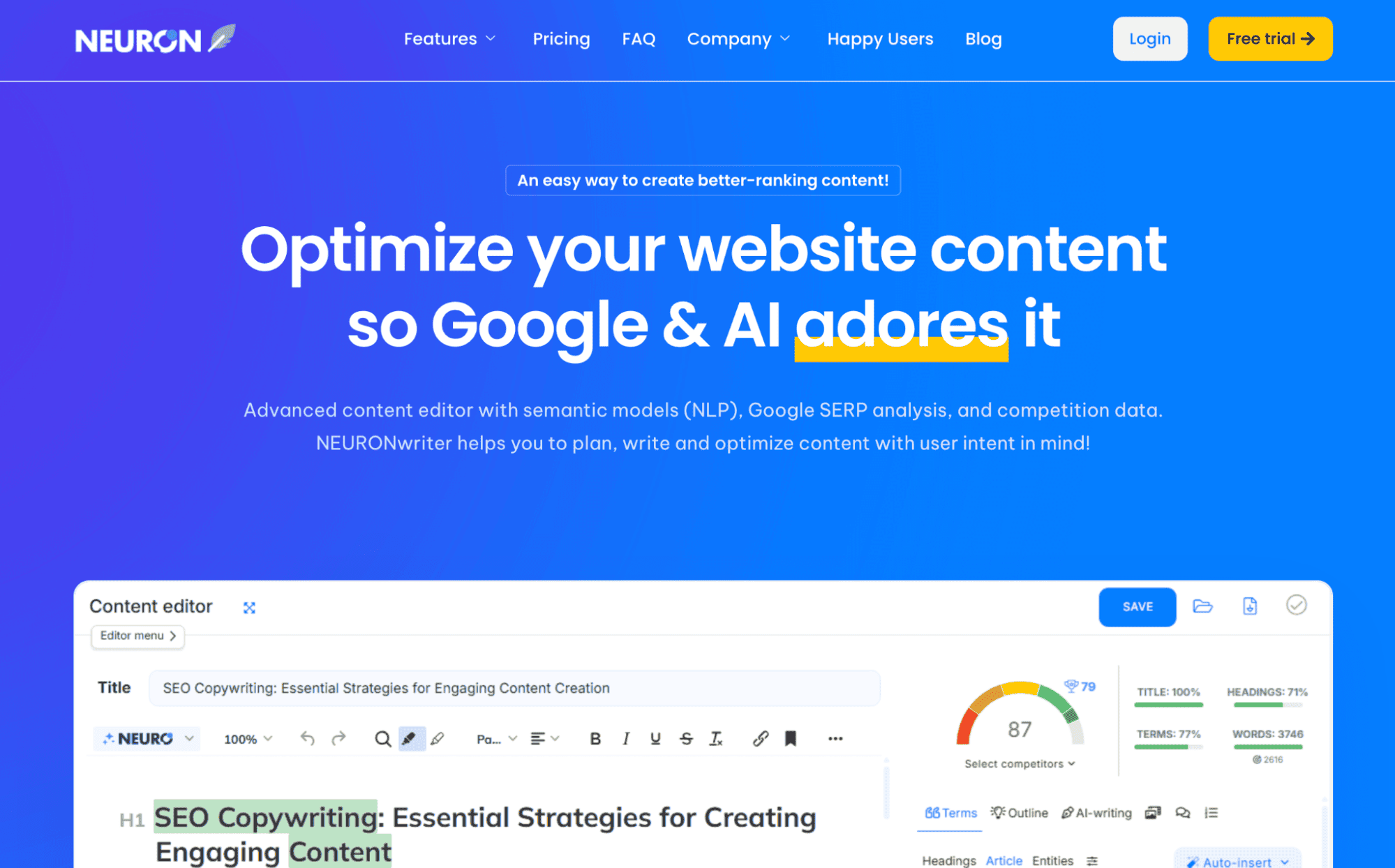
That’s where a tool like NEURONwriter can be useful.
- It helps you with keyword research, surfacing relevant long-tail keywords, related terms and semantic variations before you start writing.
- It guides you toward optimized content structure → suggestions for headings, internal links, readability, and formatting that balances human readability and search engine needs.
- It reminds you to meet on-page SEO best practices (meta tags, alt text, keyword distribution) without keyword stuffing.
- It acts as a safety net: you stay focused on delivering useful, high-quality content, while NEURONwriter supports content optimization behind the scenes.
Used wisely, it blends seamlessly into your workflow: you still write for humans but benefit from SEO discipline.
Putting it all together: a simple framework
Here’s a practical framework you can apply anytime you plan to write content (blog post, landing page, guide):
- Define goal & intent: Who are you writing for? What do you want them to get? Traffic, conversion, education?
- Research keywords & questions: Use tool(s) + manual thinking — find terms people search for and map common questions.
- Map structure: H1, subheadings, sections; think in terms of readability and easy scanning.
- Write for people → add value: Provide guidance, examples, stories, clarity; avoid fluff.
- Optimize technical & on-page SEO: Clean URLs, meta tags, internal links, alt text, headings, image optimization.
- Link internally & build context: Use pillar-cluster model or at least link to related content on your site.
- Review & polish: Read for flow, clarity, typos; ensure you’ve balanced SEO and readability.
- Publish — then monitor & update: Use analytics to track performance, refresh content regularly, fix issues, iterate.
Why this matters: The payoff of SEO-friendly content
When you invest time to create useful content and integrate smart SEO, you get a compound benefit:
- Your content becomes easier to find — boosting your site’s visibility in search results.
- You build trust and authority. Consistent, high-quality content signals expertise and relevance.
- Over time, you generate ongoing organic traffic — not just from one article, but from a network of interlinked, well-optimized content.
- You reach the right audience. By aligning content with user intent and real needs, you attract visitors with a higher chance of conversion (subscribing, contacting, buying).
That’s the core of a successful SEO content strategy — combining content marketing and SEO in a way that delivers long-term value.
Final thoughts
Integrating search engine optimization into your content doesn’t require special tricks or technical wizardry. It’s about being thoughtful: choosing relevant topics, writing with clarity and value, structuring content properly, optimizing for both users and search engines, and maintaining what you publish.
If you’re just starting, focus on building a simple content plan, write with purpose, and gradually layer in SEO best practices. Over time, consistency and quality will pay off — both in better visibility and in the trust you build with your audience.
And yes — tools like NEURONwriter can help take some of the heavy lifting off your shoulders, letting you focus on creating high-quality content while keeping SEO best practices in mind.
Once you try this approach, you’ll notice how SEO and content marketing become two parts of the same growth engine.