
How to Reach AI Overviews? The Information Gain Strategy That Will Change Your Visibility in Google and SearchGPT.
In February 2026, search engines closed a process that was inevitable anyway. The model of “write the same as others, just longer and with more links” stopped working. In a system where LLMs like GPT-5 or Claude 4 produce complete content in seconds, replicating patterns ceased to have any value. Google stopped rewarding content that is indistinguishable from others.
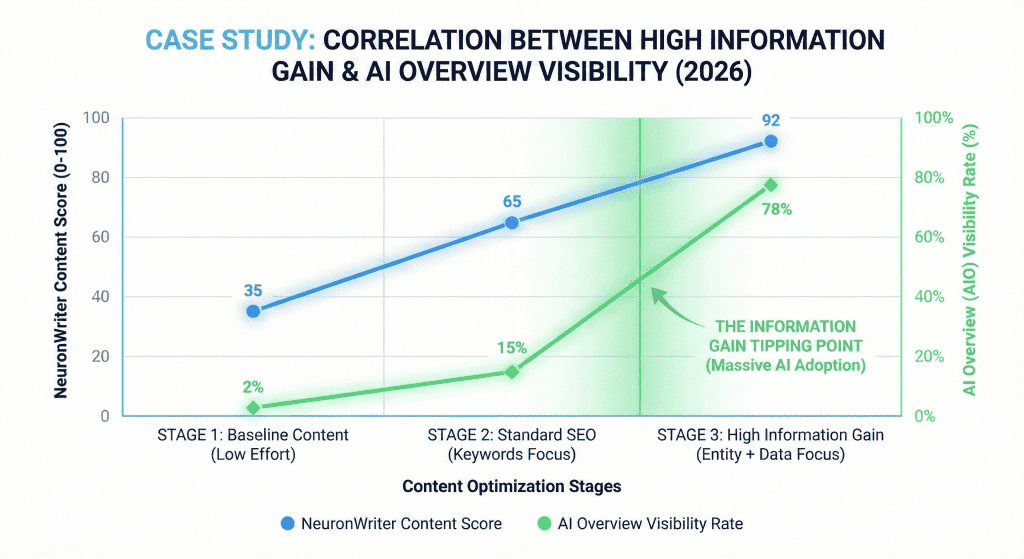
Today, the most important currency in SEO is Information Gain. Algorithms actively promote pages that provide something competitors do not. If your article is just a synthesis of the first ten SERP results, in 2026 you have no chance of reaching the TOP 3.
What is Information Gain and Why It’s the Foundation of SEO in 2026.
Google’s patent on Information Gain assumes a simple, but deadly-for-weak-creators, rule: if a user has already read three articles on a topic, the search engine should serve a fourth that contains new, unique information, not a repetition of the same facts.
The Math of Uniqueness
Google evaluates information gain in a loop. The system analyzes a set of documents (e.g., your page and competitors’ pages) and calculates an “Information Gain Score” for each document based on what the user may have already read elsewhere.
If your content has high similarity (so-called Cosine Similarity) to texts in the TOP 10, your IG Score is close to zero. In 2026, such pages are pushed to the second page or completely omitted from AI Overviews, regardless of domain authority. Google simply doesn’t want to waste resources indexing a “copy of a copy.”
Why This Is a Problem for Traditional SEO
Most old SEO tools analyze only what is already in the TOP 10. This leads to the phenomenon of “averaging the internet.” If everyone optimizes for the same keywords, the web becomes monothematic. NEURONwriter solves this problem by going one step beyond ordinary LSI (Latent Semantic Indexing).
Strategy for Building Unique Authoritative Value with NEURONwriter.
For your text to achieve a high Information Gain score, it must go through the Deep Research Integration process. NEURONwriter has unique features that support this process at every stage.
A. Semantic Gap Analysis
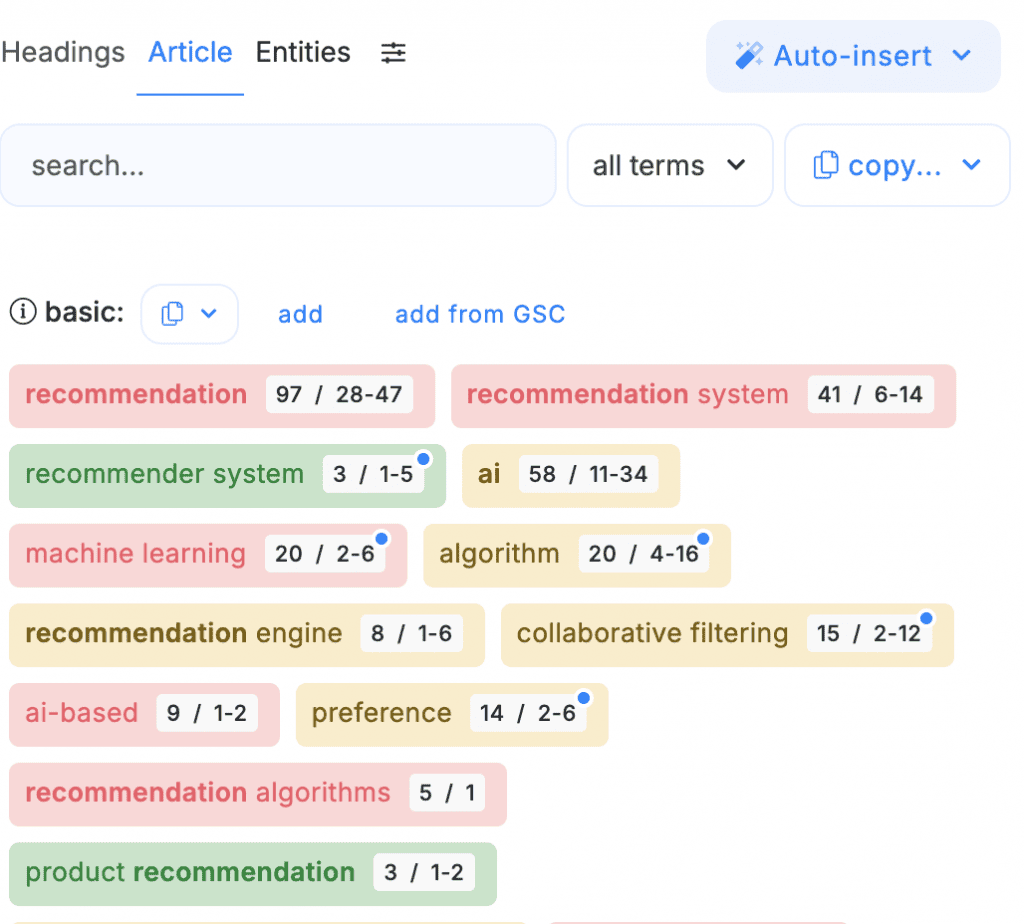
In the NEURONwriter editor, the NLP term list is not just a “homework task.” The key is to pay attention to terms from the “Smart Suggestions” group and those your competitors skipped (score 0/5 or 0/10). Check out our Step-by-Step Guide to Finding Gaps in NLP to learn exactly how.
Practice: If you write about “photovoltaics” and Neuron suggests rare entities like “bifacial modules in temperate climates” or “LID degradation,” and competitors ignore them – this is your entry point for Information Gain.
B. Own Data and Case Studies
Nothing builds authority like your own numbers. In 2026, Google treats charts and raw data as “proof of experience” (E-E-A-T).
Example: Instead of writing “SEO is important for e-commerce,” write “Analysis of 45 Shopify stores conducted in the NEURONwriter editor in Q4 2025 showed a 12% conversion increase after optimizing for AI Overviews.”
C. Substantive Controversy and Unique Perspective
AI models are trained on consensus (what most people think). If you present a well-supported, different point of view, your text immediately gains value in the eyes of algorithms that promote diversity of opinion.
Optimizing Structure for “Semantic Scanability”
Users don’t read – they scan for a specific answer. If they don’t find it in 3 seconds, they return to the AI chat.
H2 and H3 Architecture as Microtext.
Every heading should promise new knowledge.
Bad heading: “Advantages of Having a Blog.”
Good heading: “Why Information Gain-Based Blogs Generate 400% More Citations in SearchGPT?”
Table: Content Strategy Comparison 2024 vs. 2026
| Feature | SEO Content 2024 | SEO Content 2026 (Information Gain) |
|---|---|---|
| Main Goal | Keyword Matching | Delivering New Knowledge (Entity-based) |
| Role of AI | Generating Entire Texts | Support in Research and NLP Optimization |
| Success Metric | SERP Position | Presence in AI Overviews and LLM Citations |
| Main Tool | Simple Text Editor | NEURONwriter (GSC + NLP Analysis) |
Technical Aspects of Information Gain: Entities and LSI 2.0
Google no longer understands only words; it understands relationships between entities. In 2026, technical SEO has moved into the content itself.
In the NEURONwriter editor, it is key to use the entity view. If you write about “healthy nutrition,” Neuron will suggest connections to “gut microbiome,” “bioactive polyphenols,” and “circadian rhythms.” Information Gain is about describing the relationship between these entities in a way not yet available online.
NEURONwriter: Efficient Workflow
When implementing a two-month plan, you need to act fast. NEURONwriter offers functionalities that fill gaps in your process:
-
Integration with Google Search Console (GSC): Shows which phrases your site almost ranks for but lacks “that something.” Ideal for adding Information Gain.
-
Advanced AI Writing (Agentic Mode): You don’t just click “Generate.” You use advanced prompts built into Neuron that force the model to use specific statistical data and your unique brand style (Brand Voice).
-
Content Planner 2.0: Helps avoid cannibalization. If you already have content on SEO basics, the Planner suggests going deeper, e.g., “Technical SEO for Edge Computing.”
FAQ
-
Will AI Overviews completely eliminate organic traffic?
No, but it will drastically change its nature. “Quick answer” traffic (e.g., “how many calories in an apple”) has been almost entirely taken over by chatbots. However, for queries requiring in-depth analysis, expert opinion, or option comparison, users still click sources cited by AI. The key is to be in this narrow group of cited sites. In 2026, we do not fight for “clicks,” but for “trusted source” status. -
How can I measure Information Gain in my texts myself?
The simplest way is to compare your text with the top three ranking results. Ask yourself: “Does my text contain at least one thesis, statistic, or conclusion not present in competitors’ content?” In 2026, algorithms use advanced semantic analysis to detect repetition. If your text is just a synthesis of existing content, your Information Gain score is close to zero. -
Do long articles (2500+ words) still make sense in the AI Overviews era?
Yes, provided they are not “fluff.” In 2026, length serves to build full topical authority. Algorithms must see that you covered the topic from all angles, including the latest trends and niche issues. Remember structure: a long article must consist of short, specific knowledge blocks that the AI algorithm can easily “cut” and include in summaries. -
Can AI alone create content with high Information Gain?
This is the biggest myth of 2026. Language models inherently rely on historical data – what has already been written. AI can help with structure or style, but it will not generate “new truths” for you. You, as the author, must provide the input: your own tests, unique industry insights, or market analyses. Only combining human experience with technological optimization yields content that Google considers valuable. -
What is more important in 2026: optimizing for Google or for SearchGPT?
The line between them has nearly disappeared. Both systems seek the same: credibility, uniqueness, and semantic precision. A strategy based on delivering new knowledge (Information Gain) is universal. If your site becomes a knowledge leader in Google, it will also be cited more often by systems like SearchGPT or Perplexity.