
What is an AI Search Agent? A Trend Report for 2026 and Beyond
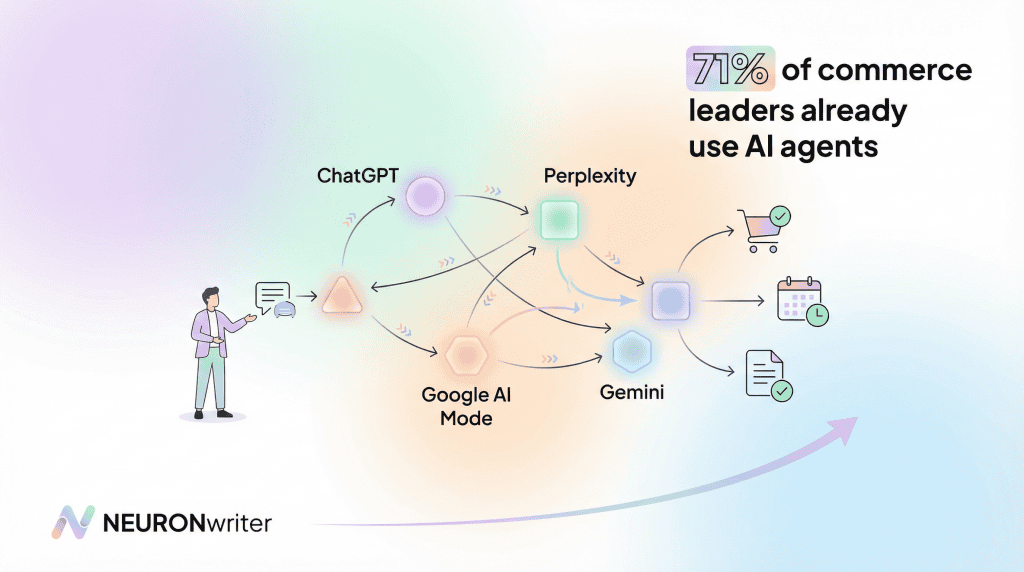
For two decades, SEO has been a game of winning clicks. In 2026, that game is over. We are in the middle of a seismic shift from a search-and-click model to a conversation-and-action model, driven by the rise of autonomous AI Search Agents.
These are not just chatbots. They are intelligent systems that research, compare, negotiate, and purchase on our behalf, often without us ever visiting a website. The data shows this isn’t a distant future; it’s the new reality:
•71% of commerce leaders are already using or experimenting with AI agents
•22% of e-commerce sites have already reported a measurable drop in search traffic due to AI-generated suggestions replacing traditional click
•73% of AI search interactions now end without a click, making brand visibility in the answer itself the new top prize.
“To win in 2026, your strategy must pivot from SEO-ranking to ‘Agentic Optimization,’ ensuring your brand is discoverable by AI agents that are no longer bound by Google’s legacy defaults.” — Adthena
This guide provides a strategic framework for this new era. It explains what an AI Search Agent is, how it differs from traditional search, and gives you a concrete action plan to ensure your brand is not just visible, but selected, in this new autonomous landscape.
The Old Way vs. The New Way: A Fundamental Reset
The transition from keyword-based search to agent-based discovery requires a complete reset of our assumptions. What worked for the last 20 years will not work for the next five.
| Factor | The Old Way (Traditional SEO) | The New Way (Agentic Optimization) |
| Primary Goal | Win the click and drive traffic | Be the cited source in the AI’s answer |
| Core Signal | Backlinks & Keyword Density | Content Depth & Source Credibility |
| User Interaction | Bouncing between multiple websites | A single, continuous conversation |
| Success Metric | Organic Traffic & Keyword Rankings | Brand Mentions & Share of Voice in AI |
| Content Focus | Keyword-optimized landing pages | Comprehensive, conversational, well-structured knowledge hubs |
Early Signals: Where to See the Future Today.
This shift isn’t just theoretical. Here are three early signals from the market that show the agentic era is already here:
Signal 1: The Rise of “Answer Engines” like Perplexity.
Platforms like Perplexity are not search engines; they are “answer engines.” They don’t provide a list of links; they provide a direct, synthesized answer with citations. Their entire model is a preview of how all search will work. Their rapid user adoption is a clear signal that users prefer direct answers over lists of links.
Signal 2: The Growth of Agentic Commerce.
Agentic Commerce is the term for AI agents making purchasing decisions. It’s not just a B2C phenomenon. While 39% of consumers are using AI for product discovery, McKinsey estimates that 15% of all B2B purchasing decisions will be handled by AI agents by 2028
This includes complex procurement tasks, software evaluation, and vendor selection.
Signal 3: The Emergence of Autonomous Browsing Agents.
Companies like OpenAI (Atlas) and Perplexity (Comet) are developing agents that can autonomously browse the web to complete tasks. These agents don’t “see” your website design; they parse its underlying structure and data. A website that is not machine-readable, with clear schema and semantic structure, will be invisible to these agents.
What This Means For You: A Segmented Strategy.
The impact of AI agents won’t be the same for everyone. A lot depends on what you do and how your business operates — so your strategy should reflect your specific situation.
If you’re an SEO freelancer or solopreneur:
Your biggest advantage is flexibility. You can adapt and shift direction much faster than large organizations. Instead of trying to cover everything, it’s more effective to focus on a specific niche and really go deep. Build a consistent body of content around it and gradually position yourself as a go-to source in that space. Tools like NEURONwriter can help you identify and structure that direction.
If you’re an in-house SEO Manager:
Here, the main challenge is usually organizational — people, processes, and how success is measured. You’ll likely need to explain to your team why the current metrics are no longer enough. Instead of focusing only on traffic, it’s worth looking at broader visibility — for example, how often your brand appears in AI-generated answers. This may require new tools and a different reporting approach, but it makes it easier to have meaningful conversations about direction and budget.
If you run an SEO agency:
The role of agencies is also shifting. Clients are often unsure what to do next, so they need guidance as much as execution. This is a good moment to move beyond standard services and help them rethink their strategy in this new landscape. That might include auditing content for AI visibility, identifying gaps, and planning next steps. It naturally shifts your role toward a more strategic partnership, rather than purely task-based work.
The Action Plan: Your First 90 Days of Agentic Optimization.
Getting started with Agentic Optimization doesn’t require rebuilding your entire content strategy from scratch. Here’s a focused, 90-day action plan to build momentum.
Days 1–30: Audit & Foundation
•Goal: Identify your most valuable content and make it machine-readable.
•Action 1: Conduct a full content audit. Use NEURONwriter’s Content Score to identify your top 10 most commercially important pages.
•Action 2: For these 10 pages, perform an “Entity Audit.” Are you clearly defining the primary entity? Are you using consistent terminology?
•Action 3: Implement comprehensive schema markup for these pages. Go beyond basic Article schema. Use Product, Organization, FAQ, and Person schema to remove all ambiguity.
Days 31–60: Authority Building
•Goal: Become the definitive source for one key topic.
•Action 1: Choose your single most important commercial topic cluster. Use NEURONwriter’s Content Planner to map out a complete hub-and-spoke model.
•Action 2: Create or update your hub page to be the most comprehensive, in-depth resource on that topic on the internet. Think 3,000+ words, multiple media formats, and expert quotes.
•Action 3: Publish at least 3-5 supporting “spoke” articles that cover key sub-topics in detail, all linking back to your central hub page.
Days 61–90: Measure & Iterate
•Goal: Establish your baseline and start optimizing based on data.
•Action 1: Set up AI Visibility Tracking in NEURONwriter for your 5 most important brand keywords and topic areas.
•Action 2: Establish your baseline share of voice across ChatGPT, Perplexity, and Google AI Overviews.
•Action 3: Analyze the results. Which topics have low coverage? Which competitors are being cited more often? Use this data to inform your content strategy for the next 90 days.
How to Measure Success: A New KPI Framework
The traditional SEO KPI framework is no longer sufficient. To win in the agentic era, you need to adopt a new, three-tiered approach to measurement.
Tier 1: Foundational KPIs (Still Relevant)
These are the classic metrics that still matter as indicators of overall site health and authority.
•Organic Traffic
•Keyword Rankings (for directional trends, not absolute positions)
•Backlink Profile & Domain Authority
Tier 2: Generative KPIs (The Bridge)
These metrics measure your visibility in the AI-enhanced search results that are the bridge to the fully agentic future.
•AI Overview Appearance Rate
•Featured Snippet Capture Rate
•People Also Ask (PAA) Presence
Tier 3: Agentic KPIs (The New Frontier)
This is where the real value lies, and it requires a new generation of tools. This is what NEURONwriter’s AI Visibility Tracking is built for.
•Brand Citation Frequency: How often is your brand mentioned in AI-generated answers for your target topics?
•Share of Voice in AI Search: What percentage of AI answers in your category mention your brand vs. competitors?
•Citation Source Quality: Which of your pages are most frequently cited by AI platforms?
•Topic Coverage Score: For how many of your target topics does your brand appear in AI answers?
Brands that master this new KPI framework will have a significant competitive advantage.
Expert Predictions: What’s Next?
We asked three leading experts in AI and search for their predictions on the agentic era. Here’s what they said:
Prediction 1: “Hyper-Personalization at Scale.”
“AI agents will create a new standard for personalization. They will know your preferences, your budget, your past purchases, and your long-term goals. Brands that provide generic, one-size-fits-all content will be ignored. The future is about providing a library of structured, machine-readable content that an agent can assemble into a perfectly personalized recommendation.” — Dr. Elena Petrov, AI Researcher
Prediction 2: “The Death of the Funnel.”
“The traditional marketing funnel is dead. Awareness, consideration, and decision will be compressed into a single moment, executed by an agent. The new goal is not to move a user through a funnel, but to be the pre-approved, trusted choice that the agent selects by default. This requires a long-term investment in brand authority and E-E-A-T.” — Mark Chen, Digital Strategist
Prediction 3: “The Rise of the ‘API of You’.”
“Your brand will need an ‘API’ — a structured, machine-readable interface that an AI agent can query. This won’t just be your product catalog; it will be your brand’s values, your unique selling proposition, and your expert point of view. The brands that make themselves the easiest to understand for machines will win.” — NEURONwriter
FAQ
What is the difference between an AI search agent and a chatbot?
A chatbot is typically designed for a specific, limited task (e.g., customer support). An AI search agent is a more general-purpose, autonomous system that can perform complex, multi-step tasks across different platforms and sources.
Will AI agents replace SEO?
No, but they will fundamentally change it. The focus will shift from technical ranking factors to building a credible, authoritative brand narrative that AI agents can trust and cite. This is the essence of Agentic Optimization (AO).
How can I track the ROI of optimizing for AI agents?
Traditional ROI models based on traffic and conversions will become less effective. The new model will be based on measuring your share of voice in AI-generated answers. Tools with AI Visibility Tracking will be essential for measuring how often your brand is cited for key topics versus your competitors.
What is the single most important thing I can do today to prepare for AI agents?
Start building your topical authority. Choose your most important commercial topic and commit to creating the most comprehensive, in-depth cluster of content on that topic on the internet. This is the single strongest signal you can send to AI agents that you are a definitive source of knowledge.
How does E-E-A-T relate to AI agents?
E-E-A-T (Experience, Expertise, Authoritativeness, Trustworthiness) is more important than ever. AI agents are designed to identify and prioritize sources that demonstrate these qualities. Your content must be written by credible authors, backed by data, and published on a site that is recognized as an authority in its field. Our guide to E-E-A-T provides a deeper look at this.