
Content Decay: How to Identify and Fix Underperforming Content.
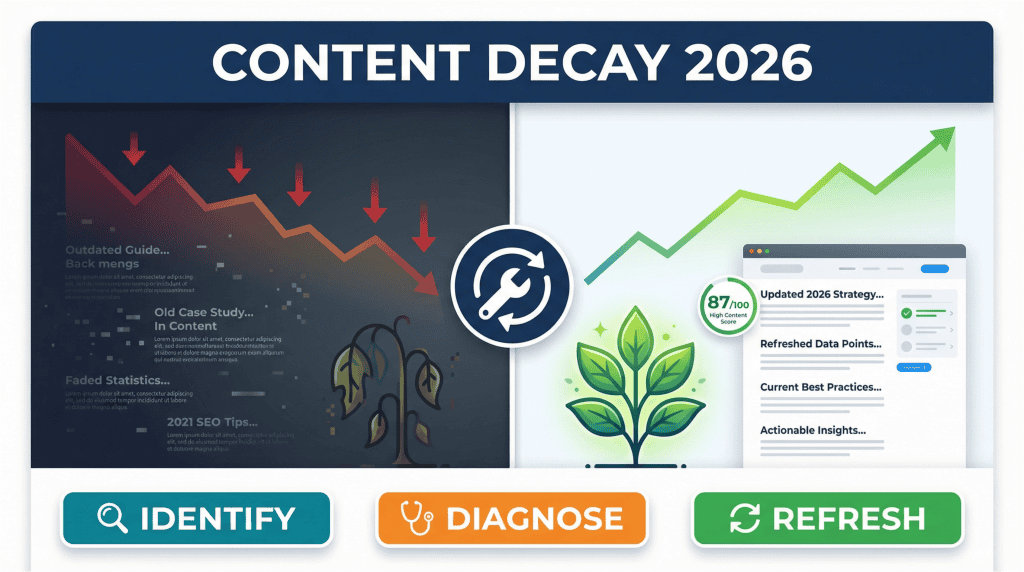
Your best-performing articles, the ones that once drove thousands of visitors to your site, are slowly losing traffic. Their rankings are slipping, and engagement is down. This isn’t a sudden drop; it’s a slow, silent decline known as content decay. It’s one of the most overlooked challenges in any content optimization platform workflow.
Content decay is the gradual erosion of a page’s SEO performance over time. It happens when your content becomes outdated, less relevant, or is outmaneuvered by more comprehensive competitor articles. With Gartner predicting that search query volume will drop by 25% by 2026 as users turn to AI assistants, maintaining the performance of your existing content is more critical than ever
This guide will walk you through a systematic process to identify decaying content, diagnose the cause, and implement a targeted refresh strategy using NEURONwriter to reclaim your rankings and traffic.
Identifying Content Decay.
Before you can fix content decay, you need to find it. It’s crucial to distinguish true decay from other common causes of traffic drops.
| Cause of Traffic Drop | Key Differentiator |
| Content Decay | Slow, gradual decline in traffic and rankings over 6+ months for an indexed page. |
| Seasonal Drops | Predictable, cyclical drops in traffic related to seasonal interest (e.g., swimwear in winter). |
| Technical Issues | Sudden drops caused by de-indexing, canonical errors, or broken redirects. |
| Tracking Errors | Inaccurate data due to misconfigured analytics (e.g., duplicate GA tags). |
Step Content Decay Audit:
1.Set the Timeframe: Only analyze content that is at least 6-12 months old. Anything newer is likely still finding its footing in the SERPs.
2.Use Google Search Console (GSC):
- Go to the Performance > Search results report.
- Set the date range to compare the last 6 months to the previous 6 months.
- Click on the “Pages” tab to see a list of all your URLs.
- Sort by “Clicks Difference” in ascending order to find the pages with the biggest traffic drops.
3.Analyze the Declining Pages: For each page with a significant drop, ask:
- Is the traffic drop consistent and gradual?
- Is the page still indexed in GSC?
- Is the topic non-seasonal?
If you answered “yes” to all three, you’ve likely found a piece of decaying content.
The 3-Pronged Fix Strategy.
Once you’ve identified a decaying page, you need to choose the right strategy to fix it. There are three primary options:
1.Update (or Refresh): This is the most common solution. It’s ideal for content that is still fundamentally strong but has become outdated or is no longer as comprehensive as the competition.
2.Consolidate (or Merge): Use this when you have multiple articles on your site competing for the same keywords (keyword cannibalization). By merging them into a single, authoritative piece, you create a much stronger signal for Google.
3.Redirect (or Prune): This is for content that is completely irrelevant, obsolete, or has very low traffic and backlinks. Redirecting it to a more relevant page preserves any remaining SEO value and improves user experience.
The Decision Matrix:
To choose the right strategy, score each decaying page on a scale of 0-3 for the following criteria:
| Criteria | 0 | 1 | 2 | 3 |
| Traffic | < 50/mo | 50-200/mo | 200-1000/mo | > 1000/mo |
| Keyword Rankings | No top 50 | 1-2 top 50 | 3-5 top 20 | > 5 top 10 |
| Backlinks | 0-1 | 2-5 | 6-15 | > 15 |
| Conversions | 0 | Low | Medium | High |
Total Score:
- 1-3: Redirect the page.
- 4-6: Consolidate with another page.
- 7-9: Update and repromote the page.
The Content Refresh Workflow with NEURONwriter.
For pages that need an update, a full content refresh is required. Here’s how to do it systematically with NEURONwriter:
Re-Analyze the SERP.
Open your decaying article in NEURONwriter Content Editor. The first step is to click “Re-analyze SERP.” Search intent can shift over time, and what worked two years ago may not work today. NEURONwriter will pull the latest top-ranking competitors, giving you a fresh understanding of the current landscape. This is where NLP-driven analysis becomes essential.
Identify Content Gaps.
With the new SERP analysis, NEURONwriter will update the list of NLP terms. Your content score will likely have dropped. The “Terms” tab is now your roadmap. Look for:
- Missing Subtopics: Are there new angles or subtopics covered by the top competitors that you’ve missed?
- Outdated Information: Are there old statistics, dates, or product names that need updating?
- Semantic Gaps: Which key terms and entities are you missing that are now considered essential for topical authority?
Update and Expand the Content.
Now, begin updating the article directly in the Content Editor:
- Add Missing Sections: Use the competitor analysis and missing terms to build out new sections that address content gaps.
- Update Existing Content: Refresh outdated statistics, replace old examples, and add new, relevant information.
- Incorporate Unique Value: Add new expert quotes, internal data, or unique insights to make your content stand out. This is also a key component of E-E-A-T signals. As Search Engine Land notes, “Authenticity and originality are playing a bigger role than ever
- Optimize for Readability: Break up long paragraphs, add bullet points, and use rich media like images and videos.
Optimize Metadata and Internal Links.
- Update the Title and Meta Description: Add the current year and any new, relevant keywords to your title tag and meta description to improve CTR.
- Strengthen Internal Linking: Use NEURONwriter internal linking suggestions to link to and from other relevant articles on your site, strengthening your topical cluster.
Republish and Monitor.
Once your content score is back in the green (ideally 80+), republish the article with the same URL. Do not change the URL. Announce the update on social media and in your newsletter. Finally, use NEURONwriter GSC integration to monitor its performance over the next 3-6 months.
Conclusion: Content Decay is an Opportunity.
Content decay isn’t a failure; it’s an opportunity. It’s a data-driven signal telling you exactly which pieces of content your audience values and where you should invest your time.
By building a systematic content decay audit and refresh process into your quarterly workflow, you can transform your blog from a collection of aging assets into a powerful, self-improving engine for organic growth. With tools like NEURONwriter, this process is more efficient and effective than ever, allowing you to protect your existing traffic and continuously build your site’s authority.
(FAQ)
How often should I check for content decay?
A quarterly content audit is a good starting point for most businesses. This allows enough time for trends to emerge without letting pages decay for too long.
Should I prioritize creating new content or refreshing old content?
It’s a balance. A good rule of thumb is the 80/20 rule: spend 80% of your time creating new content and 20% of your time refreshing and promoting existing content.
Can I just use AI to rewrite the article?
While AI can help generate ideas and first drafts, a successful content refresh requires human oversight to ensure accuracy, add unique insights, and align with the nuances of search intent. Learn more about humanizing AI content for best results. Use AI as a co-pilot, not an autopilot.
What’s the most common cause of content decay?
Outdated information and new, more comprehensive competitor content are the two most common causes. Search engines are always looking for the most current and thorough answer to a user’s query.