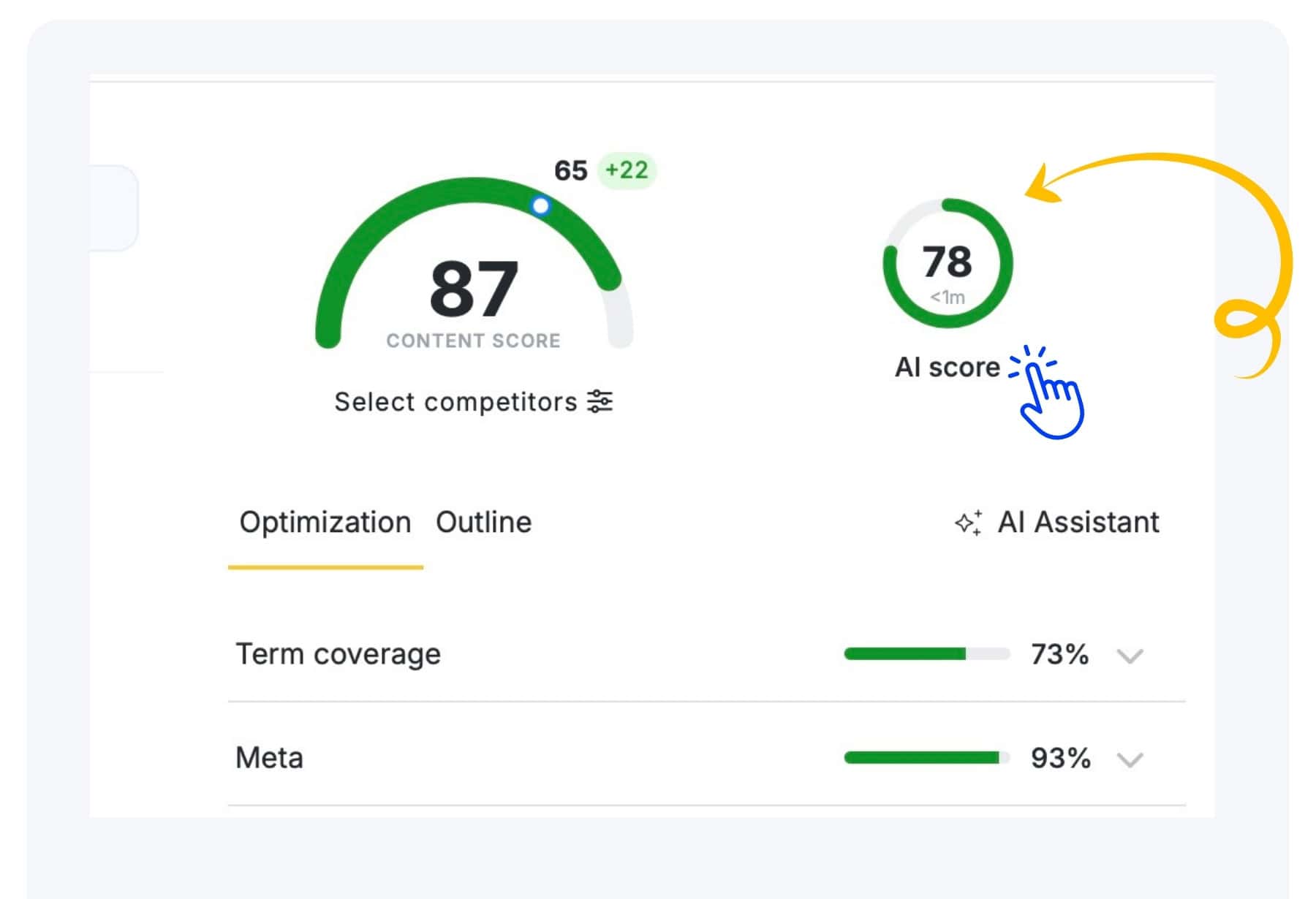
What is AI Score in NEURONwriter?
In NEURONwriter, the AI Score measures how well your content is optimized for AI-generated answers and AI search visibility (for example, in tools such as ChatGPT, Google AI Overviews, and Perplexity).
Unlike a traditional SEO content score, which focuses mainly on keywords and on-page optimization, the AI Score evaluates whether AI systems can easily understand, extract, and use information from your content.
How does AI Score Metric help you optimise for AI search?
Create LLM-ready content: Structure and phrase your writing in a way that large language models can easily interpret, summarize, and surface.
Fill topic gaps AI systems care about: The Topic Coverage score helps you include the concepts and questions LLMs expect for strong relevance signals.
Improve AI interpretability: A higher Structure and Clarity score makes your content easier for LLMs to understand, rank, and reuse in responses.
Boost overall AI compatibility: By refining your content using the AI Score, you produce material that performs better across emerging AI reading, indexing, and retrieval models.
Tip: Aim for a higher AI Score to be clearly interprets and useful for advanced AI systems.
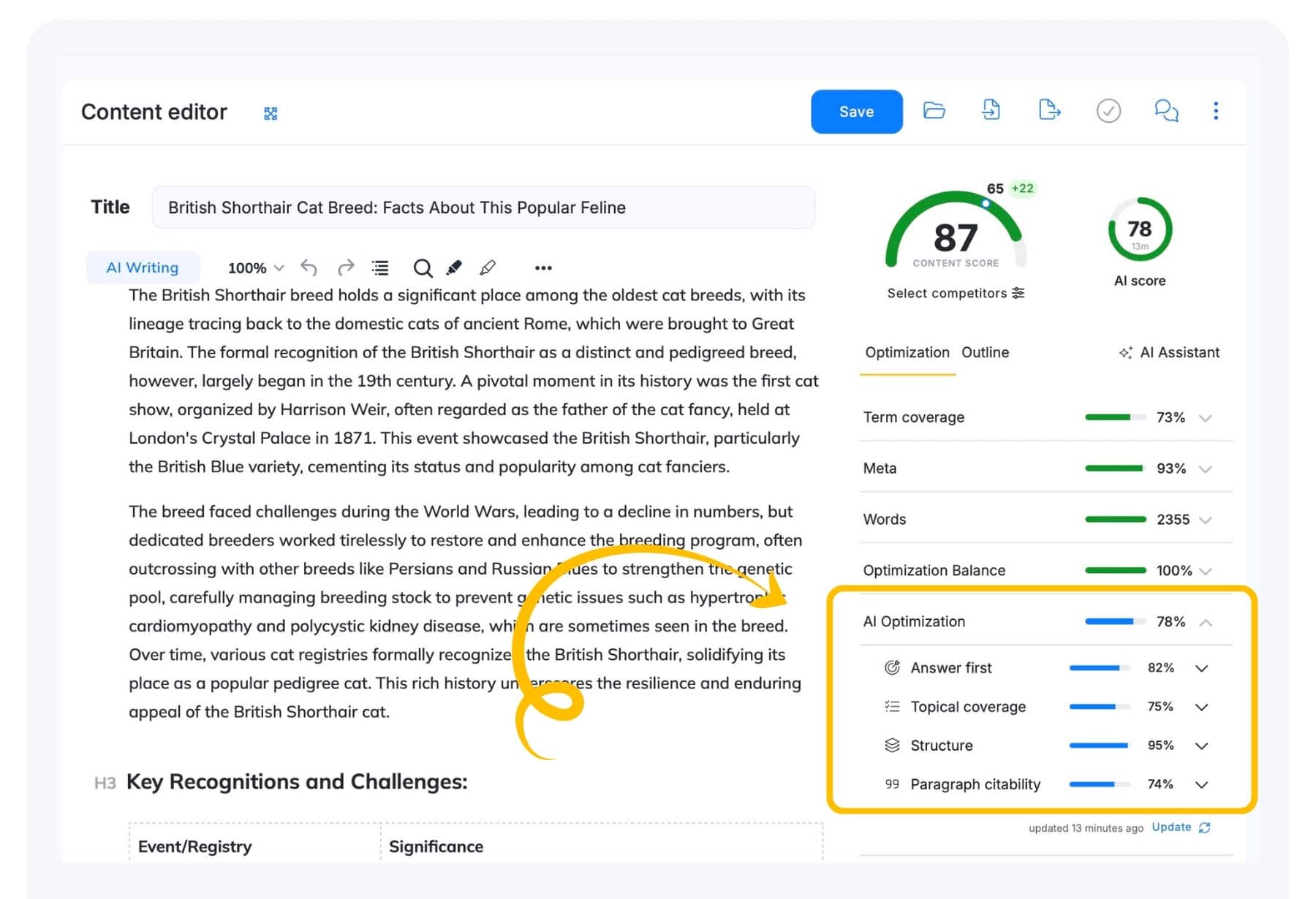
How the AI Score works?
AI Score to display a detailed, real-time evaluation of your text directly in the editor panel. The system analyzes your content across Topic Coverage, Structure, Clarity and Direct answers in the content — helping you refine text that performs better for users, search engines, and LLMs.
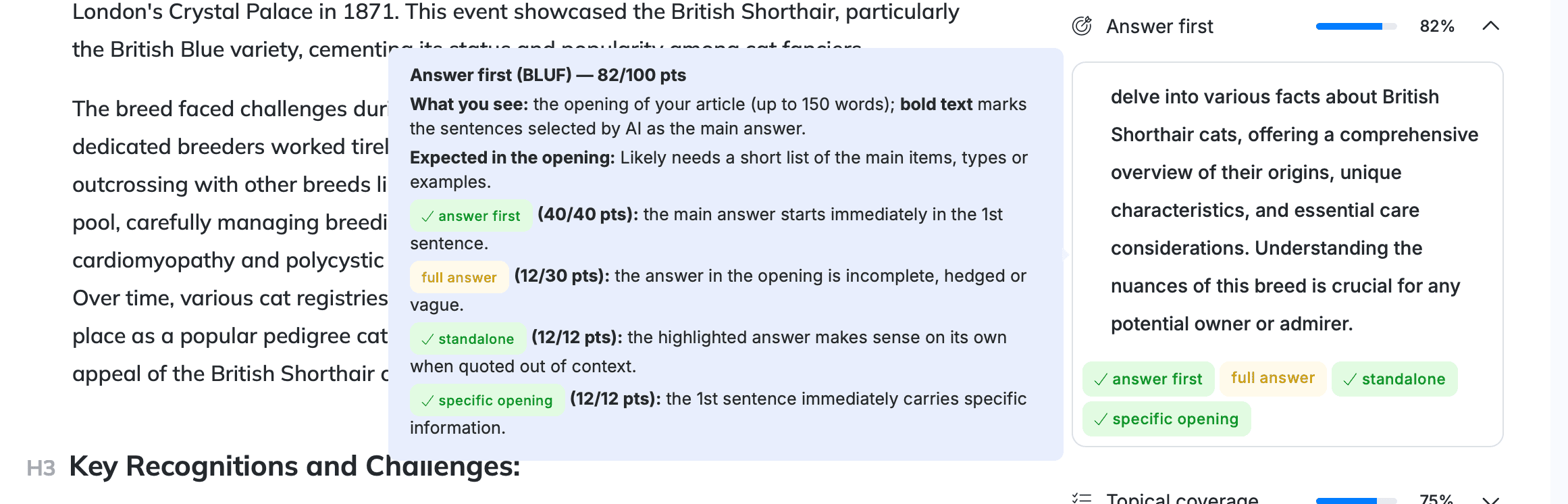
1. Answer First
What it means:
Measures whether your content provides a direct answer to the user’s question early in the article or section.
AI systems tend to favor content that answers questions clearly and immediately, rather than making readers go through long introductions.
Example:
- Good: A paragraph starts with a direct answer, followed by an explanation
- Less effective: Several introductory paragraphs appear before the actual answer.
How to improve it: Start important sections with a concise answer, then expand with details, examples, and supporting information.
2. Topical Coverage
What it means:
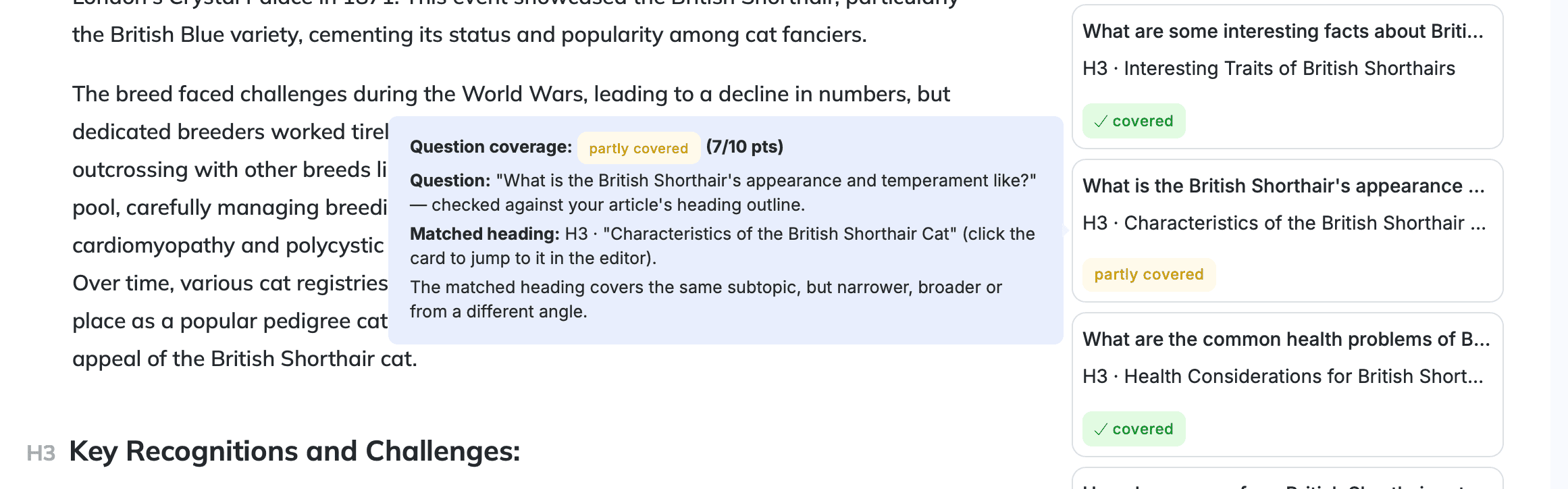
Measures how comprehensively your content covers the topic and its related subtopics.
AI systems look for content that provides enough context to answer a user’s question fully, rather than mentioning only the main keyword.
Example:
If your article is about the benefits of drinking green tea, relevant subtopics might include:
- Health benefits
- Antioxidants
- Caffeine content
- Recommended daily intake
- Possible side effects
How to improve it: Cover relevant subtopics, related questions, important concepts, and supporting information without adding unnecessary content.
3. Structure
What it means:
Measures how well your content is organized and formatted so AI systems can understand its hierarchy and relationships.
This includes:
Clear H1, H2, and H3 headings
Logical section organization
Short, focused paragraphs
Lists and tables where appropriate
A clear progression of ideas
Example:
A well-structured article uses descriptive headings and organizes information into logical sections instead of presenting everything in large blocks of text.
How to improve it: Use meaningful headings, organize related information together, and make the article easy to scan.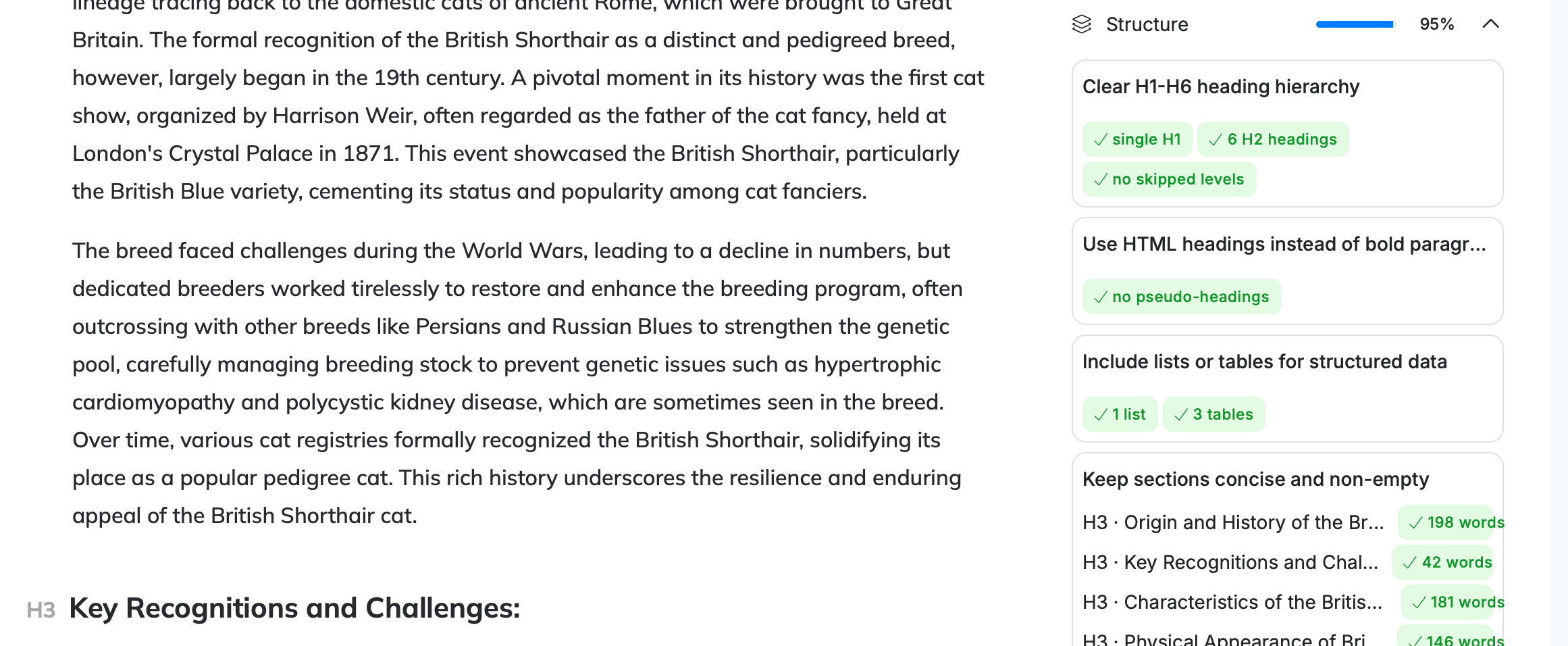
4. Paragraph Citability
What it means:
Measures how easily individual paragraphs can be extracted and used as standalone answers by AI systems.
A paragraph should ideally communicate one complete idea and make sense even when separated from the rest of the article.
Example:
- Good: Sentences provide a complete explanation that AI can potentially quote or summarize independently.
- Less effective: Short, partly explained topic in sentences without a context.
How to improve it:
Write self-contained paragraphs, define concepts clearly, avoid vague references such as “this” or “it” without context, and support important claims with evidence.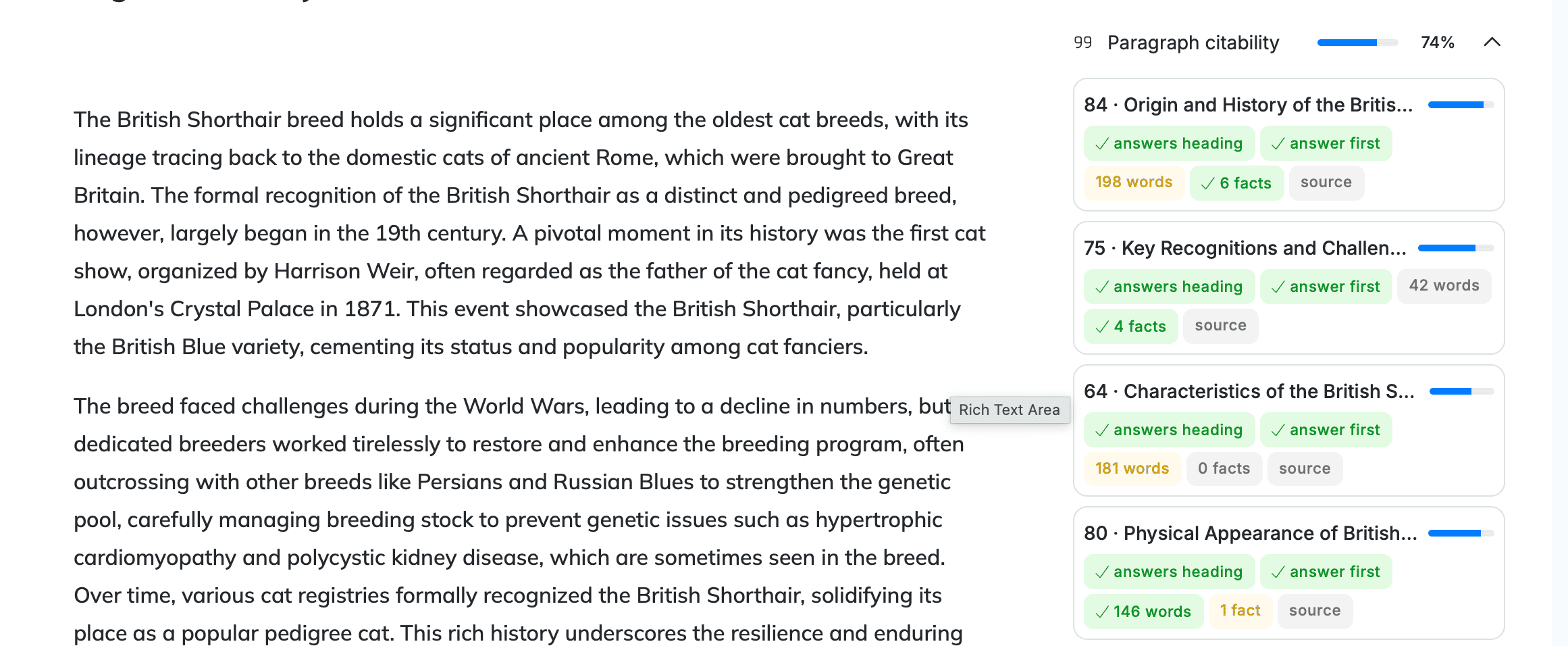
How to interpret AI Score metrics.
What it means:
Higher percentages indicate stronger performance according to the AI Score criteria. They are best treated as optimization indicators, not as a guarantee that ChatGPT, Google AI Overviews, or other AI systems will cite or recommend your content.
How to access AI Optimisation score?
- Click the AI score field next to the Content score.
- Once you appear in the AI Optimisation section — your central hub for AI content quality metrics and recommendations. Just click Update button to verify AI score.
Once this option is selected, the system will analyze your content and generate a summary along with detailed recommendations for each AI Score metric, helping you improve your content for readers, search engines, and LLMs.