
What is Generative Engine Optimization (GEO)? A Complete Guide.
The world of search is undergoing its most significant transformation in a decade. For years, the goal was simple: rank on the first page of Google. Success was measured in blue links, positions, and click-through rates. But as users increasingly turn to AI-powered answer engines for their queries, the old playbook is becoming obsolete. Gartner predicts that traditional search engine volume will drop by a staggering 25% by 2026, as users migrate to platforms like ChatGPT, Perplexity, and Google’s own AI Overviews
Getting found online is no longer just about ranking on Page 1. It’s about being the source AI engines trust and cite when they generate an answer. This is the new frontier of digital marketing, and it has a name: Generative Engine Optimization (GEO).
This guide provides a comprehensive, expert-level overview of GEO. We will explore what it is, why it represents a fundamental strategic shift from traditional SEO, and provide a practical, 4-step framework for optimizing your content to be seen, cited, and recommended by AI.
What is Generative Engine Optimization (GEO)?
Generative Engine Optimization (GEO) is the strategic process of structuring your content and digital presence to ensure that AI-powered search platforms including ChatGPT, Google AI Overviews, Perplexity, Claude, and Copilot can efficiently retrieve, understand, cite, and recommend your brand when answering user questions.
If traditional SEO was about earning a spot among 10 blue links, GEO is about earning a place among the two to seven domains a large language model (LLM) typically cites in a single response. The competition is tougher, but the payoff is immense. When an AI engine names your brand in its answer, it delivers an implicit, conversational endorsement that no organic listing ever could.
This isn’t a futuristic concept; it’s happening now. AI Overviews already appear in 13% of all Google searches, ChatGPT serves over 800 million users weekly, and Perplexity processes hundreds of millions of queries monthly
The shift is here, and mastering GEO is the key to navigating it.
GEO vs. SEO: A Fundamental Shift in Strategy
While GEO builds on many principles of SEO, it is not simply a rebranding. It represents a fundamental shift in goals, metrics, and authority signals. Understanding this distinction is the first step toward building a successful GEO strategy.
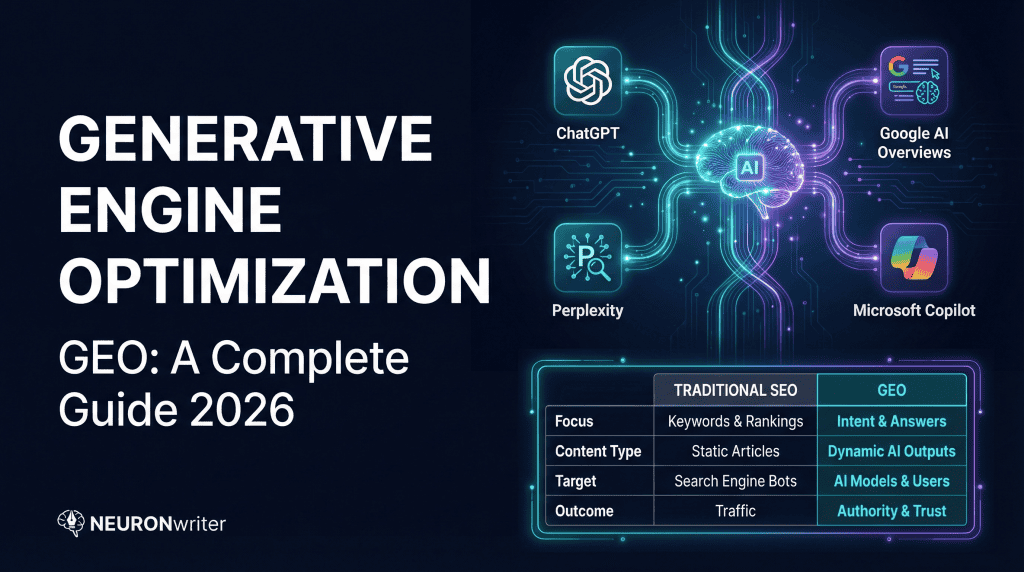
| Feature | Traditional SEO (Search Engine Optimization) | Generative Engine Optimization (GEO) |
| Primary Goal | Rank on a Search Engine Results Page (SERP) | Get cited directly within an AI-generated answer |
| Success Metric | Organic Position & Click-Through Rate (CTR) | Citation Frequency & Share of Voice in AI responses |
| Key Authority Signal | Backlinks from other websites | Citation authority from earned media and trusted sources |
| Results Format | A list of 10 blue links | A synthesized, conversational paragraph |
| Domains Shown | ~10 per page | ~2-7 per response |
Source: Adapted from Search Engine Land
As the table illustrates, the entire strategic focus changes. SEO is a game of visibility and clicks; GEO is a game of authority and trust. You are no longer optimizing for a list; you are optimizing for inclusion in a definitive, AI-curated answer.
The 4-Step GEO Framework: A Practical Guide to AI Visibility.
Treating GEO as a one-time technical tweak is the biggest mistake you can make. In reality, GEO demands the same ongoing discipline as SEO. The following 4-step framework, adapted from best practices outlined by industry leaders, provides a repeatable structure to get it right
Phase 1: Assess Your AI Search Readiness.
Before you can optimize, you must understand your baseline. This phase is about auditing your existing content and technical setup to see how well you are currently positioned for AI engines.
Content & Entity Audit: Analyze your existing content for clarity, factual accuracy, and depth. Is your brand, product, or service defined as a clear, unambiguous entity? Do you have comprehensive content that covers your core topics in detail? Use tools to identify the key entities on your site and how well they are defined.
Technical & Schema Audit: Ensure your website is technically accessible to AI crawlers. This includes a clean site structure, fast load times, and, most importantly, robust schema markup. Schema provides the structured data that LLMs need to understand the context of your content, such as what a product is, who an author is, or what questions an FAQ section answers.
Brand & Authority Audit: Where does your brand appear online? A 2025 Princeton study on citation bias in AI search confirmed that LLMs heavily favor authoritative, third-party sources (earned media) over a brand’s own content
Audit your brand mentions, press coverage, and reviews to understand your current level of third-party validation.
Phase 2: Optimize Your Content for AI Engines.
With your audit complete, you can begin the targeted optimization process. This phase is about refining your content to speak the language of AI.
Prioritize Factual, Citable Content: AI engines are designed to answer questions. Structure your content to provide clear, direct answers to common user queries. Use FAQ sections, data-driven statements, and expert quotes that are easy for an LLM to extract and cite.
Implement Comprehensive Schema Markup: Go beyond basic schema. Implement detailed Product, Article, Author, Organization, and FAQPage schema to give AI engines a complete, structured picture of your content. This removes ambiguity and makes your content a more reliable source.
Build Topical Authority: Don’t just write one article on a topic. Build a hub-and-spoke model where a central pillar page is supported by a cluster of in-depth articles covering related sub-topics. This signals to AI that you are a comprehensive authority on the subject.
Cultivate Earned Media: Proactively seek out third-party citations. This can include digital PR, guest posting on authoritative sites, and encouraging reviews on trusted platforms. Every high-quality, third-party mention of your brand builds the citation authority that GEO is built on.
Phase 3: Measure Your AI Search Performance.
Measuring GEO requires a new set of tools and metrics. Traditional rank tracking is insufficient when the goal is citation, not just position.
Track Citation Frequency: Use specialized GEO tools to monitor how often your brand is cited in AI responses for your target queries across different platforms (ChatGPT, Perplexity, etc.).
Analyze Share of Voice: Beyond frequency, measure your share of voice. What percentage of all citations for a given topic mention your brand compared to competitors? This is the true measure of your authority in the AI space.
Monitor Referral Traffic from AI: While direct clicks are less of a focus, you should still monitor your web analytics for referral traffic from AI platforms. This can indicate that users are seeking more information after seeing your brand cited.
Phase 4: Iterate and Scale.
GEO is not a set-it-and-forget-it strategy. It is a continuous loop of assessment, optimization, and measurement.
Identify Content Gaps: Use your measurement data to identify topics where your competitors are being cited but you are not. This reveals content gaps that need to be filled.
Refine and Update: Continuously update your existing content with new data, facts, and schema markup to keep it fresh and authoritative.
Scale What Works: Double down on the strategies and content formats that are generating the most citations. If data-driven reports are earning you mentions, create more of them. If expert interviews are working, scale that initiative.
How NEURONwriter Prepares You for the GEO Era.
Adapting to GEO requires a toolset built for the new realities of AI-driven search. NEURONwriter is uniquely positioned to help you execute a sophisticated GEO strategy by focusing on the core pillars of AI visibility.
- Entity-Driven SEO: NEURONwriter NLP-powered analysis goes beyond keywords to identify the key entities your content needs to cover. This helps you build the rich, semantic context that AI engines rely on to understand your content.
- Building Topical Authority: The platform’s content planning and internal linking suggestions help you build out robust hub-and-spoke models, establishing your site as a comprehensive authority on your core topics.
- SERP-Driven Optimization: By analyzing the top-ranking content, NEURONwriter ensures your articles are structured to answer user questions directly and comprehensively, making them prime candidates for AI citation.
- Built-in Schema Markup: NEURONwriter automatically generates schema markup for your articles, including FAQ schema, making it easy to provide search engines with the structured data they need.
-
AI Visibility Monitoring: NEURONwriter dedicated AI Visibility feature allows you to track how your content and brand appear across the major generative AI platforms. You can see which of your pages are being surfaced in AI-generated answers, identify which topics you are already winning, and pinpoint the gaps where competitors are being cited instead of you.
-
AI Tracking and Citation Analysis: Beyond visibility, NEURONwriter provides AI tracking capabilities that let you monitor citation frequency and share of voice over time. This transforms GEO from a guessing game into a data-driven discipline. Instead of manually querying ChatGPT or Perplexity to check if your brand appears, you get a consolidated, actionable view of your AI search performance in one place.
By integrating these features into your workflow, you are not just optimizing for today’s search engines, but building a foundation of authority and clarity that will make your content visible and valuable in the AI-powered future of search.
The Future is Written by AI. Will You Be a Source?
The shift from SEO to GEO is not a trend; it is the new strategic imperative. As billions of users integrate AI into their daily search habits, the brands that will win are those that become trusted sources for these new engines of discovery. By building a strategy rooted in authority, clarity, and factual accuracy, you can move beyond the race for clicks and earn a far more valuable prize: the explicit endorsement of AI itself.
The 5 Core Signals That Drive AI Citations.
Understanding what AI engines look for when selecting sources is the most direct path to improving your GEO performance. While the algorithms are complex and proprietary, research and observation have identified five core signals that consistently drive citations.
Factual Accuracy and Verifiability
AI engines are fundamentally designed to provide reliable answers. Content that makes clear, verifiable, and well-cited factual claims is far more likely to be used as a source than content that is vague or opinionated. This means grounding your content in data, statistics, and research, and citing those sources explicitly. A claim supported by a link to a reputable study is infinitely more trustworthy to an LLM than an unsupported assertion.
Topical Depth and Comprehensiveness
A single, well-written article on a topic is rarely enough to establish authority in the eyes of an AI. LLMs assess the breadth and depth of a site’s coverage on a given subject. A website that has a comprehensive, interconnected library of content on a topic covering it from multiple angles, at multiple levels of depth signals genuine expertise. This is the principle behind topical authority, and it is one of the most powerful GEO signals available.
Entity Clarity.
As explored in our guide to Entity SEO, AI engines understand the world through entities distinct, named concepts such as people, places, organizations, and products. The clearer and more unambiguous your entity definition, the more confidently an AI can cite you. If your brand, product, or core concept is poorly defined or confused with similar entities, you will be systematically overlooked. Schema markup, clear “About” pages, and consistent naming conventions all contribute to entity clarity.
Earned Media and Third-Party Validation.
As noted by the Princeton study on citation bias, AI engines are heavily biased toward sources that have been validated by other trusted entities
A brand mentioned in a TechCrunch article, cited in an industry report, or reviewed on a reputable platform carries far more weight than a brand that only speaks about itself on its own website. Building a robust earned media strategy through digital PR, expert commentary, and industry partnerships is not just a brand-building exercise; it is a core GEO tactic.
Structured Data and Schema Markup.
Schema markup is the structured vocabulary that allows you to communicate the meaning of your content directly to machines, bypassing the ambiguity of natural language. For GEO, this is particularly powerful. FAQPage schema allows AI engines to directly extract question-and-answer pairs from your content. Article and Author schema establish the credibility and expertise of your content. Organization schema defines your brand as a clear entity with verifiable attributes. Implementing comprehensive schema markup is one of the highest-ROI technical actions you can take for GEO.
GEO Strategies for Different Business Types.
While the core principles of GEO apply universally, the specific tactics and priorities will vary depending on your business model and target audience.
For B2B SaaS and Technology Companies
B2B buyers increasingly use AI to research solutions before ever contacting a vendor. Your GEO strategy should focus on establishing your product as the definitive solution for specific, high-intent queries. This means creating detailed comparison content, technical documentation, and case studies with measurable outcomes. When a prospect asks an AI “What is the best tool for [your use case]?”, your goal is to be the answer.
For E-commerce and Product-Based Businesses
For e-commerce, GEO is about product visibility in AI-generated recommendations. Ensure your product pages have rich, structured data including Product schema with detailed attributes, reviews, and pricing. Create comprehensive buying guides and comparison content that positions your products within a broader context. When a user asks an AI for a product recommendation, you want your products to be part of the answer.
For Publishers and Content Creators
Publishers are both the most exposed to the disruption of AI search and the most naturally positioned to benefit from GEO. Your content is already the raw material that AI engines consume. The key is to ensure it is structured, cited, and authoritative enough to be selected as a source. Focus on original research, expert interviews, and data journalism—content that AI cannot easily replicate and that provides genuine information gain.
For Local and Service Businesses
For local businesses, GEO intersects with local SEO. Ensure your Google Business Profile is complete and accurate, as this is a key data source for AI Overviews. Build your presence on local review platforms and industry directories. Create content that answers hyper-local questions, such as “What are the best [service type] providers in [city]?”
GEO and Internal Linking: Building an AI-Readable Architecture
One of the most underrated aspects of GEO is the role of internal linking. For AI engines, your internal link structure is a map of your content’s hierarchy and relationships. A well-structured internal linking strategy signals which pages are most important, how topics relate to each other, and the overall depth of your topical coverage.
When you link from a cluster article to your main pillar page, you are reinforcing the authority of that pillar. When you link between related cluster articles, you are demonstrating the breadth of your coverage. This interconnected web of content is precisely what AI engines look for when assessing whether a source is truly authoritative on a topic.
A practical approach to internal linking for GEO involves mapping your content architecture before you write. Identify your core pillar topics and plan the cluster articles that will support them. Ensure every cluster article links back to the pillar, and that the pillar links out to the most important cluster articles. This creates a coherent, navigable structure that is as easy for an AI to understand as it is for a human reader.
For a deeper dive into this topic, our guide on internal linking for SEO provides a comprehensive framework for building a link architecture that serves both traditional and AI-powered search.
FAQ.
Is SEO dead because of GEO?
No, SEO is not dead, but its focus is evolving. Traditional SEO practices like technical optimization, keyword research, and backlink building are still foundational. GEO builds upon this foundation, adding a new strategic layer focused on getting cited in AI answers. Think of GEO as the next evolution of SEO, not a replacement.
Which AI platforms should I focus on for GEO?
You should focus on the platforms your target audience uses most. However, a good starting point is the “big four”: Google AI Overviews, ChatGPT, Perplexity, and Microsoft Copilot. Optimizing for these will generally have a halo effect across other, smaller platforms.
How long does it take to see results from GEO?
Similar to SEO, GEO is a long-term strategy. You may see initial citations within a few weeks of implementing targeted optimizations like schema markup. However, building the deep topical authority and earned media signals required for consistent, high-level visibility can take six months or more. The results, like with SEO, are compounding.
What is the single most important factor in GEO?
If there is one single factor, it is verifiable, third-party authority. AI models are designed to minimize risk and provide reliable answers. They are therefore heavily biased toward citing information from sources that are already trusted and validated by others (e.g., reputable news sites, academic papers, industry-leading publications). Building your brand’s presence on these external sites is crucial.
Can I just use AI to write content and rank in AI?
No. Using AI to generate generic, unoriginal content is the fastest way to be ignored by AI engines. LLMs are designed to identify and reward information gain—content that adds new, unique value to the conversation. Your content must be original, feature unique data or insights, and be backed by human expertise to stand out.