
How to Build a Content Team for the AI Era: Roles & Workflow
For the past decade, scaling content was a simple, if brutal, equation: more content required more writers. The assembly line grew longer, but the roles remained the same. In 2026, that model is officially broken. The rise of generative AI hasn’t just given us a new tool; it has triggered a fundamental restructuring of how content teams operate, who they hire, and what they value.
This isn’t about replacing humans with machines it’s about augmenting them. As AI takes over repetitive, time-consuming parts of content production, people can focus on what truly matters: strategic thinking, creative direction, and understanding the audience.
Recent industry data shows that AI is already a standard part of marketing workflows—91% of marketers actively use it, and 50% say it helps them bring work to market faster. The experimentation phase is over; now we’re firmly in the operational era.
This guide outlines the new blueprint for a high-performing content team in the AI era. We will explore the new roles, the new workflow, and the new mindset required to not just survive, but to thrive in this new landscape. If you are also looking to scale your output through automation, our guide on how to scale content creation is a natural companion to this article.
The New Structure: From Assembly Line to Mission Control
The old model was linear: brief -> write -> edit -> publish. The new model is a dynamic, interconnected system where humans act as strategic directors, guiding a suite of AI tools to execute specific tasks. Knotch refers to this as the shift from campaigns to content systems.
Instead of a large team of generalist writers, the 2026 content team is smaller, more specialized, and operates as a center of influence rather than a production bottleneck. Their primary job is not to write every word, but to design the engine that produces, optimizes, and distributes content. This is closely tied to the concept of topical authority: the team’s goal is not to publish more, but to own a topic space completely.
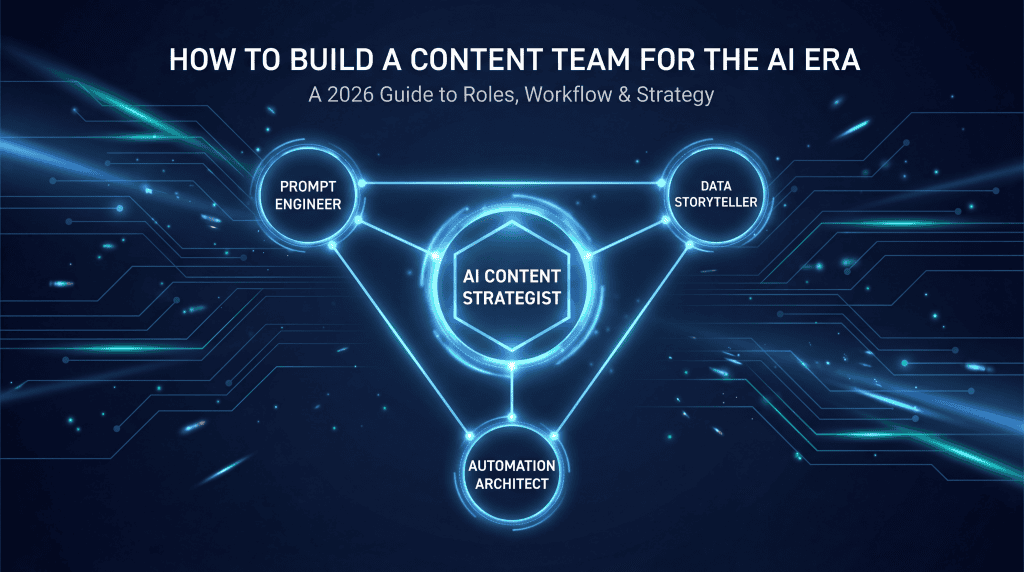
This new structure is built around five emerging, critical roles:
AI Content Strategist (the person who connects the dots)
This isn’t just a “strategist.” It’s someone who:
- decides what’s actually worth creating from a business perspective
- checks what works and what doesn’t (SEO, traffic, conversions)
- figures out how to use AI without wasting time
In reality: part marketer, part analyst, part product thinker
Often, this person also covers parts of other roles
AI + Editing Specialist (the person who knows how to work with AI)
This isn’t some “prompt engineer” from LinkedIn It’s someone who:
- can get useful drafts out of AI (not generic fluff)
- edits content so it sounds human and fits the brand voice
- makes sure there are no mistakes or nonsense
In reality: a strong copywriter who understands AI tools
One of the most critical roles — without this, AI = spam
Data & Insights Person (the one who says “here’s what this means”)
It’s not about building dashboards — it’s about:
- understanding which content drives results
- spotting trends (e.g. “this topic is taking off”)
- translating data into action: “do more of this, less of that”
In reality: often someone from SEO or performance marketing
Frequently combined with the strategist role
Automation Person (the one who makes things run smoothly)
Not always a full-on developer. This person:
- connects tools (AI + CMS + analytics)
- automates repetitive tasks (publishing, distribution, workflows)
- ensures the system is fast and scalable
In reality:
- in smaller teams: a tech-savvy marketer
- in larger teams: automation / no-code / Python specialist
Community & Voice Manager (the one who handles the human side)
This is more than just social media:
- manages comments, conversations, and user-generated content
- keeps the brand voice consistent everywhere
- listens to the audience and feeds insights back into content
In reality: crucial role AI can’t build relationships
Also a great source of content ideas
What it actually looks like in practice
Here’s the key thing:
it’s rarely 5 roles = 5 people
Most of the time:
- 2–3 people cover everything
- roles overlap heavily
- AI reduces production work, but increases the need for thinking and decision-making
In simple terms
A modern content team is not a content factory. It’s:
a small team that:
- decides what’s worth creating
- uses AI to execute faster
- tracks what works
- continuously improves the system
The New Workflow: A 4-Stage AI-Assisted Process
The modern content workflow is a continuous loop, not a one-way street. It’s designed for agility, with AI embedded at every stage to support human decision-making not replace it.
Stage 1: AI-Powered Insight & Strategy
- Who: AI Content Strategist, Data & Insights Person
• Process:
Instead of doing everything manually, the team uses AI to quickly analyze SERPs, competitors, and audience behavior. The AI Content Strategist decides what’s actually worth creating from a business perspective, while the Data & Insights Person looks at patterns and trends to answer one key question: what will work and why?
The outcome isn’t just a keyword list it’s a clear direction: who the content is for, what it should achieve, and what makes it different.
Stage 2: AI-Assisted Creation & Refinement
- Who: AI + Editing Specialist
• Process:
This is where AI becomes a real productivity boost but only with the right person behind it. The AI + Editing Specialist turns the strategy into effective prompts and generates a first draft using AI tools.
Then comes the most important part: editing. The draft is rewritten, cleaned up, fact-checked, and adjusted to match the brand voice. The goal isn’t to publish AI output it’s to use it as a strong starting point and save time on repetitive work.
Stage 3: Automated Production & Distribution
- Who: Automation Person
• Process:
Once the content is ready, the Automation Person ensures everything runs smoothly behind the scenes. Content is formatted, optimized (e.g., schema, structure), and scheduled across channels.
AI can also help turn one piece into many social posts, newsletters, or scripts without starting from scratch every time. This is what makes content scalable without growing the team.
Stage 4: Continuous Optimization & Learning
- Who: All Roles
• Process:
Publishing is not the finish line. The Data & Insights Person tracks performance and shares what’s actually working. The AI Content Strategist uses this to adjust direction:
- Which topics bring results?
- What formats perform best?
This feedback loop turns content into a system that improves over time not a series of one-off projects.
How NEURONwriter Powers the AI-First Content Team
Building a modern content team requires tools that support how teams actually work today. NEURONwriter is not just an AI writer it helps each role do their job better:
- For the AI Content Strategist:
NEURONwriter SERP analysis and planning tools help quickly identify opportunities and build a strategy based on real data not guesswork. - For the AI + Editing Specialist:
Custom AI templates and optimization features make it easier to guide AI outputs and turn drafts into high-quality, ranking content. - For the Data & Insights Person:
Content scoring and performance tracking help you clearly see what works and turn that into better decisions for future content.
Conclusion: The Future is Human-Led, AI-Powered.
Moving to an AI-powered content team isn’t just about tools it’s about changing how you think about content. Instead of focusing on producing more, the focus shifts to building systems that consistently deliver results. What matters most now are human skills: deciding what’s worth creating, shaping ideas, and thinking critically about what works. Teams that adapt will not only work faster, but also create content that actually performs. The future isn’t about choosing between humans and AI it’s about combining both effectively. To understand how to measure the business impact of this transformation, read our guide on the ROI of content optimization.