
How to Humanize AI Content (Without Losing SEO)
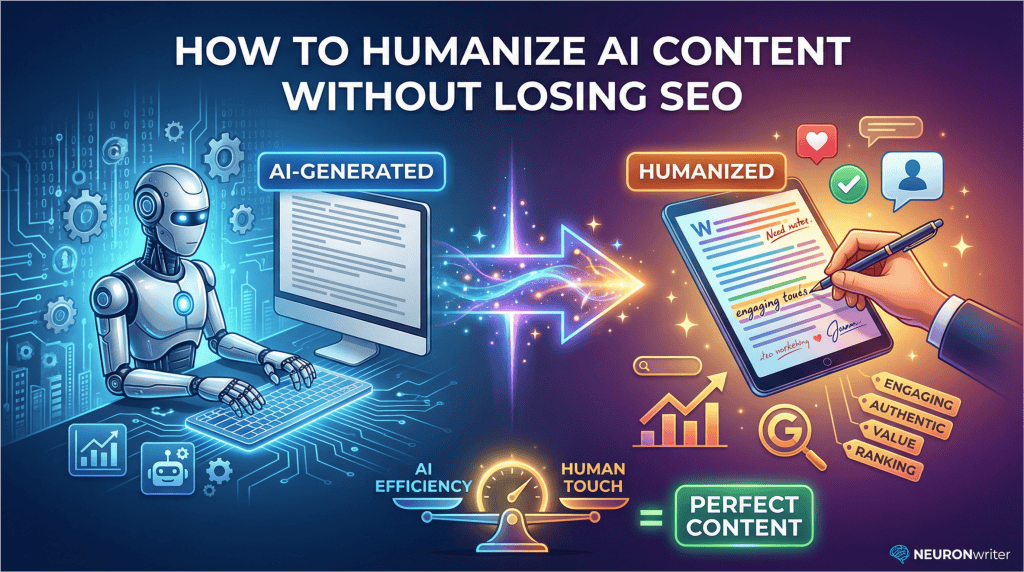
AI writing tools are highly effective, but they have one significant drawback — they often sound too formulaic and impersonal. As Google increasingly prioritizes helpful, people-first content, publishing raw AI-generated text is a quick path to poor performance. Your content needs to sound natural.
“Humanizing” your content isn’t about bypassing AI detectors. It’s about something much more important: adding real value, personal perspective, experience, and character. These elements are what make your content engaging for readers and trustworthy in the eyes of search engines. In this guide, you’ll learn how to give your content a human touch — without sacrificing SEO performance.
Why Humanizing AI Content is Crucial for SEO.
Google’s official stance is that high-quality AI-generated content is not against their guidelines. However, their emphasis is on E-E-A-T (Experience, Expertise, Authoritativeness, and Trustworthiness). Raw AI content, by its nature, lacks real-world experience and a unique human perspective.
Here’s why humanizing is essential:
- Builds Trust: Readers are more likely to trust content that sounds like it was written by a real person with real experience.
- Increases Engagement: A unique voice, personal anecdotes, and a conversational tone keep readers on the page longer.
- Demonstrates E-E-A-T: Adding your own insights and experiences is the most effective way to demonstrate E-E-A-T to Google.
- Avoids Penalties: While Google doesn’t penalize AI content outright, low-quality, unhelpful content will not rank well.
Actionable Strategies to Humanize AI Content.
Forget about “AI humanizer” tools that just spin your text. True humanization is about adding value. Here are five strategies that work.
Inject Real Experience (The “E” in E-E-A-T)
This is the most important step. AI can’t replicate your personal experiences. Add sections to your content that only you could write.
- Personal Anecdotes: Start your introduction with a short, relatable story.
- Specific Examples: Instead of generic examples, use real-world examples from your own work or your clients’ projects.
- Case Studies: Include mini case studies with real data to back up your claims.
Pro Tip: After generating an article with an AI tool like NEURONwriter, look for opportunities to replace generic paragraphs with your own unique insights and experiences.
Develop a Unique Brand Voice.
AI tools tend to write in a neutral, formal tone. To stand out, you need to develop a distinct brand voice.
- Use Contractions: Use “you’re” instead of “you are,” and “it’s” instead of “it is.”
- Vary Sentence Length: Mix short, punchy sentences with longer, more descriptive ones.
- Ask Questions: Engage your readers by asking them questions throughout the article.
- Add Personality: Don’t be afraid to be a little informal, use humor, or express your own opinions.
Rewrite Intros and Conclusions
Introductions and conclusions are the most important parts of your article for making a human connection. Never use the raw AI-generated versions.
- Your Introduction: Should hook the reader with a relatable problem or a bold statement.
- Your Conclusion: Should summarize your unique perspective and provide a clear call to action.
Add Original Data and Visuals
AI tools are trained on existing data from the internet. To make your content truly unique and valuable, you need to add something new.
- Run a Survey: Even a small survey of your audience can provide unique data for your article.
- Create Custom Graphics: Use a tool like Canva to create custom charts, graphs, and infographics.
- Take Screenshots: Include annotated screenshots to illustrate your points.
Fact-Check and Add Credible Sources
AI tools can sometimes make mistakes or “hallucinate” facts. Building trust means ensuring your content is accurate.
- Verify All Claims: Double-check any statistics or factual claims made by the AI.
- Cite Your Sources: Link out to credible, authoritative sources to back up your points. This is a strong signal of trustworthiness to both readers and Google.
How NEURONwriter Helps Create Human-Centric Content.
While no AI can replace a human writer, a tool like NEURONwriter is designed to augment the human writing process, not just automate it.
- Data-Driven Outlines: NEURONwriter provides a data-driven outline based on top-ranking competitors, giving you a solid, SEO-friendly structure to which you can add your own unique insights.
- NLP Term Suggestions: Instead of just generating text, NEURONwriter provides you with the key terms and concepts you need to cover, allowing you to write in your own voice while still ensuring comprehensive, optimized content.
- Focus on Quality: The Content Score encourages you to create high-quality, comprehensive content, which naturally aligns with Google’s focus on helpfulness.
Conclusion: AI as a Co-Pilot, Not the Pilot
A winning content marketing strategy isn’t about choosing between humans and AI. It’s about using AI as a co-pilot, handling the tedious tasks of data analysis and creation while you, the expert, provide experience, insights, and personality that no machine can replicate.
By following these strategies, you can leverage the speed and power of AI without sacrificing the human touch that is essential for building a loyal audience and ranking on Google.
FAQ
Do I need to use an “AI humanizer” tool?
No. We do not recommend them. These tools often just spin content, which can lead to lower quality. The best way to humanize content is to add your own unique value and experience.
How much of the AI-generated text should I edit?
As a rule of thumb, aim to edit or rewrite at least 20-30% of the text, focusing on the introduction, conclusion, and adding personal examples and insights throughout.
Can Google detect AI-generated content?
Yes, Google can detect AI-generated content, but their policy is to reward high-quality content, regardless of how it’s produced. The focus should be on helpfulness and E-E-A-T, not on trying to trick the algorithm.
Ready to create AI-powered content that feels authentically human?