
How to Optimize for Google AI Mode.
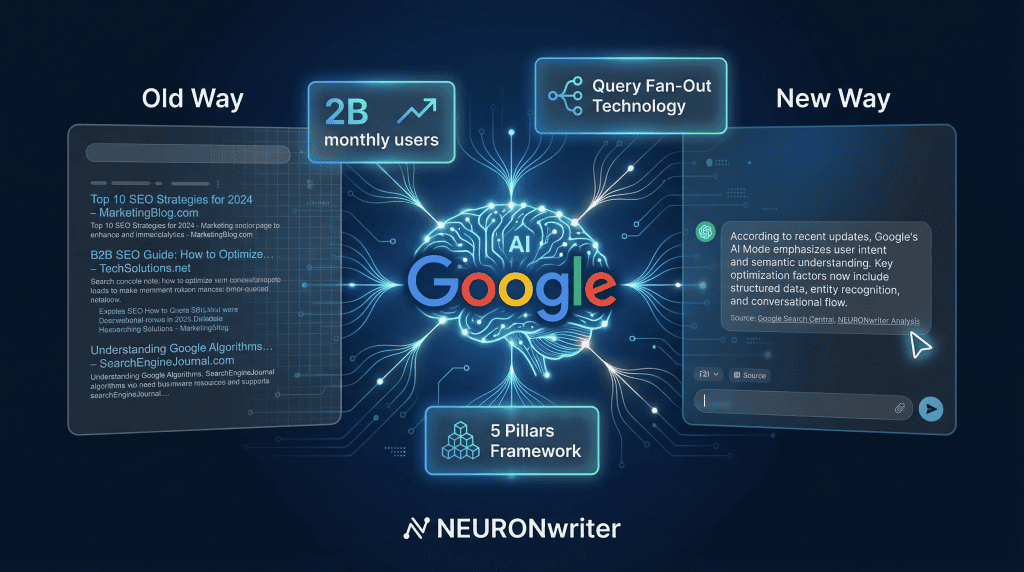
For years, the goal was simple: rank #1. Today, that goal is obsolete. Google’s AI Overviews are now served to 2 billion monthly users, and the full, interactive AI Mode is fundamentally changing how users discover and trust information
In this new reality, your brand isn’t just competing for a blue link; you are competing for a citation within an AI-generated answer.
If your content isn’t structured for AI consumption, you are not just losing traffic; you are becoming invisible to a rapidly growing segment of search. Traditional SEO tactics focused on keyword density and backlink volume are failing because AI doesn’t just rank content it understands it. This guide provides a new playbook for this new era.
The Concept Explained: What is Google AI Mode?
Google AI Mode is an interactive, conversational search experience powered by Google’s advanced Gemini 2.5 model. Unlike a standard search, which returns a list of links, AI Mode engages in a dialogue, synthesizes information from multiple sources, and provides comprehensive, multi-faceted answers directly in the SERP.
It’s crucial to distinguish it from the more common AI Overviews.
| Feature | AI Overviews (The “Old” AI Search) | AI Mode (The New Standard) |
| Experience | Static summary at the top of the SERP | Fully interactive, conversational interface |
| Interaction | One-shot answer to a query | Multi-turn dialogue with follow-up questions |
| Technology | Standard Gemini 2.0 | Advanced Gemini 2.5 with Query Fan-Out |
| Input | Text only | Multimodal (text, voice, images) |
| Goal | Provide a quick, definitive answer | Facilitate deep, exploratory research |
What is Query Fan-Out?
This is the key technological difference. When you ask AI Mode a question, it doesn’t just perform one search. It intelligently breaks your query down into multiple sub-queries, searches for them simultaneously, and then synthesizes the findings into a single, coherent answer. This means it values topical depth and entity relationships far more than any previous version of Google
Why Most People Get It Wrong: The Optimization Trap.
The most common mistake marketers make is treating AI Mode optimization as just “more SEO.” They stuff more keywords, build more links, and write longer articles, hoping something sticks. This fails because AI Mode doesn’t reward content that is merely relevant; it rewards content that is useful, authoritative, and structured for AI consumption.
- The Trap: Optimizing for keywords, not entities.
- The Reality: AI Mode thinks in terms of entities (people, places, concepts) and their relationships. If your content doesn’t clearly define and connect these entities, the AI cannot trust it as a reliable source.
- The Trap: Believing E-E-A-T is just about author bios.
- The Reality: Experience, Expertise, Authoritativeness, and Trustworthiness are demonstrated through deep, nuanced content that covers a topic from multiple angles, cites sources, and provides unique insights—all signals an AI is trained to detect.
- The Trap: Thinking more content is better.
- The Reality: More comprehensive content is better. A single, well-structured pillar page that covers a topic exhaustively is more valuable to AI Mode than ten shallow blog posts.
The Framework: The 5 Pillars of AI Mode Optimization.
To win in AI Mode, you need a systematic approach. This framework shifts your focus from chasing algorithm changes to building a durable foundation of authority that any AI will recognize and reward.
Pillar 1: Comprehensive Topical Authority.
Instead of targeting individual keywords, you must cover entire topics. This means building hub-and-spoke models where a central “pillar” page provides a comprehensive overview of a topic, and dozens of “cluster” pages dive deep into specific sub-topics. This signals to the AI that you are a definitive source of knowledge. Our guide to topical authority provides a detailed walkthrough of this model.
Pillar 2: Entity-First SEO.
Optimize for “things, not strings.” For every piece of content, clearly define the primary entity (e.g., “Google AI Mode”) and connect it to related secondary entities (e.g., “Gemini 2.5,” “Query Fan-Out,” “multimodal search”). This is the foundation of semantic SEO and is critical for AI comprehension. Our guide to Entity SEO explains this in detail.
Pillar 3: Structured for AI Readability.
Your content must be easy for a machine to parse and understand. This means using clear, hierarchical headings (H1, H2, H3), answering questions directly and concisely (ideal for Featured Snippets and AI citations), and using lists and tables to structure data. Most importantly, it requires robust Schema Markup to explicitly label your content for the AI.
Pillar 4: Demonstrable E-E-A-T.
Go beyond author bios. Demonstrate Experience, Expertise, Authoritativeness, and Trustworthiness within your content by including original data, citing credible sources, quoting experts, and providing unique, first-hand insights. Our guide to E-E-A-T shows how to weave these signals into your content.
Pillar 5: AI-Powered Measurement.
You cannot optimize what you cannot measure. Traditional rankings and traffic are no longer enough. You must track your Share of Voice in AI Search—what percentage of AI answers for your key topics cite your brand? This is the new north star metric for AI-era SEO.
Step-by-Step Walkthrough: Optimizing a Page for AI Mode.
Let’s apply the framework to a practical example. Imagine we want to optimize a blog post about “content marketing ROI.”
Step 1: The Intent Audit (Before)
- Before: The article targets the keyword “content marketing roi” and is optimized for keyword density.
- After (AI-First): We analyze the SERP for “content marketing roi” and identify the core user questions: How do you calculate it? What is a good benchmark? What tools are needed? How do you prove it to your boss? The article is now structured to answer these questions directly.
Step 2: The Content Structure (Before)
- Before: A long, unstructured article with generic H2s like “Introduction” and “Conclusion.”
- After (AI-First): The article is restructured with clear, question-based headings:
- H1: How to Calculate Content Marketing ROI: A CFO-Ready Guide
- H2: What Is Content Marketing ROI?
- H2: The 4-Step Formula to Calculate ROI (with a worked example)
- H2: What is a Good Content Marketing ROI? (Industry Benchmarks)
- H2: How to Track the Metrics That Matter
- H3: Leading vs. Lagging Indicators
Step 3: The Entity Optimization (Before)
- Before: The article repeats the phrase “content marketing roi” 15 times.
- After (AI-First): The article defines the primary entity (“Content Marketing ROI”) and connects it to related entities like “lead generation,” “customer lifetime value (CLV),” “multi-touch attribution,” “marketing analytics,” and “HubSpot.”
Step 4: The E-E-A-T Integration (Before)
- Before: A generic article written by “Admin.”
- After (AI-First): The article includes a quote from a real CFO, features a custom-designed ROI calculator widget (Experience), and cites data from a recent Gartner report (Authoritativeness).
Step 5: The Measurement (Before)
- Before: We track the article’s keyword ranking and organic traffic.
- After (AI-First): We use NEURONwriter’s AI Visibility Tracking to monitor how often our article is cited in AI Mode answers for queries related to “content marketing ROI.” We see a 15% increase in our Share of Voice in AI Search within 60 days.
Real-World Application: NEURONwriter’s Role in AI Mode Optimization
Real-world application of this approach requires a tool that takes into account the specifics of AI-based search. NEURONwriter can be considered a workspace that organizes the entire process and allows you to translate AI Mode optimization assumptions into concrete actions.
When planning topical authority, NEURONwriter allows you to view content in a broader context. Instead of working on individual articles, you can view entire topic clusters, identify gaps, and gradually build a content structure based on connections between topics. This approach better aligns with how AI systems interpret credibility and completeness of information.
Another crucial element is the entity-based approach. NLP-based analysis shifts the focus from keywords to meanings and connections between concepts. This makes it easier to determine which contexts and terms should appear in the text for it to be correctly understood by language models.
When creating content, its structure also becomes crucial. The editor, based on search results analysis, suggests how to organize headlines, questions, and information layout so that they are readable not only for the user but also for AI systems selecting fragments for citations or summaries.
Another aspect is the technical layer, including structured data. The ability to generate schemas, such as FAQs, directly while working on the text facilitates the preparation of content in a manner consistent with machine processing requirements, without having to delve into implementation details.
Finally, there is the issue of visibility in the AI environment. Instead of relying on general impressions, you can observe how content performs in AI-generated results and how it contributes to visibility relative to competitors. This allows you to treat presence in AI Search as a measurable element of your strategy, not just an experiment.
Quick-Win Checklist: 5 Actions to Take Today.
Pick one high-traffic article and restructure it to answer the top 3-5 user questions directly.
Add a FAQ section to your top 5 pages using question-based H2s.
Generate and implement Schema Markup for those 5 pages.
Identify the primary entity for your most important page and ensure it’s clearly defined in the opening paragraph.
Set up AI Visibility Tracking in NEURONwriter for your most important commercial keyword.
FAQ
Is Google AI Mode replacing traditional search?
Not entirely, but it is becoming the default for an increasing number of complex, exploratory queries. Traditional search will likely remain for simple, navigational queries, but the future of informational and commercial search is conversational and AI-driven.
How long does it take to see results from AI Mode optimization?
Unlike traditional SEO, which can take months, improvements in AI visibility can be seen much faster. Because AI models are constantly processing new information, a well-structured, authoritative piece of content can be cited by AI Mode within weeks, or even days, of being published and indexed.
Do I still need to build backlinks?
Yes, but their role is changing. High-quality backlinks from authoritative sources are a powerful signal of trust (the ‘T’ in E-E-A-T). However, a diverse profile of brand mentions, social proof, and on-page authority signals is now equally, if not more, important for AI citation.
Is this the same as Generative Engine Optimization (GEO)?
This is the next evolution of it. GEO is the broad practice of optimizing for all generative AI engines. Optimizing for Google AI Mode is a specific, highly technical application of GEO focused on the world’s largest search engine and its unique “Query Fan-Out” technology.