
A Practical Guide to Link Building: Strategies That Work in the AI Era.
Link building has always been one of the most debated topics in SEO. For years, it was a numbers game: the more links you had, the better you ranked. Today, that equation has fundamentally changed. In 2026, Google’s AI-powered algorithms evaluate links not just for quantity, but for editorial intent, topical relevance, and the genuine authority of the linking source. This guide provides a practical, modern framework for building a backlink profile that drives sustainable organic growth.
Why Link Building Still Matters (But Has Changed)
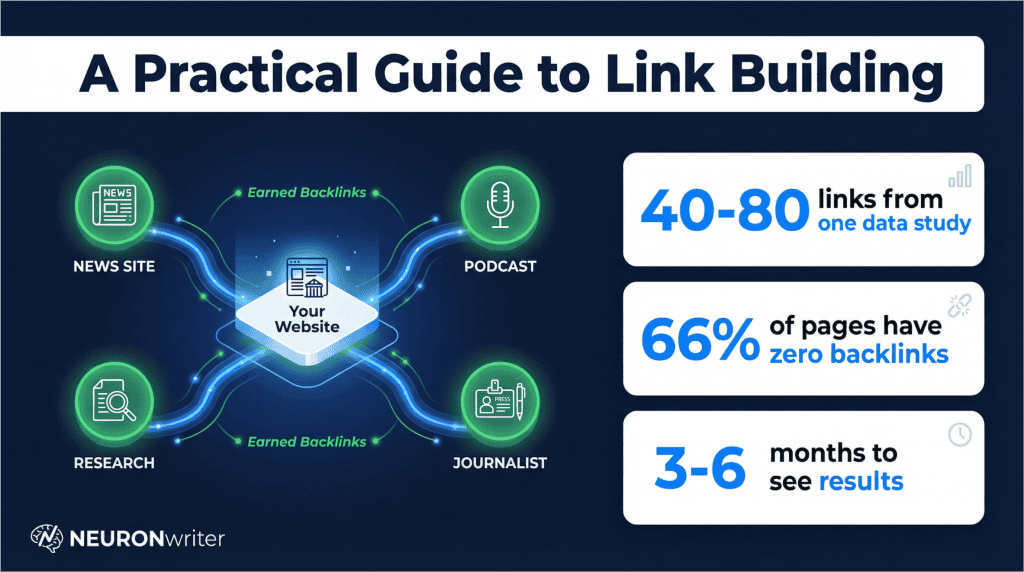
Despite the rise of AI search and the growing importance of E-E-A-T, backlinks remain one of Google’s most significant ranking factors. A study by Ahrefs found that 66% of pages on the internet have zero backlinks, and those pages struggle to rank for anything competitive.
The correlation between backlinks and rankings is still strong but the type of backlink matters more than ever.
The fundamental shift in 2026 is this: Google has become increasingly effective at distinguishing between earned links (genuine editorial endorsements) and manufactured links (paid placements, mass guest posts, link schemes). Tactics that worked in 2018 buying links, submitting to directories, or publishing thin guest posts on irrelevant sites now carry significant penalty risk.
“Journalists receive hundreds of pitches daily. Generic press releases about product launches get deleted. What breaks through is genuinely newsworthy content: original research, expert commentary on trending topics, or creative campaigns that resonate with their audience.”
This shift means that modern link building is less about outreach volume and more about creating link-worthy assets content so valuable, insightful, or unique that other websites want to cite it as a source.
The Modern Link Building Framework.
Effective link building in 2026 is built on three interconnected pillars: creating linkable assets, strategic outreach, and relationship building. These are not sequential steps but ongoing, parallel activities that reinforce each other over time.
| Pillar | Core Activity | Primary Outcome |
| Linkable Assets | Original research, ultimate guides, free tools | Passive link earning |
| Strategic Outreach | Digital PR, broken link building, unlinked mentions | Active link acquisition |
| Relationship Building | Journalist connections, podcast appearances, expert quotes | Long-term link velocity |
Strategies That Earn High-Quality Links in 2026.
1. Digital PR and Original Research.
This is the single most powerful link building strategy available today. By conducting and publishing original research surveys, data studies, or industry reports you become the primary source for new data. Journalists and bloggers will cite your research and link back to your site as the authoritative source.
The mechanics are straightforward: identify a knowledge gap in your industry, survey a statistically significant audience (300-500+ respondents is the minimum for credibility), and publish your findings in a comprehensive, visually rich format. A well-executed data study can generate 40-80 high-quality editorial links from a single piece of content.
What makes research link-worthy:
- Counterintuitive or surprising findings that challenge conventional wisdom
- Data that is specific to a niche or underserved audience
- Embeddable visuals (charts, infographics) that make it easy for journalists to cover your data
- A clear methodology section that establishes credibility
The distribution strategy is equally important. Pitch exclusive previews to tier-one publications before public release. Create separate press releases highlighting different findings for different publication types a tech blog and a business publication will be interested in different angles from the same dataset.
2. The Skyscraper Technique, Evolved.
Brian Dean’s Skyscraper Technique remains effective, but with a 2026 refinement. It is no longer sufficient to simply create a longer version of an existing popular article. Modern search engines evaluate semantic completeness whether a piece of content covers a topic comprehensively from multiple angles. This is closely tied to topical authority the more thoroughly you cover a subject, the more authoritative your site becomes in Google’s eyes.
The evolved approach works as follows: identify a piece of content in your niche that has earned a significant number of backlinks, then analyze it not just for length but for topical gaps. What questions does it fail to answer? What data has become outdated? What perspectives are missing? Create a resource that addresses all of these gaps, then reach out to the websites that linked to the original piece and present your improved version.
The key insight is that you are not just offering something longer you are offering something more useful to the webmaster’s audience.
3. Broken Link Building.
This technique provides direct, immediate value to webmasters, which is why it maintains a high conversion rate. The premise is simple: websites accumulate broken links over time as pages are deleted or URLs change. By finding these broken links and offering a relevant replacement, you solve a real problem for the site owner.
Use a backlink analysis tool to find broken links on resource pages and blogs in your niche. If you already have a suitable piece of content, pitch it directly. If not, create a new piece specifically designed to replace the dead resource. The outreach email should be brief, helpful, and focused entirely on the value you are providing to the webmaster not on what you want in return.
4. Reclaiming Unlinked Brand Mentions.
This is one of the most overlooked and highest-converting link building tactics available. When a website mentions your brand, product, or a key person in your company without linking to you, you have a warm lead for a backlink. The author already knows who you are and has already decided you are worth mentioning they simply forgot to add the link.
Set up monitoring alerts for your brand name, product names, and key team members using tools like Google Alerts or a dedicated brand monitoring service. When you identify an unlinked mention, send a brief, friendly email to the author thanking them for the mention and politely asking if they would consider adding a link. Conversion rates for this tactic are significantly higher than cold outreach because the relationship is already established.
5. Strategic Expert Positioning (HARO, Podcasts, Roundups)
In the AI search era, being cited as an expert source is doubly valuable: it earns backlinks and increases the likelihood of being cited in AI-generated responses. Platforms like Help a Reporter Out (HARO) and Qwoted connect journalists with expert sources, and responding quickly with specific, quotable insights is the key to success.
“According to the State of Journalism Report, 45% of reporters said one follow-up is ideal, and 51% said this follow-up should come within 3-7 days after the pitch. The expert who responds in two hours gets quoted. The one who responds tomorrow gets ignored.”
Beyond journalist platforms, guest appearances on industry podcasts are a consistently undervalued link building channel. Most podcast episodes have show notes pages that link to the guest’s website and any resources mentioned during the interview. A single podcast appearance can generate a high-authority link from a highly relevant domain, along with referral traffic from an engaged audience.
What No Longer Works (And What to Avoid)
Understanding what to avoid is as important as knowing what to pursue. The following tactics carry significant risk in 2026 and should be avoided entirely.
| Tactic | Why It Fails | Risk Level |
| Mass guest posting | Google devalued thin, scaled guest posts | High |
| Paid link placements | Violates Google’s link scheme guidelines | Very High |
| Directory submissions | Low relevance, low authority | Medium |
| Comment spam | Ignored or penalized | High |
| Private Blog Networks (PBNs) | Actively targeted by Google | Very High |
| Reciprocal link exchanges | Detectable pattern, devalued | Medium |
The common thread across all of these tactics is that they attempt to manufacture the appearance of authority rather than earn it. Google’s algorithms are increasingly effective at detecting these patterns, and the penalties both manual and algorithmic can be severe.
How NEURONwriter Supports Your Link Building Strategy.
While NEURONwriter is primarily a content optimization platform, it plays a direct role in creating the link-worthy assets that are the foundation of modern link building.
The platform’s SERP analysis and NLP term recommendations help you create content that is more semantically comprehensive than competing pages.
When your content covers a topic more thoroughly than anything else available, it naturally attracts more links. This is the Skyscraper Technique applied at scale NEURONwriter identifies exactly what topics and entities your content needs to cover to be considered the definitive resource on a subject.
For Digital PR campaigns, NEURONwriter Content Editor ensures that the research reports and data studies you publish are optimized for both readability and search visibility. A high Content Score signals to both readers and search engines that your content is authoritative and comprehensive which also strengthens your overall branded search presence which increases the likelihood that journalists will cite it and that Google will surface it when other writers are looking for sources.
Measuring Link Building Success.
Link building is a long-term investment, and measuring its impact requires tracking the right metrics over time. Focus on these four indicators:
Domain Rating / Domain Authority: A gradual increase in your site’s overall authority score indicates that your link building efforts are accumulating value. Sudden spikes may indicate low-quality links.
Referring Domains: The number of unique domains linking to your site is more important than the total number of backlinks. One hundred links from ten domains is less valuable than fifty links from fifty different domains.
Organic Traffic Growth: Ultimately, link building should translate into improved rankings and increased organic traffic. Track this at the page level for your most important content.
Keyword Rankings: Monitor the ranking positions of the pages you are actively building links to. Improvements in rankings for competitive keywords are a direct indicator of link building success.
Conclusion: Links Are Earned, Not Built
The most important mindset shift in modern link building is moving from “building links” to “earning links.” This means investing in content quality, original research, and genuine relationships with journalists and other content creators in your niche. The tactics outlined in this guide Digital PR, Skyscraper content, broken link building, and expert positioning all share a common thread: they create real value for real people, and the links follow naturally.
This approach is more sustainable, more resilient to algorithm changes, and ultimately more effective than any shortcut. Start with one strategy, execute it consistently, and build from there.
FAQ
How long does link building take to show results?
Link building is a long-term strategy. Most practitioners see meaningful ranking improvements within 3-6 months of consistent effort, though highly competitive niches may take longer. Digital PR campaigns can generate links within days, but the ranking impact accumulates over time.
How many links do I need to rank?
There is no universal answer, as it depends entirely on the competitiveness of your target keywords. Analyze the backlink profiles of the top-ranking pages for your target keywords using a backlink analysis tool this gives you a realistic benchmark for your own link building goals.
Is internal linking part of link building?
Internal linking is often overlooked but is a critical component of a comprehensive link building strategy. Internal links distribute the authority from your externally-earned backlinks across your site, helping more of your pages rank. NEURONwriter internal linking suggestions make this process systematic and efficient. For a deeper look at how content optimization supports link earning, see our complete NEURONwriter guide.
Can I do link building without a big budget?
Absolutely. Broken link building, unlinked brand mention reclamation, and HARO outreach are all highly effective tactics that require time rather than money. Original research is the most resource-intensive strategy, but even a well-designed survey can be conducted at relatively low cost using tools like Typeform or Google Forms.