Schema Markup for AI Agents: The 5 Tags You Need.
For years, content teams treated schema markup as an afterthought a task handed off to developers long after the “real” writing was done. In the traditional search era, this approach meant missing out on a few rich snippets. In the AI-first search era of 2026, it actively kills your visibility.
AI answer engines like ChatGPT, Perplexity, and Google’s AI Overviews do not guess which sources to cite. Understanding how AI search agents work is the first step to optimizing for them. They rely on machine-readable signals that explicitly define what the content covers, who created it, and how it connects to known entities.
Schema markup provides those exact signals.
Recent data underscores the stakes: AI Overviews now drive a significant portion of all queries, and every generated answer draws from a pool of sources defined by structured data
Pages without schema are not just missing a formatting enhancement; they are failing to communicate with the systems deciding which content becomes the definitive answer.
This guide breaks down exactly how schema influences AI citations, the five specific tags you need to implement in 2026, and how to use NEURONwriter to ensure your structured data is backed by true topical authority.
How Schema Markup Actually Influences AI Citations.
Before implementing tags, it is crucial to understand the mechanics of how AI systems use structured data. A common misconception is that AI engines parse your JSON-LD semantically in real time to form their answers word-for-word. This is inaccurate.
AI engines process schema markup indirectly through search engine index enrichment
Your schema feeds Google’s Knowledge Graph and Bing’s entity index. When an AI grounds its response in search data (Retrieval-Augmented Generation), it relies on these enriched indexes. Therefore, schema makes your content more digestible to search crawlers and knowledge graphs, which in turn increases the probability that your information gets selected as a citation.
The impact is measurable. Independent studies have shown that attribute-rich schema can earn a citation rate of over 60%, whereas generic, minimally populated schema actually underperforms having no schema at all. The goal is not just to “add schema,” but to add complete, accurate schema that faithfully mirrors your visible page content.
The 5 Essential Schema Tags for AI Agents in 2026.
While Schema.org offers hundreds of types, AI systems disproportionately rely on a specific subset to extract facts, verify authorship, and understand procedures. Here are the five most critical tags for Answer Engine Optimization (AEO) in 2026.
1. FAQPage (The Conversational Anchor).
FAQPage schema remains the highest-leverage tag for conversational queries
LLMs are fundamentally question-answering machines, and FAQPage schema perfectly aligns with this format, helping models parse questions and surface concise, direct answers.
Studies have shown that pages with FAQPage schema achieve significantly higher citation rates—sometimes up to 2.7 times higher than pages without it
Even though Google restricted FAQ rich results in traditional SERPs back in 2023, AI search platforms have embraced FAQ schema as a primary source for extracting information.
Implementation Rules:
- Only use FAQPage if your page contains FAQs where there is a single, definitive answer to each question.
- Structure questions as H3 headings in your visible content, matching the “name” property in your schema exactly.
- Keep answers concise (ideally 30-80 words) so they are easy for AI to extract as a single unit.
2. HowTo (The Procedural Guide).
Step-by-step instructions marked with HowTo schema are preferentially cited by AI systems generating procedural answers.
If your content answers “how do I…” queries, this schema is non-negotiable. It breaks down complex processes into machine-readable steps, making it highly valuable for both text-based AI answers and voice search.
Implementation Rules:
- Ensure every step in the schema exactly matches a visible step on the page.
- Use HowToStep for individual actions and HowToDirection if a step requires further breakdown.
3. Article & Author (The Credibility Signal)
AI systems are increasingly tasked with evaluating the credibility of the information they cite. Article schema, specifically when combined with robust Author markup, establishes publication authority.
By linking the content to a specific, verifiable author entity, you provide the AI with the trust signals necessary to select your content over an anonymous competitor.
Implementation Rules:
- Always include the author property, linking it to a Person or Organization entity.
- Use sameAs within the author markup to link to their social profiles (e.g., LinkedIn) or author bio page, reinforcing their identity across the web.
4. Organization (The Entity Anchor).
Organization schema serves as the entity anchor that makes everything else credible.
It defines who is publishing the content, what their official website is, and how to contact them. For AI systems building knowledge graphs, this schema connects your individual articles and products back to a verified corporate entity.
Implementation Rules:
- Implement this site-wide (often in the footer or homepage).
- Include properties like logo, contactPoint, and sameAs (linking to official corporate social profiles).
5. Product (The Commercial Driver).
For e-commerce and SaaS companies, Product schema is the structured commercial data required for AI-powered purchase queries.
When a user asks an AI agent for “the best CRM software under $50/month,” the AI relies on Product schema to extract pricing, reviews, and specifications.
Implementation Rules:
- Always include AggregateRating and Offers (price and currency) properties.
- Ensure the data in the schema perfectly matches the visible pricing and reviews on the page.
The Role of NEURONwriter in Your Schema Strategy.
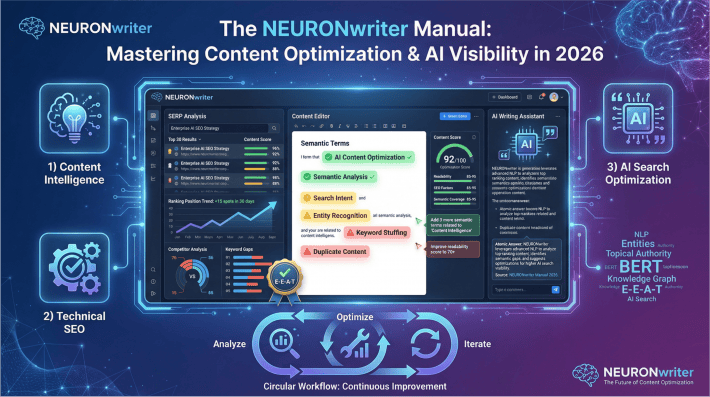
Adding structured data to a weak article is like putting a shiny wrapper on an empty box. Schema markup tells the AI what the content is about, but the content itself must possess the semantic depth and entity richness required to be cited. This is where NEURONwriter becomes essential.
Before you generate your JSON-LD, you must ensure your content covers the topic comprehensively. NEURONwriter helps you achieve this by:
1.Building Topical Authority: NEURONwriter content planning tools help you map out entire topic clusters. When an AI agent sees Organization schema connecting dozens of highly relevant, interconnected articles, your brand’s authority multiplies.
2.Entity Optimization: NEURONwriter NLP-driven editor ensures you include the specific terms and entities that AI models associate with your topic. If your FAQPage schema promises an answer about “technical SEO,” NEURONwriter ensures your text actually contains the semantic signals (like “crawl budget,” “rendering,” and “indexation”) that prove your expertise.
3.Structuring for Readability: By guiding you to use proper H2 and H3 hierarchies, NEURONwriter naturally prepares your content for schema types like FAQPage and HowTo.
You use schema markup to make your content machine-readable; you use NEURONwriter to make it machine-citable. For a deeper look at how to structure your content so AI agents can parse it effectively, read our guide on how to structure content for AI agent consumption.
FAQ
Do I need to know how to code to implement schema markup?
No. Most modern CMS platforms (like WordPress) have plugins (such as Yoast SEO or Rank Math) that automatically generate basic schema. For custom tags, you can use free online JSON-LD generators and simply paste the code into your page’s header.
Can I use multiple schema types on one page?
Yes. It is common and recommended to use multiple types if they accurately reflect the content. For example, a blog post might use Article schema for the main content, FAQPage schema for a Q&A section at the bottom, and Organization schema site-wide.
Will adding schema guarantee my content is cited by AI Overviews?
No. Schema markup is a prerequisite, not a guarantee. It ensures the AI understands your content, but the AI will only cite it if the content is highly relevant, authoritative, and semantically rich (which is why tools like NEURONwriter are necessary).
What happens if my schema doesn’t match my visible content?
Google and other search engines strictly penalize “spammy” structured data. If your JSON-LD describes FAQs or Reviews that are not visible to the human reader, your site may receive a manual action penalty, and the markup will be ignored.
How do I test if my schema is working?
Use Google’s Rich Results Test or the Schema Markup Validator at validator.schema.org. These tools will parse your code and highlight any syntax errors or missing required properties.