
The Architecture of Success: How NEURONwriter Internal Linking Turns Scattered Posts into a Powerful Knowledge Ecosystem.
Imagine you’re building your dream house. You have the best materials, a stunning façade, and thanks to AI Score & NLP Optimisation you’ve ensured that every room is perfectly finished. But… you forgot the doors. Guests enter the living room and can’t find their way to the kitchen or the bedroom. What do they do? They leave, frustrated and confused.
In the world of SEO, those “doors” are your internal links. They ensure that Google’s bots don’t get lost in dead ends and that readers, instead of consuming just one article, read three, because each one is a natural continuation of the last.
In this article, we’ll show you how NEURONwriter takes the role of “link detective” off your shoulders and becomes the intelligent architect of your website.
Why Internal Linking is the “Holy Grail” You Often Forget.
Most of us fall into the trap of “assembly line production.” We write an article, publish it, and… forget about it as we chase the next topic. Meanwhile, every new piece of content is an opportunity to breathe life into your existing ones and strengthen your Topical Authority & Topic Maps.
Internal linking plays two critical roles:
- For Google: It passes “authority” from strong, established pages to new ones. It helps algorithms understand the hierarchy of your site.
- For the Reader: It builds trust. If you can lead a user from a problem to a solution through a series of related posts, you stop being a “random Google result” and become a trusted expert.
The Magic of Semantics: How NEURONwriter “Sees” Connections.
Traditional linking methods involve either tedious manual searching of your own site or installing heavy plugins that randomly drop links, ruining the carefully crafted AI Profiles & Humanizer you’ve worked so hard on.
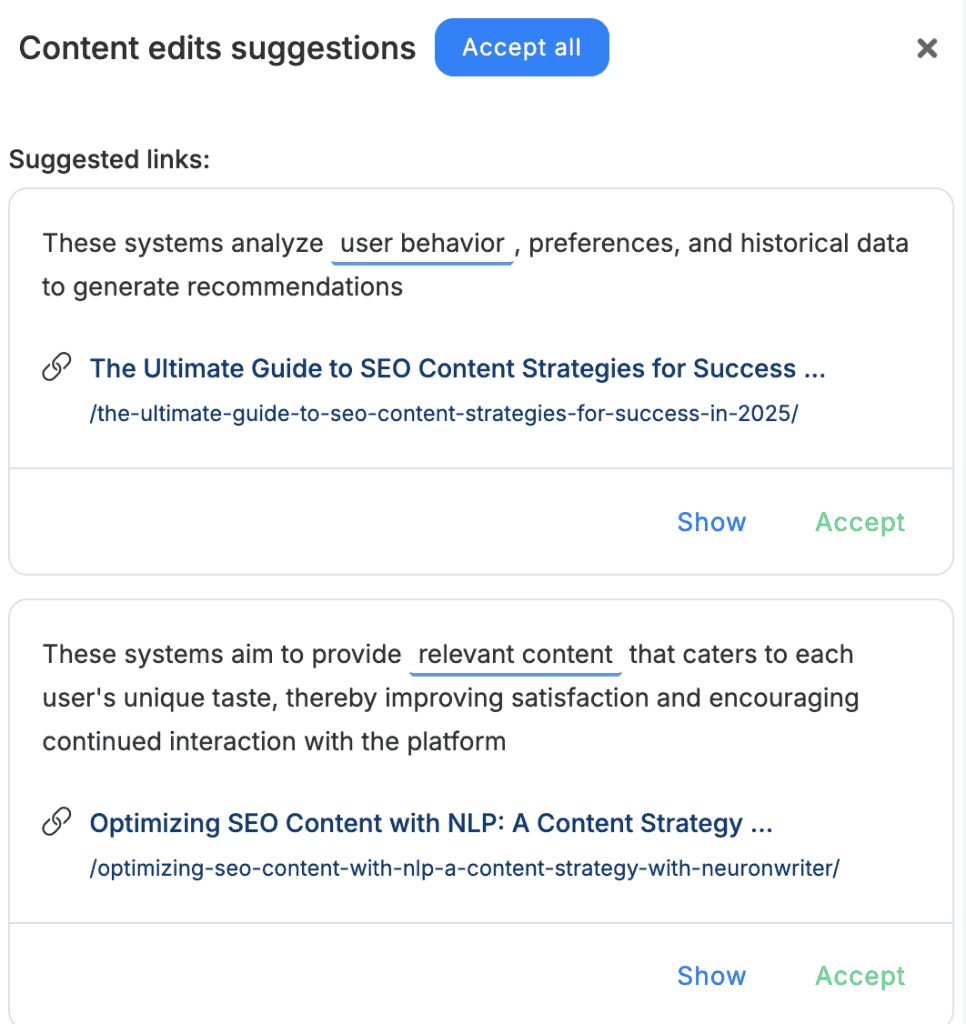
Internal Link Suggestions in NEURONwriter works differently. The tool doesn’t just look for matching keywords. It understands context.
Through semantic analysis, the system knows that if you’re writing about a “keto diet,” your older post about “healthy fats” is its natural complement. The tool suggests connections that make logical sense. It’s like having an assistant who has memorized every single sentence ever posted on your blog.
Strategy vs. Chance: Comparing Linking Methods.
Before we dive into practice, let’s see how intelligent suggestions compare to other content management methods.
| Feature | Manual Linking | Auto-Plugins | NEURONwriter (Semantic) |
| Precision | High, but time-consuming | Low (often irrelevant) | Very High (context-based) |
| User Experience | Good | Often irritating | Excellent (natural flow) |
| Authority Building | Depends on author’s memory | Negligible | Maximum (strengthens clusters) |
| Effort Required | Hours per month | Minutes | Seconds (suggestions at hand) |
How to Implement Perfect Linking in 3 Steps.
- Listen to Real-Time Suggestions: While writing in the editor, check the right-hand panel. NEURONwriter will show you a list of pages from your domain that fit the current topic.
- Choose a Smart Anchor Text: Don’t just link the words “click here.” Choose a phrase that best describes the destination. This maintains a high level of usability for your site.
- Take Care of “Orphaned Pages”: Use the AI-Tracking feature to check which articles are losing their rankings. Often, the reason is a lack of fresh internal links from your newer, high-traffic posts.
FAQ: Internal Linking Without the Mystery.
1. Can too many links be harmful?
Yes. Google promotes usability. If you put a link in every sentence, the reader will feel overwhelmed. Aim for a few high-value links per 1,000 words.
2. Which is more important: linking to old or new texts?
Both are crucial. Linking to new texts gives them a “kickstart” in authority. Linking from new to old tells Google that your knowledge base is consistent and still relevant.
3. Does internal linking affect sales?
Definitely. By leading a reader from an educational article to a product review, you shorten their buyer’s journey.
4. Do I have to manually type every keyword into these links?
Not necessarily. Once your links are set, you can use the Auto-optimisation Advanced Auto Insert feature to ensure the entire text is technically perfect while you focus on the linking structure.
Summary: Connect the Dots and Dominate the Search Results.
A good content strategy isn’t a sprint for individual keywords. It’s about building a web of connections that keeps the user on your site longer. With Internal Link Suggestions, NEURONwriter gives you tools that were previously reserved only for top-tier SEO agencies.
Don’t let your best content gather dust in obscurity. Connect the dots and create an authority that the competition simply cannot undermine.
Ready to turn your website into a cohesive whole?
Launch Link Suggestions in NEURONwriter and master your content structure today!