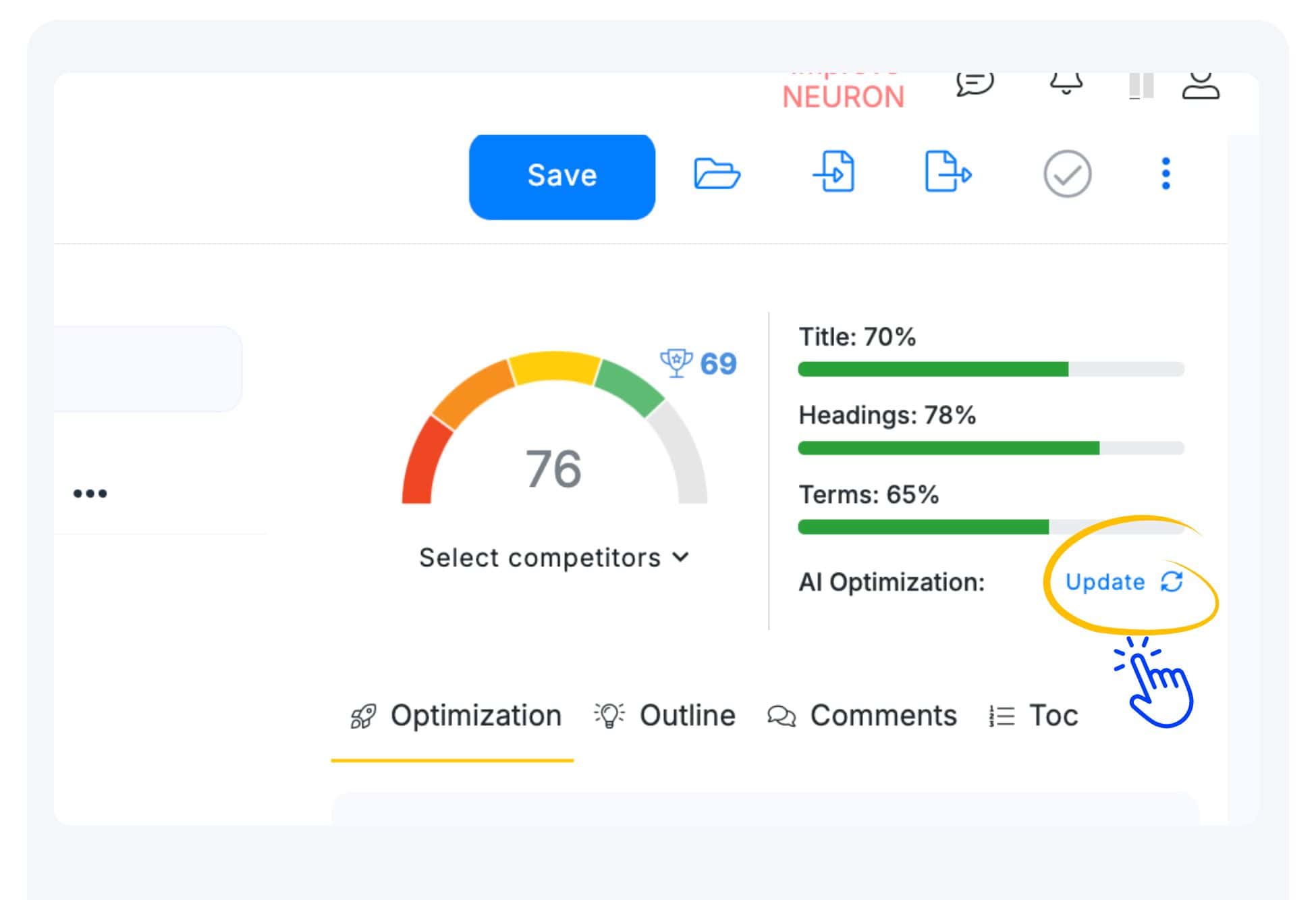
What is AI Score in NEURONwriter?
The AI Score is an AI-Optimisation metric in NEURONWriter that evaluates your content across critical dimensions — Topic Coverage, Structure, Clarity, Bottom Line up, Fact and Sourse dencity to be understandable, well-structured, and thematically comprehensive for AI. It helps you create text that is clearer, more comprehensive, and better organized, ultimately boosting readability, engagement, and overall content effectiveness for both Google and LLMs.
How does AI Score Metric help you optimise for AI search?
Create LLM-ready content: Structure and phrase your writing in a way that large language models can easily interpret, summarize, and surface.
Fill topic gaps AI systems care about: The Topic Coverage score helps you include the concepts and questions LLMs expect for strong relevance signals.
Improve AI interpretability: A higher Structure and Clarity score makes your content easier for LLMs to understand, rank, and reuse in responses.
Boost overall AI compatibility: By refining your content using the AI Score, you produce material that performs better across emerging AI reading, indexing, and retrieval models.
Tip: Aim for a higher AI Score to be clearly interprets and useful for advanced AI systems.
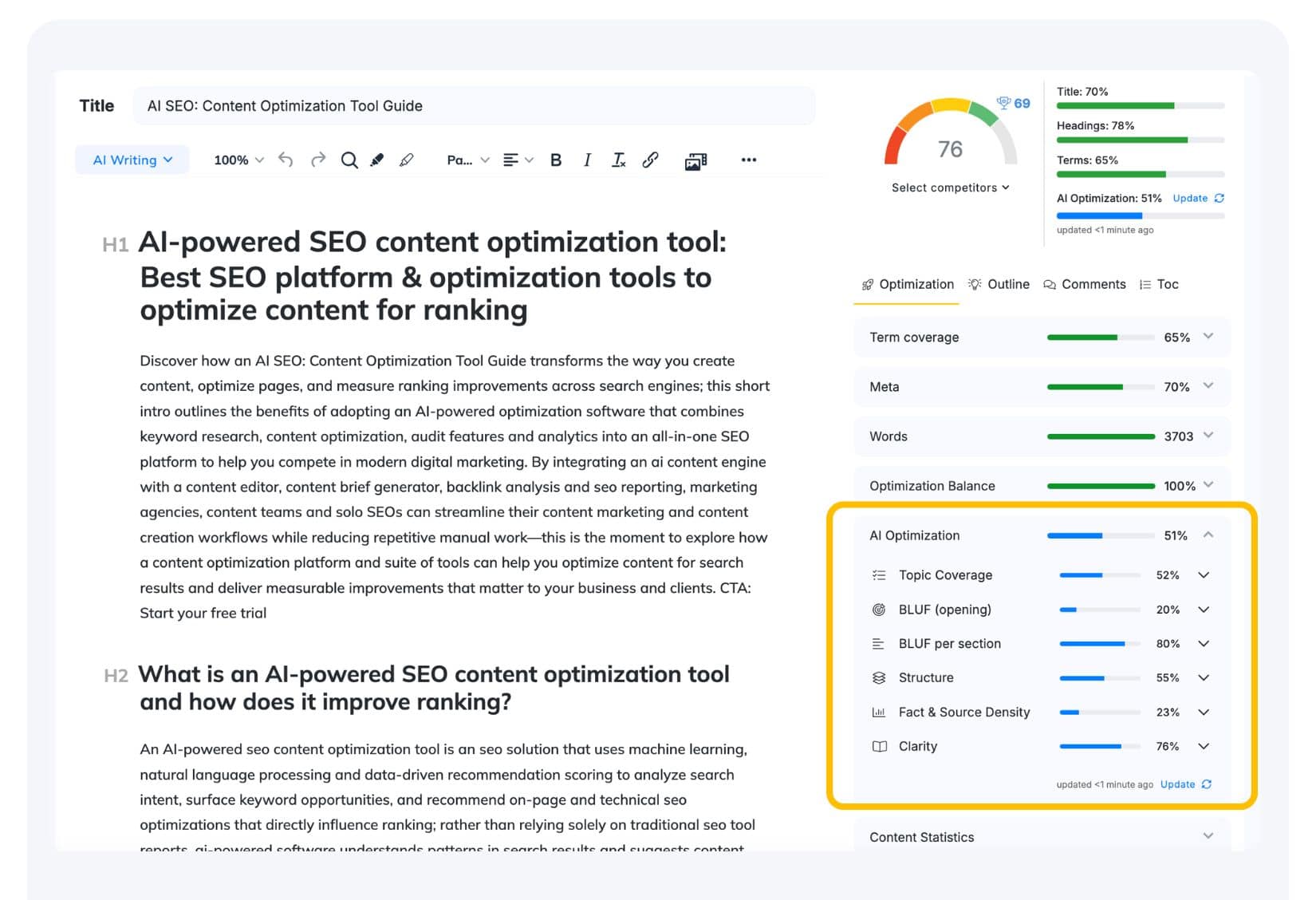
How the AI Score works?
AI Score to display a detailed, real-time evaluation of your text directly in the editor panel. The system analyzes your content across Topic Coverage, Structure, and Clarity—helping you refine text that performs better for users, search engines, and LLMs.
1. Topical Coverage
What it means:
Shows how well your content covers the most important topics and answers key questions. Based on SERP and competitor analysis, it checks how closely your text aligns with essential topics expected by search engines and AI systems.
Benefits:
- Helps ensure your content fully answers user intent and key questions.
- Improves relevance for search engines and AI-generated answers.
- Increases chances of ranking higher due to complete topic coverage.
How to interpret it: A low score means your content is missing important topics or does not fully match what top-performing pages and users expect.
Recommendations:
- Add missing subtopics identified from SERP and competitors.
- Answer all key audience questions clearly.
- Expand sections where important concepts are underdeveloped
2. BLUF (Bottom Line Up Front)
What it means:
Checks whether your introduction delivers the most important takeaway first, so readers and AI systems immediately understand the core message.
Benefits:
- Improves first impression and content clarity for users.
- Helps AI systems generate accurate summaries.
- Increases engagement by showing value immediately.
How to interpret it:
A low score means your key message is delayed or unclear in the introduction.
Recommendations:
- Start with the main answer, conclusion, or benefit.
- Clearly state what the article is about in the first sentences.
- Avoid long introductions without clear purpose.
3. BLUF per Section
What it means:
Evaluates whether each section starts with a clear takeaway that explains what the reader will learn.
Benefits:
- Improves scanability and readability.
- Helps AI and readers quickly understand section purpose.
- Makes long content easier to navigate and digest.
How to interpret it:
A low score indicates sections start without clear direction or main idea.
Recommendations:
- Begin each section with a short summary sentence.
- Clearly state the key point before details.
- Avoid burying conclusions at the end of sections.
4. Structure
What it means:
Evaluates the logical flow of your content—how headings, sections, and ideas connect and build on each other.
Benefits:
- Helps readers follow your argument easily.
- Improves AI understanding of topic relationships.
- Strengthens overall content hierarchy and SEO performance.
How to interpret it:
A low score means content is disorganized, fragmented, or difficult to follow.
Recommendations:
- Organize content with clear heading hierarchy.
- Group related ideas together logically.
- Ensure smooth transitions between sections.
5. Fact & Source Density
What it means:
Measures how much factual, specific, and verifiable information your content includes, and whether claims are supported by sources or references.
Benefits:
- Increases credibility and trustworthiness.
- Strengthens authority in AI and search systems.
- Improves content usefulness for readers seeking real data.
How to interpret it:
A low score means content is too general, lacks data, or has unsupported claims.
Recommendations:
- Add statistics, examples, and concrete facts.
- Support claims with credible sources or references.
- Avoid vague or generic statements.
6. Clarity
What it means:
Measures how easy your content is to read, understand, and extract information from, focusing on sentence structure, paragraph flow, and formatting.
Benefits:
- Improves readability for all users.
- Helps AI systems interpret content accurately.
- Increases engagement and content retention.
How to interpret it:
A low score means content is dense, complex, or hard to scan.
Recommendations:
- Break long paragraphs into smaller chunks.
- Use simple, clear sentences.
- Add bullet points and formatting for structure.
How to access AI Optimisation score?
- Click the Update button next to the Content score
- Go to the Content Optimization tab.
- Locate the AI Optimisation section — your central hub for AI content quality metrics and recommendations.
Once selected, the system will analyze your content and generate a summary along with detailed recommendations for each AI Score metric, helping you improve your content for readers, search engines, and LLMs.