
Entity SEO in 2026: Building an Unambiguous Brand Identity for LLMs
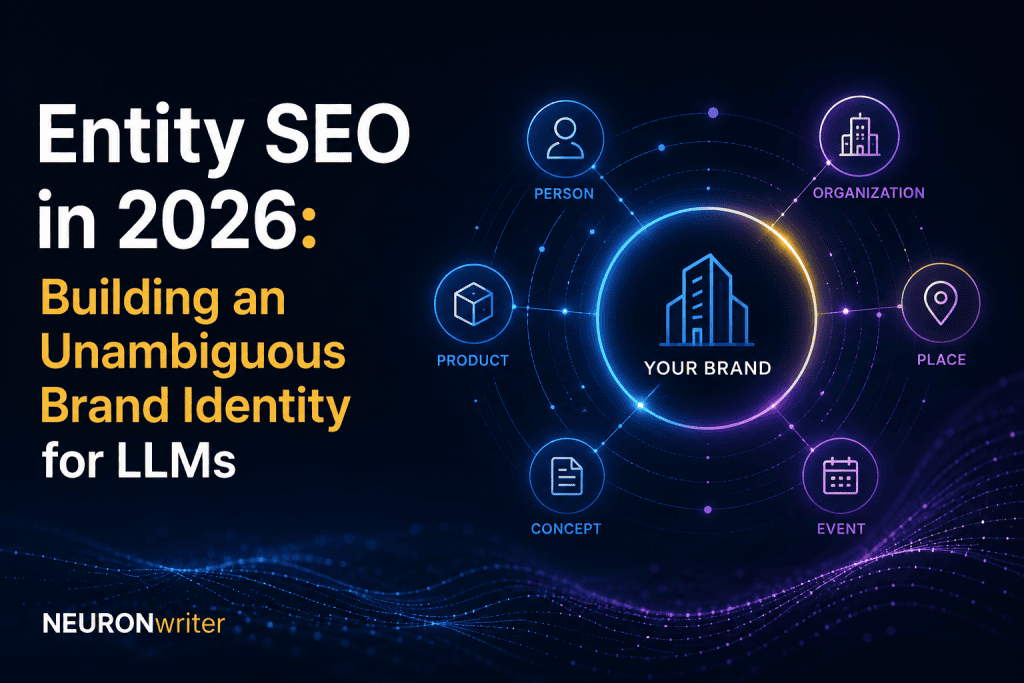
Entity SEO is the practice of making your brand recognizable as a single, well-defined “thing” an entity rather than a string of keywords, so that search engines and large language models can identify it correctly and connect it to the right facts.
Where classic SEO optimizes for the words someone types, entity SEO optimizes for whether Google’s knowledge graph and models like ChatGPT or Gemini actually know who you are.
Entity SEO vs. semantic SEO vs. traditional SEO
Entity SEO is a specific piece of the broader semantic SEO discipline, not a separate competing strategy. Semantic search and semantic SEO focus on meaning and the semantic relationships between topics generally how concepts connect to each other across a whole site or industry.
Entity SEO narrows that down to one specific question: is this one brand, product, or concept defined clearly and consistently enough for a search engine or an AI system to recognize it as a single, defined thing?
Traditional SEO and traditional search still matter underneath all of this a page that ranks well in Google search results and appears in AI Overviews already has a visibility advantage, since AI systems and AI models frequently draw on the same underlying pages that already rank in modern search.
Entity SEO, semantic SEO, and generative engine optimization overlap more than they compete: strong entity signals feed semantic understanding, which in turn feeds how an AI answer gets constructed and which sources it draws on.
Entities vs. keywords: why this distinction matters now
A keyword is a string of text; an entity is a real-world thing a person, company, product, or concept that a search engine or LLM stores as a node with attributes and relationships, not just a matched phrase.
Google’s Knowledge Graph has worked this way for over a decade, but it matters more now because large language models do something similar internally: when ChatGPT or Perplexity is asked about your brand, it isn’t searching a live index of your site, it’s recalling a model of your brand built (partly) from training data and (partly) from retrieval.
If that model is confused, incomplete, or inconsistent, the LLM either says nothing about you, or says something wrong.
How search engines and LLMs interpret an entity
Search engines interpret an entity through named entity recognition a natural-language processing step that pulls out people, organizations, products, and places from text and tries to define the entity by matching it to something already in a knowledge graph or, failing that, building a new node for it.
Modern search engines like Google combine this with signals from Google Search Console and off-site corroboration to decide how confidently they can label a mention as referring to your specific brand rather than a similarly-named one.
LLMs do something conceptually similar but less transparent: it’s harder to say exactly how a given model forms its internal picture, but the practical result is the same the clearer and more consistent your entity signals are, the easier it is for LLMs to understand who you are, and the more confidently an AI-driven search feature or an AI-powered search assistant can cite you by name instead of describing you vaguely or not at all.
This is also why entity optimization and entity coverage across a whole content library compound over time: a single well-defined page rarely moves the needle on its own, but a site where every page reinforces the same entity mapping starts to look, from a model’s perspective, like a source worth trusting.
Entity types worth mapping for your brand
Not every entity on your site carries equal weight. Prioritize mapping these first:
- The organization itself — your company as a single, named entity with a canonical definition, founding details, and off-site corroboration.
- Core products or services — each treated as its own defined entity connected back to the parent organization, not folded anonymously into general company copy.
- Key people — founders, named experts, or spokespeople whose consistent bios and credentials reinforce entity authority for both the individual and the company.
- Location or market entities — relevant for local SEO specifically, where a business’s name, address, and category need the same consistency across every directory listing.
Treat entity connections between these as part of the map too the founder entity should connect to the organization entity, which connects to the product entities, rather than each existing as an island search engines and LLMs have to reconstruct on their own.
Why ambiguity is the real enemy of entity SEO
Ambiguity, not absence, is usually the actual problem. A brand rarely fails at entity SEO because nothing was ever written about it it fails because different pages, bios, and directory listings describe it in slightly different, inconsistent ways: one page calls the product a “platform,” another calls it a “tool,” a third uses an old company name that was rebranded two years ago.
A model trying to build a coherent picture of a defined entity from scattered, inconsistent signals often just picks the most common version it saw, which may not be the one you want repeated back to a buyer.
Building an unambiguous entity: 4 steps
Entity clarity comes down to giving every source your own site and everything off it the same consistent answer to “what is this, exactly?”
Step 1: Write one canonical definition, and reuse it everywhere
Draft a single, precise sentence that defines what your brand or product is, and use that exact definition not a rephrased version on your About page, your product page, your press kit, and anywhere else you control.
Consistency matters more than elegance here: a model that sees the same definition repeated across sources treats it as a corroborated fact, while five different phrasings of the same idea read as five weaker, uncorroborated signals.
Step 2: Keep naming and aliases consistent on-site and off-site
If your product used to have a different name, or if people commonly refer to it by a nickname or abbreviation, state that explicitly (“NEURONwriter, formerly known as…”) rather than letting old and new names float around unlinked.
The same discipline applies off-site: your G2 listing, Crunchbase profile, LinkedIn page, and any directory entries should use the same canonical name and description, not independently-written variants.
Step 3: Add schema markup that links to your canonical profiles
Organization or Product schema with a sameAs property pointing to your Wikidata entry, Crunchbase profile, or verified social accounts gives search engines and AI crawlers a direct, machine-readable link between your on-page content and your identity elsewhere on the web.
This doesn’t replace the written definition it corroborates it in a format a machine can parse without inferring anything.
Step 4: Make entity relationships explicit, not implied
State the connections between your brand and related concepts directly: product → the specific benefits it delivers → the use cases it’s built for → the constraints or limitations that are also true.
A page that only lists features and assumes the reader will infer the relationships is asking an LLM to guess at exactly the kind of connection entity SEO exists to make explicit.
| Ambiguous (before) | Unambiguous (after) |
| Three different pages calling the same product a “tool,” a “platform,” and a “suite” | One canonical definition — “an SEO content optimization platform” — repeated identically across every page and off-site profile |
| A features list with no stated relationships between them | An explicit line: “This feature helps [specific use case] by [specific mechanism]” |
Off-page entity signals still matter
On-page consistency only goes so far a knowledge graph and an LLM’s internal model of your brand both draw heavily on sources you don’t directly control.
A defined entity in Wikidata, a complete and accurate Crunchbase profile, consistent bios across G2, Capterra, and industry directories, and press coverage that uses your canonical name rather than a dated or informal variant all reinforce the same identity from independent angles.
This is also where brand mentions even without a link start to matter almost as much as backlinks, since a model doesn’t distinguish a linked mention from an unlinked one the way a classic search engine ranking algorithm does.
Measuring entity SEO success
Ask several LLMs directly: “What do you know about [your brand] in the context of [your category]?” and compare what comes back against your intended canonical definition and against what competitors get.
Track this monthly rather than once entity salience (how strongly a model associates a given topic with your brand specifically) shifts as models retrain and re-crawl the web, so a single good answer today doesn’t guarantee the same answer next quarter.
If you want to check whether this work is actually translating into citations, our checklist for checking if ChatGPT or Perplexity is citing your site walks through exactly that verification step, engine by engine.
Common mistakes in entity SEO
- Treating entity SEO as a one-time project. Definitions drift as products change; a canonical definition written two years ago and never revisited quietly becomes another inconsistent source.
- Fixing on-page content but ignoring off-page profiles. A perfectly consistent website next to an outdated Crunchbase listing or a stale G2 bio still leaves the model with conflicting inputs.
- Confusing entity SEO with keyword stuffing a brand name. Repeating your brand name doesn’t create entity clarity — a precise, consistent definition and explicit relationships do.
- Assuming schema alone is enough. Structured data corroborates a written definition; it doesn’t substitute for having one.
How this connects to writing atomic paragraphs
Entity clarity and paragraph-level writing are the same discipline applied at different scales. Our guide on the Atomic Answer Framework covers Rule 3 making every paragraph self-contained by naming the subject directly instead of relying on pronouns like “it” or “this.” That rule is entity SEO in miniature: a paragraph that says “NEURONwriter AI-Tracking does this by…” instead of “It does this by…” reinforces the same unambiguous identity a retrieval system or LLM is trying to build, one sentence at a time.
Put simply, entity-based SEO focuses on making your brand easier for LLMs and search engines alike to parse correctly it’s not a niche add-on to optimize for search in general, it’s the layer that determines whether your visibility in AI search and visibility in LLMs actually reflects who you are.
Search engines understand entities through structured, corroborated signals; LLMs understand them through consistent repetition across the sources they were trained on or retrieve from.
Get both right, and brand entities that would otherwise be scattered across the search landscape start reading as one coherent thing to Google and LLMs alike which is the entire point of optimizing for AI visibility in the first place.
FAQ
What is entity SEO and how does it differ from traditional keyword-based SEO?
Entity SEO optimizes for how search engines and LLMs represent your brand as a defined “thing” with consistent attributes and relationships, rather than for the specific words someone types into a search box. Traditional keyword SEO targets phrases; entity SEO targets a coherent, corroborated identity.
How do large language models use entities for ranking and understanding content?
LLMs build an internal model of a brand or topic from training data and retrieval, then draw on that model to answer questions a process closer to recall than live lookup. Consistent, well-corroborated entity signals make that internal model more accurate and more likely to be cited correctly.
What are the key steps for optimizing content for entity-based SEO?
Write one canonical definition and reuse it everywhere, keep naming and aliases consistent on-site and off-site, add schema markup with sameAs links to verified profiles, and make relationships between your brand and related concepts explicit rather than implied.
How can schema markup improve entity recognition and AI search visibility?
Organization or Product schema with a sameAs property gives search engines and AI crawlers a direct, machine-readable link between your page and your verified identity elsewhere (Wikidata, Crunchbase, social profiles), corroborating your written definition in a format a machine doesn’t have to infer.
How do I measure the success of an entity-based SEO strategy?
Ask multiple LLMs directly what they know about your brand in context, compare the answer against your canonical definition and against competitors, and repeat this monthly entity salience shifts over time as models retrain, so a single check only tells you where you stand today.
What is the role of knowledge graphs in entity SEO?
A knowledge graph, like Google’s, stores entities as nodes with attributes and relationships rather than as indexed strings; appearing correctly and consistently in that graph (and in comparable structures LLMs build internally) is largely what entity SEO is trying to achieve.
What is the difference between entity SEO and semantic SEO?
Semantic SEO is the broader practice of optimizing content around meaning, topics, and relationships rather than isolated keywords; entity SEO is a specific piece of that focused on how a single brand, product, or concept is defined and recognized as a distinct entity across sources.
What are common mistakes to avoid when implementing entity SEO?
Treating it as a one-time project instead of an ongoing consistency check, fixing on-site content while ignoring outdated off-site profiles, mistaking repeated brand-name mentions for actual clarity, and relying on schema markup alone without a clear written definition behind it.
Is entity SEO the same thing as SEO and AEO for the LLM era?
Not exactly entity SEO, AEO (answer engine optimization), and GEO all overlap heavily and reinforce each other, but entity SEO specifically targets brand and topic clarity, while AEO and GEO focus more broadly on structuring content to be extracted and cited as an answer. Optimize for entities as the foundation; the rest builds on top of it.
How do entities affect local SEO?
For a local business, the core entity work is name, address, category, and description consistency across Google Business Profile and every directory that lists you the same canonical-definition discipline described above, applied to a physical-location entity instead of a product entity.
What tools help with entity SEO?
General SEO tools that surface schema errors and site-wide inconsistencies help on the technical side, and Google Search Console can show which queries and pages Google already associates with your entity. Beyond that, the most useful “tool” is simply asking several LLMs directly what they know about you and comparing the llm responses against your intended definition.
Is entity SEO the same as LLM SEO?
They overlap substantially LLM SEO is the broader practice of optimizing for how large language models find, understand, and cite content, and entity SEO is the specific technique inside it that makes a brand’s identity unambiguous. Doing entity work well is one of the things that most directly helps search engines and makes content easier for LLMs to cite correctly.