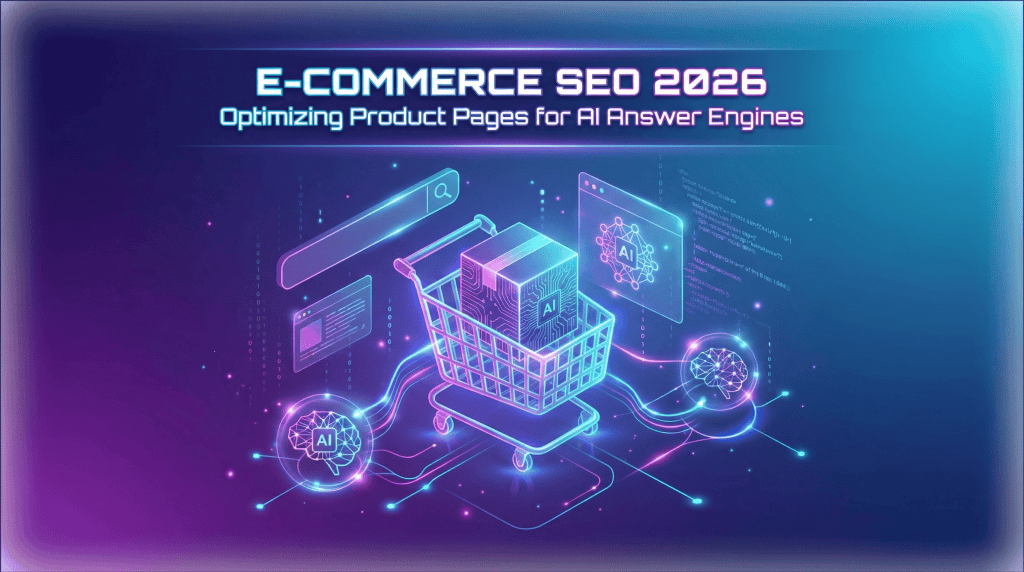
E-commerce SEO 2026: Optimizing Product Pages for AI Answer Engines.
For a brief period, e-commerce seemed immune to the disruption of generative AI search. In late 2024, data showed that Google AI Overviews appeared on barely 2% of transactional queries, leading many retailers to believe that traditional product page SEO was safe.
That protective narrative has collapsed. By early 2026, the landscape of e-commerce search fundamentally shifted. A comprehensive analysis of nearly 21 million shopping keywords revealed that Google AI Overviews now appear on 14% of all shopping queries a staggering 5.6x increase in just four months.
For e-commerce brands, the zero-click SERP is no longer just a problem for informational blogs; it is a direct threat to product discovery and revenue. However, it is also a massive opportunity. Brands that successfully secure citations within these AI Overviews are seeing a 35% increase in organic clicks compared to brands that are not cited.
This guide provides a data-backed playbook for e-commerce SEO in 2026. We will explore how Google’s AI decides which products to feature, why the intent behind the query matters more than ever, and the specific optimizations your product pages need to rank in the age of Answer Engine Optimization (AEO).
The Intent Divide: How AI Overviews Filter Shopping Queries.
The most strategically important finding in 2026 e-commerce data is that Google is not applying AI Overviews randomly. The algorithm uses strict query intent to determine when a generative summary is useful and when it is an obstacle to conversion.
Understanding this intent divide is the first step in optimizing your e-commerce strategy:
- Informational/Comparison Queries (“best air fryer”): AI Overview presence skyrocketed to 83% in 2026 (up from 5% the prior year). If your strategy relies on ranking category pages or buyer’s guides for “best” keywords, you are now competing directly with an AI-generated roundup that occupies the top of the SERP.
- Transactional Queries (“buy air fryer”): AI Overview presence remained flat at 13%. Google recognized that when a shopper is ready to buy, generative text gets in the way. Traditional product listing ads and organic blue links still dominate here.
- Pure Product Name Queries (“Ninja Air Fryer Max”): AI presence is also relatively low at 14%. This means the battleground for e-commerce SEO has shifted to the mid-funnel. Shoppers researching features, comparing options, or seeking recommendations are being intercepted by AI Overviews. If your product is not recommended by the AI in that crucial research phase, the shopper will never reach your transactional page.
Category Disruption: Who is Affected Most?
The impact varies wildly by industry. Categories where text-based comparison, explanation, and instruction guide purchase decisions see massive AI Overview retention.
- Grocery and Food: Grew from 5% to 49% AI presence (queries blending shopping with recipes/nutrition).
- Electronics (TVs, Laptops): Expanded from 9% to 24%.
- Apparel and Furniture: Remained largely flat (around 2-11%), as these are highly visual, high-touch categories where shoppers need photos and dimensions, not generative text.
The 4-Step Playbook for Product Page AEO.
Traditional SEO focused on keywords, backlinks, and site speed. Answer Engine Optimization (AEO) for e-commerce focuses on machine readability, structured data perfection, and semantic entities.
To get your product cited by Google AI Overviews, Perplexity, or ChatGPT, you must structure your product pages for LLM extraction.
1. Write Answer-First Product Descriptions.
AI engines do not want to read marketing fluff; they want dense, factual information. When an LLM scans a product page to answer a user’s query (e.g., “Which running shoe is best for wide feet?”), it looks for explicit, undeniable facts.
- Front-load the specifications: Place the most critical data (dimensions, materials, compatibility, weight) immediately below the product title.
- Use declarative language: Instead of “Experience the ultimate comfort on your morning jog,” write “The XYZ Shoe features a 4E wide toe box and dual-density foam designed for wide feet.”
- Incorporate Q&A formats: Add a dedicated FAQ section directly on the product page addressing common pre-purchase objections. This format mirrors how LLMs are trained to process information.
2. Perfect Your Schema Markup and Product Feeds.
In 2026, structured data is the primary language of AI search. If an AI agent cannot instantly parse your product’s price, availability, and reviews via JSON-LD, it will skip your page and cite a competitor. For a deeper dive into the most important schema types for AI visibility, see our guide to schema markup for AI agents.
- Comprehensive Product Schema: Go beyond the basics. Ensure your Product schema includes brand, material, color, audience, and aggregateRating.
- Variant Consistency: Ensure that the product variants (size, color) match exactly across the page HTML, your JSON-LD schema, and your Google Merchant Center feed. Discrepancies here cause AI engines to lose trust in the data accuracy. For catalogs with hundreds of SKUs, maintaining this level of data purity manually is nearly impossible, making a centralized product information management system critical for keeping variant data standardized across all channels.
- Merchant Center Integration: A fully optimized, error-free Google Merchant Product Feed is mandatory. Google AI Overviews pull heavily from the Shopping Graph, which is fed directly by Merchant Center data.
3. Leverage Authentic User-Generated Content (UGC)
AI engines are programmed to seek out real human experiences to satisfy E-E-A-T (Experience, Expertise, Authoritativeness, Trustworthiness) guidelines. Product reviews are no longer just for conversion rate optimization; they are raw data for AI summaries.
- Extractable Reviews: Ensure your reviews are indexable text, not locked behind JavaScript widgets that crawlers cannot parse.
- Encourage Specificity: Incentivize customers to mention specific use cases in their reviews (e.g., “This laptop backpack perfectly fits my 16-inch MacBook Pro and my gym clothes”). AI engines scrape these specific use cases to answer highly tailored long-tail queries.
4. Build Entity Authority with Expert Content.
AI engines cite brands they recognize as authoritative entities within a specific niche. A standalone product page is rarely enough; it needs to be supported by a web of expert content.
Create detailed buyer’s guides, comparison charts, and “how-to-use” articles on your blog that internally link back to your product pages. This establishes your domain as the definitive source of truth for that product category a concept known as topical authority increasing the likelihood that an AI Overview will cite your brand as the expert source.
How NEURONwriter Drives E-commerce SEO.
Navigating the transition from traditional e-commerce SEO to Answer Engine Optimization requires precision. NEURONwriter provides the semantic intelligence needed to structure your product pages for AI extraction.
1.Semantic Entity Optimization: NEURONwriter analyzes top-ranking content to identify the exact entities, terms, and specifications that AI engines associate with your product category. Including these terms ensures your product page speaks the language the algorithm expects.
2.Competitor Gap Analysis: By analyzing what your competitors are missing, NEURONwriter helps you identify the “Information Gain” opportunities. Adding unique, factual data that competitors lack makes your product page highly citable by AI Overviews.
3.Structuring for Readability: NEURONwriter content editor guides you in structuring your product descriptions with logical H2/H3 hierarchies, ensuring that LLMs can easily parse and extract your product features.
FAQ
Will AI Overviews steal traffic from my e-commerce site?
It depends on the query intent. For informational “best of” queries, CTRs are dropping. However, data shows that brands cited within the AI Overview receive 35% more organic clicks than those that are not. The goal is no longer just ranking in the blue links; it is securing the AI citation.
Do I still need traditional SEO for my product pages?
Yes. AEO is an evolution of SEO, not a replacement. Technical accessibility, fast load times, and high-quality backlinks are still required for Google to discover and trust your site before it will consider citing you in an AI Overview.
How important is Google Merchant Center for AI Overviews?
It is critical. Google’s Shopping Graph, which powers the product recommendations within AI Overviews, relies heavily on the structured data provided via Google Merchant Center feeds.
Should I use AI to write my product descriptions?
You can use AI for drafting, but you must heavily edit and humanize the content. Google’s 2026 standards penalize generic, overly paraphrased content. Focus on injecting proprietary data, specific dimensions, and real-world use cases that AI cannot generate on its own.
How do I optimize category pages for AI search?
Category pages should act as comprehensive hubs. Include buying guides, filtering options, and FAQ sections at the bottom of the category page to answer the informational queries that trigger AI Overviews.