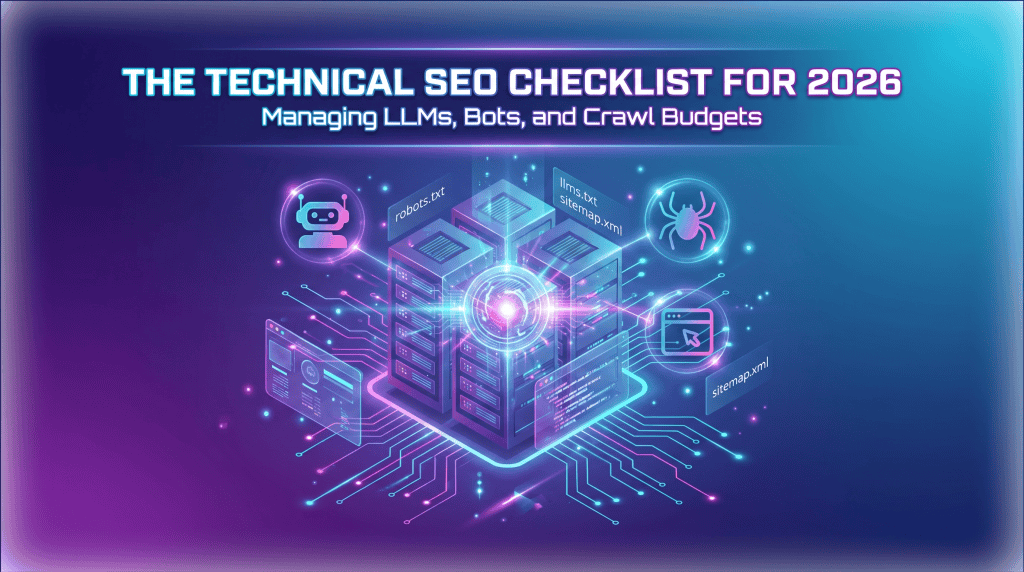
The Technical SEO Checklist for 2026: Managing LLMs, Bots, and Crawl Budgets
For decades, technical SEO was a relatively straightforward discipline. The primary objective was to ensure that a single dominant search engine Google could crawl, render, and index your website with
out encountering significant errors. You managed your robots.txt file, monitored your XML sitemaps, and optimized your Core Web Vitals. If the Googlebot could access your content efficiently, your technical foundation was considered solid.
In 2026, that foundational assumption has been entirely upended. The search landscape is no longer a monopoly; it is a highly fragmented ecosystem populated by traditional search engines, generative answer engines, and autonomous AI agents. The bots crawling your site today are not just indexing links; they are actively reading, extracting, and synthesizing your content to train Large Language Models (LLMs) or to provide immediate answers in zero-click interfaces.
This shift has created an unprecedented strain on server resources and fundamentally altered the rules of technical accessibility. Managing your crawl budget is no longer just about helping Google; it is about controlling a vast array of machine visitors, each with different roles and intentions. This comprehensive technical SEO checklist for 2026 will guide you through the new realities of bot management, infrastructure optimization, and semantic structuring required to thrive in an AI-first web.
The New Bot Landscape: Understanding Machine Roles in 2026.
The most significant change in technical SEO is the diversification of web crawlers. Previously, SEO professionals maintained a simple list of “good bots” (like Googlebot and Bingbot) and “bad bots” (scrapers and spam). Today, major technology vendors operate multiple bots, each assigned a highly specific function. Understanding these distinct roles is the first step in regaining control over your technical infrastructure.
According to recent analyses of the AI crawler landscape, the governance of machine access now requires categorizing bots into specific families based on their operational purpose. A single vendor, such as OpenAI or Google, may utilize entirely different user agents depending on whether they are indexing for search, collecting data for model training, or executing a user-triggered action.
The Four Primary Families of Machine Access.
To effectively manage your server resources and protect your intellectual property, you must differentiate between the following types of machine visitors:
- Search and Discovery Crawlers: These are the traditional bots, such as Googlebot and Applebot. Their primary function is to discover content and add it to a searchable index. Allowing these bots access is essential for visibility in standard search results and traditional discovery surfaces.
- Training Data Collectors: These crawlers, including GPTBot (OpenAI), ClaudeBot (Anthropic), and Google-Extended, are designed specifically to scrape content for the purpose of training future iterations of Large Language Models. They do not directly drive traffic to your site; their sole purpose is data acquisition.
- Answer and Retrieval Systems: These bots operate closer to the query time. Systems like OAI-SearchBot or Claude-SearchBot fetch information to ground AI-generated answers in real-time. They are crucial for visibility in platforms like ChatGPT Search or Perplexity, where being cited as a source is the new equivalent of ranking on page one.
- User-Triggered Agents: This is a rapidly growing category of traffic generated by autonomous AI agents acting on behalf of a human user. When a user instructs an AI to “research the best CRM software,” the resulting traffic (often identified by agents like ChatGPT-User) behaves differently than a standard crawl. These agents require rapid access to specific data points and may bypass traditional navigation structures.
If you are still treating all “AI bots” as a single entity, your technical strategy is fundamentally flawed. You must decide which families of access align with your business goals and configure your server controls accordingly.
Optimizing Crawl Budget for the AI Era.
Crawl budget the number of URLs a search engine is willing and able to crawl on your site within a specific timeframe has always been a critical metric for enterprise websites. In 2026, it is a critical metric for everyone. The explosion of AI crawlers means that your server is fielding exponentially more requests than it was just a few years ago.
If your server becomes bogged down by training bots scraping your archives, it may respond slowly when Googlebot or a real-time retrieval system attempts to access your newly published flagship article. This leads to delayed indexing and lost visibility in fast-moving AI Overviews. Optimizing your crawl budget is now an exercise in aggressive resource allocation.
1. Audit Your Server Logs for AI Bot Activity.
You cannot manage what you do not measure. The first item on your technical checklist must be a comprehensive analysis of your server logs. Do not rely solely on Google Search Console; it will not show you the bandwidth consumed by Anthropic or Perplexity.
Analyze your logs to quantify the real load generated by specific user agents. Identify which bots are hitting your site most frequently and which sections of your site they are targeting. You will likely find that training crawlers are disproportionately consuming resources by repeatedly scraping low-value pages or legacy content.
2. Implement Aggressive Pruning and Consolidation.
Every page on your website that offers little to no value is a drain on your crawl budget. In the past, leaving thin content live was merely bad practice; today, it is a technical liability. AI crawlers do not discern between your high-converting landing pages and your outdated 2018 blog posts they will consume server resources to read both.
Implement a rigorous content pruning strategy to identify and remove underperforming assets. Consolidate overlapping articles, redirect outdated resources to current guides, and ruthlessly noindex tag pages, author archives, and faceted navigation parameters that create infinite URL combinations. A leaner, highly concentrated site architecture ensures that when bots do visit, they spend their allocated time on your most important content.
3. Control Access with Advanced Robots.txt Directives.
The robots.txt file remains your primary defense against unwanted crawling, but its application has become much more nuanced. You must move beyond simple Allow and Disallow commands for major search engines and begin explicitly targeting the different families of AI bots.
If your goal is to maximize visibility in AI answer engines while protecting your proprietary data from being absorbed into training models without compensation, your robots.txt strategy must reflect that. Many publishers are now explicitly blocking training crawlers like GPTBot and ClaudeBot while allowing retrieval systems like OAI-SearchBot to ensure their content can still be cited in real-time conversational search.
The Rise of llms.txt: Structuring Content for Agents.
While robots.txt tells bots where they cannot go, a new protocol has emerged in 2026 to tell AI agents exactly where they should go and how to read the information they find. The llms.txt file is rapidly becoming a standard requirement for technical SEO.
If you have not yet implemented this protocol, you are putting your content at a significant disadvantage. To understand the full technical specifications and strategic implementation of this file, refer to our comprehensive guide: What is llms.txt? The New Technical SEO Standard for AI Crawlers.
Moving from Human Readability to Machine Extractability.
Traditional technical SEO focused heavily on visual rendering ensuring that CSS and JavaScript loaded correctly so the page looked good to a human user. While Core Web Vitals remain important for user experience, AI agents do not care about your site’s aesthetic design. They care about semantic structure and extractability.
When an AI agent accesses your page, it strips away the design and attempts to parse the underlying relationships between the entities you are discussing. If your HTML is cluttered with nested div tags and lacks clear semantic markup, the agent will struggle to understand the context of your content, reducing the likelihood that you will be cited as an authoritative source.
Implement Comprehensive Semantic Markup.
To ensure your content is easily digestible by AI, you must utilize semantic HTML5 elements (<article>, <section>, <aside>, <nav>) correctly. More importantly, your implementation of structured data must go beyond the basics.
In 2026, AI agents rely heavily on Schema.org markup to quickly categorize information without needing to process the entire text of a page. You must move beyond simple Article schema and implement nested, highly descriptive markup that clearly defines the entities on your page and their relationships to one another. For a detailed breakdown of the specific tags required, read our guide on Schema Markup for AI Agents.
How NEURONwriter Future-Proofs Your Technical Content Strategy.
Managing the technical complexities of the 2026 search landscape requires more than just server-side tweaks; it requires a fundamental shift in how you structure the content itself. This is where NEURONwriter becomes an indispensable part of your technical SEO workflow.
NEURONwriter is engineered to bridge the gap between human readability and machine extractability. While you focus on creating high-quality, engaging text, NEURONwriter ensures that the underlying semantic structure is perfectly aligned with the expectations of modern AI crawlers and answer engines.
By utilizing advanced Natural Language Processing (NLP) algorithms, NEURONwriter analyzes the top-performing content in your niche and provides highly specific recommendations for entity inclusion and semantic relationships. It guides you to naturally incorporate the terms and concepts that AI models associate with topical authority. Furthermore, NEURONwriter robust content structuring tools help you build clear, logical hierarchies—using optimal H2 and H3 tags that make it effortless for both traditional bots and autonomous agents to parse your information, ultimately maximizing your crawl budget efficiency and boosting your visibility across all search surfaces.
FAQ: Technical SEO in 2026
What is the difference between Googlebot and Google-Extended?
Googlebot is the traditional crawler used to discover and index pages for Google Search. Google-Extended is a separate user agent used to collect data specifically for training Google’s generative AI models, such as Gemini. Blocking Google-Extended in your robots.txt prevents your data from being used for training, but it does not affect your visibility in standard Google Search results.
Does crawl budget really matter for small websites?
In the past, crawl budget was primarily a concern for sites with millions of pages. However, in 2026, the sheer volume of AI bots scraping the web means that even small sites can experience server strain. Optimizing your site architecture and blocking unnecessary training bots ensures that your server responds quickly when important indexing bots visit.
Will blocking AI bots hurt my SEO rankings?
Blocking training bots (like GPTBot) will not hurt your traditional SEO rankings on Google. However, if you block retrieval bots (like OAI-SearchBot), you will not appear as a cited source in platforms like ChatGPT Search. It is crucial to understand the role of each bot before applying blocks in your robots.txt file.
Do I still need an XML sitemap if I have an llms.txt file?
Yes. XML sitemaps are still essential for traditional search engines like Google and Bing to discover all the indexable URLs on your site. The llms.txt file serves a different purpose: it provides a clean, markdown-based directory of your most important, fact-dense content specifically designed for AI agents to read and process quickly.
How does page speed impact AI crawlers?
While AI agents do not “see” your page design, they are highly sensitive to server response times. If your Time to First Byte (TTFB) is slow, an AI agent attempting to retrieve information in real-time to answer a user’s query will likely abandon the request and pull data from a faster competitor.