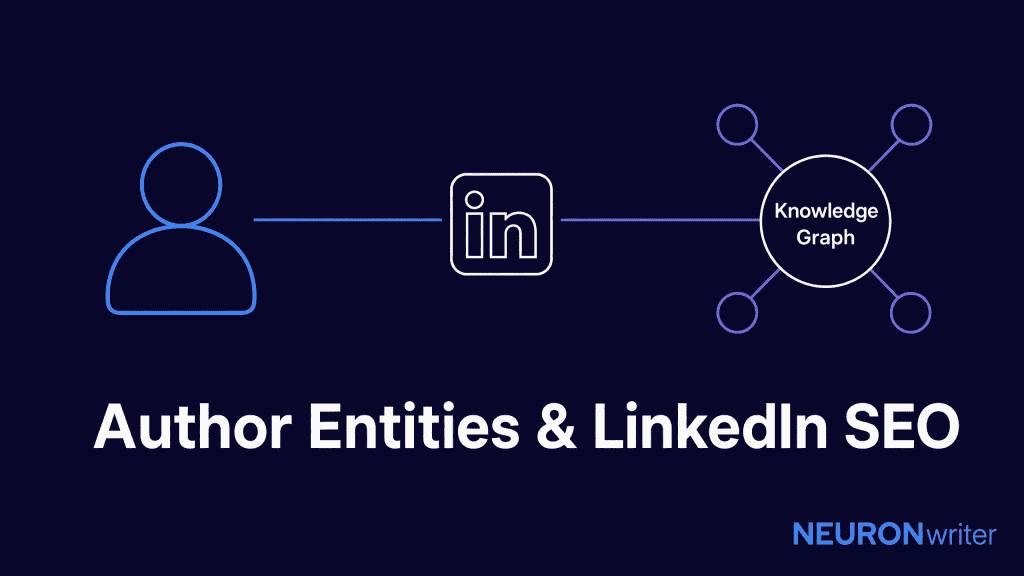
Author Entities: How to Connect Your LinkedIn Profile to Your SEO Strategy.
📍 Semantic Summary
- Idea: In 2026, search engines do not just index web pages; they index entities. An author is an entity (a person ) within Google’s Knowledge Graph. Connecting your content to a verified author entity is critical for establishing E-E-A-T (Experience, Expertise, Authoritativeness, and Trustworthiness).
- Challenge: Many websites publish content under generic bylines or fail to provide the machine-readable signals necessary for Google to recognize the author as a distinct, credible expert. Without these signals, your content is vulnerable to being outranked by AI-generated fluff or ignored by AI search engines.
- Summary: To build a robust author entity, you must connect your website’s author bio pages to authoritative external profiles specifically LinkedIn using Person schema and the sameAs property. By using NEURONwriter to optimize your content semantically and structuring your author data correctly, you prove to Google that a real, verified industry expert stands behind your content.
Read the full guide below, or explore related topics: B2B Thought Leadership SEO · Topical Authority Guide · The Complete Guide to AI Search Optimization (AEO)
In the age of generative AI, content is infinite. Anyone can generate a 2,000-word article on any topic in seconds. Because of this, Google and AI search engines like Perplexity have fundamentally shifted how they evaluate quality. They no longer ask just “What does this page say?” They ask, “Who wrote this, and why should we trust them?”
This shift is the core of Google’s E-E-A-T framework. However, algorithms cannot simply read a name at the top of a page and intuitively understand that person’s expertise. They require structured, verifiable data. They need to recognize the writer as an Author Entity within the Knowledge Graph. If your SEO strategy in 2026 does not include building and verifying author entities, you are leaving your content vulnerable. Here is how to connect your professional presence specifically your LinkedIn profile to your SEO strategy to build an unbreakable trust moat.
What is an Author Entity?
An entity is a unique, distinct, and well-defined thing or concept. In SEO, an entity can be a place, a brand, an abstract concept, or a person
Google’s Knowledge Graph is a massive database of over 800 billion facts about 5 billion different entities, and the relationships between them. When Google recognizes a specific human being as an expert in a particular field, that person becomes an Author Entity. “Google recognizes author entities by associating content with known individuals… When search engines identify a creator, they can better assess the reliability and credibility of the source, especially in the context of E-E-A-T.” — SEO Clarity
If you write about “B2B SaaS Marketing,” Google wants to know if you are a recognized entity in that space. Do you have a track record? Do other authoritative sites mention you? Do you have a verified professional history?
Why LinkedIn is the Ultimate Verification Source.
To verify an author entity, Google looks for external corroboration. It needs a digital resume that confirms your real-world expertise. In 2026, the most powerful verification source for B2B and professional niches is LinkedIn.
LinkedIn serves as an independent, high-authority database of professional credentials. When your website claims that your author has 15 years of experience in cybersecurity, Google looks to LinkedIn to verify that claim.
Furthermore, as discussed in our guide on B2B Thought Leadership SEO, LinkedIn is now one of the primary data sources cited by AI search engines. By tightly coupling your website’s author profile with an active LinkedIn presence, you feed the algorithms a consistent, verifiable loop of expertise.
How to Connect LinkedIn to Your SEO Strategy Using Schema.
You cannot rely on Google to accidentally figure out that the “Jane Doe” who wrote your blog post is the same “Jane Doe” who is a VP of Marketing on LinkedIn. You must explicitly tell the search engine using structured data specifically, Person Schema.
Here is the exact workflow to establish your author entity:
Step 1: Create a Dedicated Author Bio Page.
Every author on your website needs a dedicated URL (e.g., yourdomain.com/author/jane-doe). This page should serve as the central hub for that entity on your domain. It must include:
- A detailed biography highlighting specific experience and credentials.
- Links to all articles written by the author on your site.
- Links to the author’s external publications.
- A direct link to the author’s LinkedIn profile.
Step 2: Implement Person Schema with the sameAs Property.
The magic happens in the code. You must add JSON-LD Person schema to the author bio page. Within this schema, the sameAs property is the most critical element.
The sameAs property explicitly tells Google: “The person described on this page is the exact same entity as the person found at these external URLs.”
Here is a simplified example of how this looks:
JSON
{ “@context”: “https://schema.org”, “@type”: “Person”, “name”: “Jane Doe”, “jobTitle”: “VP of Marketing”, “worksFor”: { “@type”: “Organization”, “name”: “Your Company Name” }, “url”: “https://yourdomain.com/author/jane-doe”, “sameAs”: [ “https://www.linkedin.com/in/janedoe-marketing”, “https://twitter.com/janedoe” ] }
By including the LinkedIn URL in the sameAs array, you bridge the gap between your domain and the Knowledge Graph.
Step 3: Link Articles to the Author Entity.
Finally, on every blog post written by Jane, you must use Article or BlogPosting schema. Within that schema, set the author property to reference the dedicated author bio page URL (using the @id property ). This creates a closed loop: The article is linked to the author page, and the author page is linked to the verified LinkedIn entity.
Combining Author Entities with NEURONwriter.
Establishing an author entity proves who you are, but you still need to prove what you know.
Even a verified expert will struggle to rank if their content lacks semantic depth. This is where NEURONwriter completes the strategy.
When your verified SME (Subject Matter Expert) writes an article, run their draft through the NEURONwriter Content Editor. NEURONwriter analyzes the top-ranking competitors and provides the exact NLP (Natural Language Processing) terms and related entities that Google expects to see in a comprehensive answer.
By combining a verified Author Entity (via LinkedIn and Person schema) with high Semantic Density (via NEURONwriter), you send the strongest possible signal to modern search algorithms: This content is written by a real expert, and it covers the topic more thoroughly than anyone else.
FAQ.
Q1: What is an Author Entity?
A: An author entity is a recognized, distinct individual within a search engine’s Knowledge Graph. Instead of just seeing a text string of a name, the search engine understands the person as a verifiable node with specific expertise, credentials, and relationships to other entities.
Q2: Why is authorship important for SEO in 2026?
A: With the proliferation of AI-generated content, search engines prioritize E-E-A-T (Experience, Expertise, Authoritativeness, and Trustworthiness). Verifiable authorship proves that a real human with actual experience stands behind the content, making it more trustworthy to both algorithms and users.
Q3: How does LinkedIn help my SEO?
A: LinkedIn acts as a highly authoritative, independent verification source for professional credentials. By linking your website’s author profile to your LinkedIn profile, you provide Google with the proof it needs to verify your real-world experience and establish your author entity.
Q4: What is Person schema?
A: Person schema is a type of structured data (usually written in JSON-LD) that you add to a webpage’s code. It explicitly tells search engines detailed information about an individual, such as their name, job title, employer, and external profiles.
Q5: What is the sameAs property in schema markup?
A: The sameAs property is used within schema markup to link an entity on your website to a verified external representation of that same entity. For authors, you use sameAs to link your author bio page to your LinkedIn, Twitter, or Wikipedia profiles.
Q6: Do I need a dedicated author bio page?
A: Yes. A dedicated author bio page serves as the central hub for your author entity on your domain. It is where you should place your comprehensive Person schema and link out to your external verification sources like LinkedIn.
Q7: How does NEURONwriter fit into an author entity strategy?
A: While an author entity proves your credentials, NEURONwriter ensures your content demonstrates actual semantic expertise. NEURONwriter helps you include the necessary NLP terms and related entities in your writing, proving to algorithms that your verified expert has covered the topic comprehensively.