
Purpose and Marketing Positioning
The Overview module is the executive dashboard for AI Visibility Monitoring. It translates many individual AI search checks into a concise set of visibility indicators that marketing teams can read quickly and use to decide whether the brand is gaining or losing attention in AI-generated answers. Instead of reviewing every monitored prompt manually, users can start here to understand the overall position of the brand across AI answer environments such as AI Overviews, AI Mode, ChatGPT, and Perplexity.
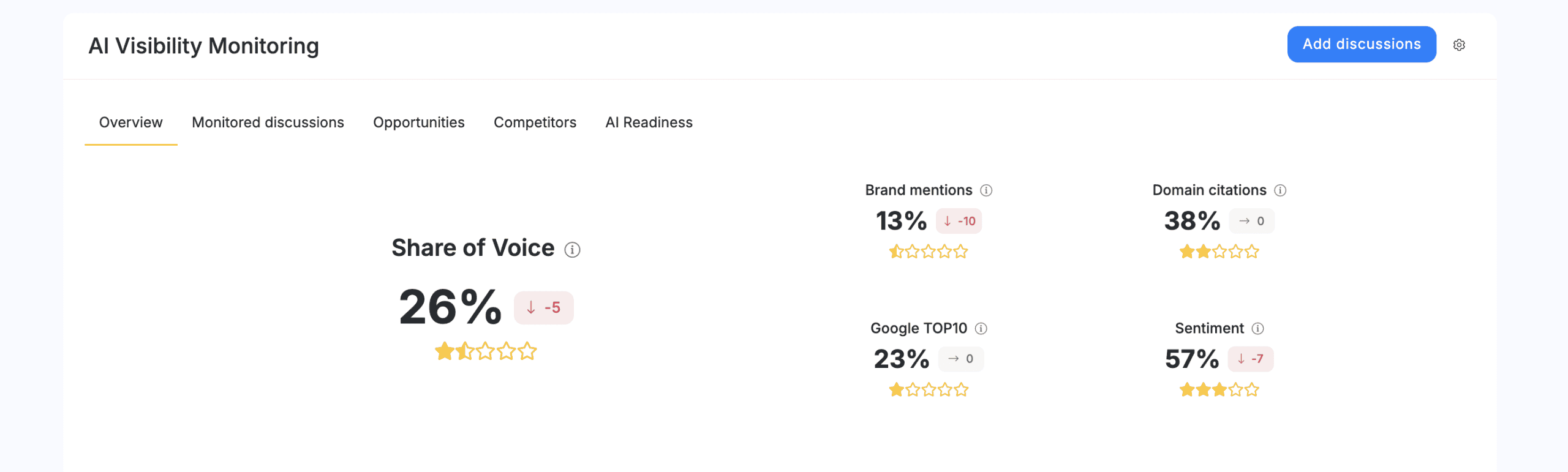
From a marketing perspective, the module answers a simple business question: “How visible and credible is our brand when people ask AI systems questions in our market?” The dashboard helps teams present AI visibility as a measurable channel, similar to SEO visibility, share of voice, brand sentiment, and citation coverage. It is especially useful for content marketers, SEO managers, product marketers, and leadership stakeholders who need a high-level view before drilling into detailed prompts, opportunities, or competitors.
|
Dashboard Area |
Marketing Meaning |
Practical Decision It Supports |
|
Share of Voice |
Shows the brand’s aggregate presence across monitored AI discussions. |
Decide whether AI visibility is improving and whether campaigns are increasing brand presence. |
|
Google TOP10 |
Indicates whether the monitored domain appears in the Google top organic results for tracked discussions. |
Identify whether traditional search visibility supports AI visibility. |
|
Brand in answers |
Measures how often AI responses mention the monitored brand. |
Evaluate brand awareness inside AI-generated recommendations and comparisons. |
|
Domain cited in answers |
Measures how often AI answers cite or reference the monitored domain. |
Understand whether the website is trusted enough to be used as a source. |
|
Sentiment |
Chart – summarizes whether brand mentions are positive, neutral, or negative. |
Detect whether AI responses are helping or harming brand perception. |
|
Brand mentions by source |
Chart – compares brand visibility across AI engines. |
Identify which AI platforms require more optimization effort. |
|
Domain citations by source |
Chart – compares website citation coverage across AI engines. |
Prioritize technical, content, and authority improvements where citations are missing. |
The Overview module should be treated as the starting point for AI visibility reporting. It is not designed to replace detailed analysis; it helps users identify where to investigate next.
When to Use the Overview Module
Use the Overview module at the beginning of every AI Visibility review. It is most valuable when a user wants to understand overall performance without opening each prompt, opportunity, or competitor report. In a recurring workflow, the Overview can be checked weekly or after major content, PR, SEO, or brand campaigns to see whether AI answer visibility has changed.
The module is also useful during client or management reporting because it presents the main performance signals in a compact, visually accessible way. If the Share of Voice is low, the marketing team can use the Opportunities module to find actions. If brand mentions exist but domain citations remain low, the team can investigate content authority, technical accessibility, and source-worthiness. If sentiment is negative or mixed, brand messaging and reputation management become the priority.
Step-by-Step: How to Use the Overview Module
- Open the relevant project and select AI Visibility from the project navigation. The AI Visibility Monitoring workspace will open with the module tabs visible at the top of the page.
- Select the Overview tab. This tab displays the main AI Visibility summary metrics, including Share of Voice, Google TOP10, Brand in answers, Domain cited in answers, Sentiment, Brand mentions, and Domain citations.
- Start with Share of Voice. Treat this as the headline indicator of the brand’s total AI visibility. A low value means that the brand is not frequently present across the monitored AI discussions. A rising value indicates that the brand is becoming more visible in AI-generated answers.
- Review Brand in answers and Domain cited in answers together. A brand can be mentioned without its website being cited. This distinction matters because mentions indicate awareness, while citations suggest that AI systems are using the website or domain as a source. If mentions are higher than citations, the next marketing task is usually to strengthen authoritative, well-structured content that AI systems can reference.
- Check Google TOP10 to understand whether classic search visibility may be supporting AI visibility. If Google TOP10 is weak, SEO fundamentals may need improvement before AI visibility can scale reliably.
- Review the Sentiment panel. If the visible sentiment is positive, the brand is being framed favorably in monitored answers. If neutral or negative sentiment increases, investigate the underlying monitored discussions to identify which prompts and answer sources are responsible.
- Compare Brand mentions across AI sources. If the brand appears in one AI platform but not another, use this difference to prioritize optimization work by source. For example, missing mentions in ChatGPT or Perplexity may require different content and authority strategies than missing visibility in Google AI surfaces.
- Compare Domain citations across AI sources. If the brand is mentioned but the domain is not cited, review whether the website provides original, credible, crawlable, and clearly structured information that AI systems can use as a source.
- Use the result to decide the next module to open. If the dashboard shows weak prompt-level performance, open Monitored discussions. If there are gaps to act on, open Opportunities. If competitors are outperforming the brand, open Competitors. If citation potential may be blocked by technical issues, open AI Readiness.
Recommended Reporting Workflow
The Overview module works best as the first slide or first section in an AI Visibility report. Begin with the current values, explain what changed since the previous reporting period, and then connect each metric to a concrete action. This prevents AI visibility reporting from becoming a passive scorecard and turns it into an operational marketing workflow.
|
Review Question |
Where to Look in Overview |
Recommended Next Action |
|
Is the brand visible in AI answers? |
Share of Voice and Brand in answers |
If low, review Opportunities and add or refine monitored discussions. |
|
Is the website being used as a source? |
Domain cited in answers and Domain citations |
If low, review AI Readiness and improve source-quality content. |
|
Is visibility consistent across AI platforms? |
Brand mentions and Domain citations by source |
Prioritize the weakest source for optimization. |
|
Is the brand represented positively? |
Sentiment |
Investigate prompts with neutral or negative framing. |
|
Are SEO foundations supporting AI visibility? |
Google TOP10 |
Improve classic SEO coverage for monitored topics. |
Practical Example
In the inspected project, the Overview showed Share of Voice at 6%, Brand in answers at 12%, and Domain cited in answers at 0%. This pattern suggests that the brand may occasionally appear in AI answers, but the monitored domain is not yet being cited as a source in selected questions (prompts). A marketing team using this dashboard would likely prioritize source authority, content optimization, and technical AI readiness before expecting a major increase in domain citations.