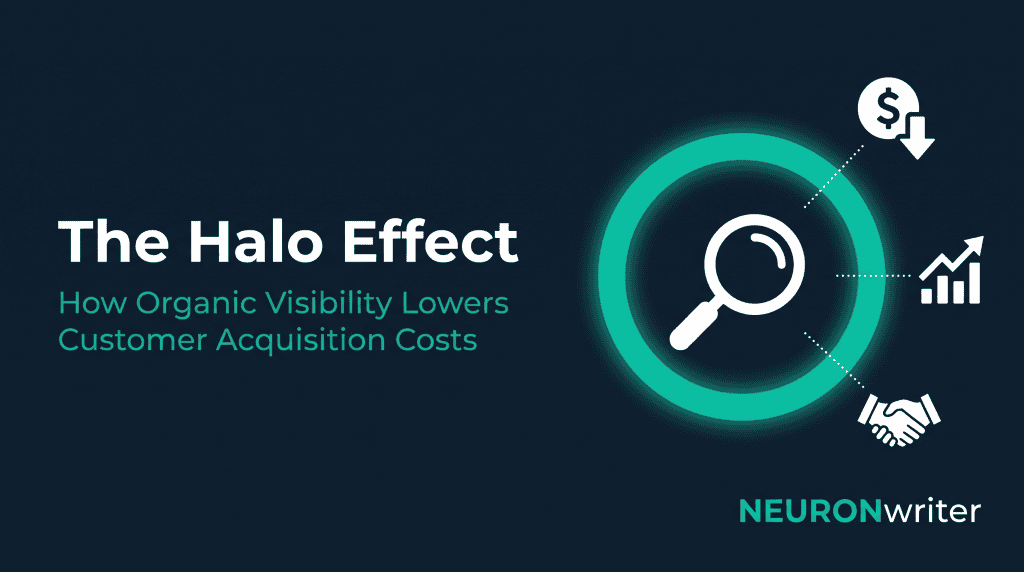
The Halo Effect: How Organic Visibility Lowers Customer Acquisition Costs
Semantic Summary
Idea: The true value of SEO extends far beyond direct organic conversions. High organic visibility creates a “halo effect” — a cognitive bias where consumers perceive a brand as more trustworthy and authoritative simply because it consistently appears at the top of search results. This trust permeates all other marketing channels, making them more effective.
Challenge: Many executives evaluate SEO purely as a direct-response channel, comparing organic conversions side-by-side with paid ads. When they fail to account for the halo effect, they severely underestimate the return on investment (ROI) of semantic SEO. This leads to underfunded content teams and an over-reliance on expensive, short-term performance marketing.
Summary: By investing in deep, semantically rich content, you build an omnipresent brand in the SERPs. This organic visibility lowers your overall Customer Acquisition Cost (CAC) by increasing click-through rates on your paid ads, shortening the B2B sales cycle, and boosting brand recall during the decision phase. Using tools like NEURONwriter to dominate entity clusters ensures your brand becomes the undisputed authority in your niche.
Related reads:
The Cost of Bad Content: Calculating the ROI of Semantic Optimization
The Attribution Crisis: Why Direct Traffic is Often Unmeasured SEO
Product-Led SEO: Why You Should Stop Writing for Traffic
Understanding the SEO Halo Effect
In psychology, the halo effect is a cognitive bias where our overall impression of a person influences how we feel about their character. In digital marketing, the halo effect occurs when a brand’s strong organic presence positively influences a consumer’s perception of its products, services, and paid advertisements.
When a user searches for informational queries (“what is X”, “how to solve Y”) and consistently sees your brand providing high-quality, helpful answers, they subconsciously register your company as the industry leader. By the time they are ready to make a purchase, that built-in trust drastically reduces the friction of the sale.
The Direct Impact on Customer Acquisition Cost (CAC)
Customer Acquisition Cost (CAC) is the total marketing and sales cost required to earn a new customer. Organic visibility systematically lowers this metric across your entire marketing ecosystem in three distinct ways.
1. Reducing Reliance on Paid Channels
The most obvious way organic visibility lowers CAC is by replacing paid clicks with free ones. While the initial investment in high-quality content creation and semantic optimization using tools like NEURONwriter requires budget, the long-term yield is exponential.
Once a page ranks well, it can drive thousands of highly qualified visitors for years without the “meter running” on every click. As organic traffic scales, the blended CAC (total marketing spend divided by total customers) drops significantly.
2. Increasing Paid Ad Click-Through Rates (CTR)
A less obvious, but equally powerful benefit is how organic visibility improves your paid search performance. When a user sees your brand in an organic listing and simultaneously sees your PPC ad at the top of the page, the psychological reinforcement is immense.
Studies consistently show that brands appearing in both paid and organic results for the same query experience a significantly higher CTR on their paid ads compared to when the ad appears alone. A higher CTR improves your Google Ads Quality Score, which directly lowers your Cost Per Click (CPC) and, consequently, your CAC.
3. Shortening the Sales Cycle
In complex B2B sales or high-ticket B2C purchases, the buyer’s journey involves extensive research. If your brand is the one educating the buyer at every step of that journey from top-of-funnel awareness to bottom-of-funnel comparisons you eliminate the need for your sales team to establish baseline trust. Prospects enter the sales pipeline already convinced of your expertise, leading to faster close rates and lower sales costs.
Measuring the Invisible: How to Track the Halo Effect
Because the halo effect influences other channels, it is notoriously difficult to measure using traditional last-click attribution models. However, you can track its impact by monitoring specific holistic metrics.
| Metric to Track | What It Indicates | How It Lowers CAC |
| Branded Search Volume | Users are bypassing generic searches and looking for you directly. | Branded clicks are highly intent-driven and essentially free. |
| Direct Traffic Growth | Users are bookmarking your site or typing your URL from memory. | Eliminates the middleman (Google/Social) and their associated costs. |
| Time to Conversion | The number of days between first touchpoint and final sale. | Faster sales cycles reduce sales team overhead and follow-up ad spend. |
| Assisted Conversions | Organic search acts as an early touchpoint, even if the final click is paid. | Proves that SEO is doing the heavy lifting of education and trust-building. |
Building a Halo-Generating Content Strategy
To generate a powerful halo effect, your content strategy must move beyond transactional keywords. You must dominate the entire semantic entity cluster surrounding your product.
Instead of only targeting “buy CRM software,” you must provide the definitive answers for “how to improve customer retention,” “sales pipeline management techniques,” and “calculating customer lifetime value.” By using NEURONwriter to ensure high semantic richness and topical coverage across all these related queries, you build an inescapable web of authority.
When a user encounters your brand at the awareness stage, the consideration stage, and the decision stage, the halo effect is complete. You are no longer just an option; you are the standard.
FAQs: Organic Visibility and the Halo Effect
What is the halo effect in SEO?
The SEO halo effect is a cognitive bias where consumers perceive a brand as more trustworthy, authoritative, and reliable simply because it consistently ranks at the top of organic search results for relevant queries.
How does organic visibility lower Customer Acquisition Cost (CAC)?
It lowers CAC by replacing expensive paid clicks with free organic traffic, increasing the conversion rates of your paid ads through brand familiarity, and shortening the sales cycle by pre-educating prospects.
Does ranking organically help my paid search (PPC) ads?
Yes. When your brand appears in both the organic results and the paid ads for the same search query, users are significantly more likely to click your ad. This higher CTR improves your Quality Score and lowers your cost-per-click.
Why is branded search volume important for the halo effect?
An increase in branded search volume proves that your top-of-funnel organic content is working. Users are remembering your name from their initial research and searching for you directly when they are ready to buy.
How do I build an SEO strategy that creates a halo effect?
You must target the entire buyer’s journey, not just transactional keywords. Use semantic SEO tools like NEURONwriter to build topical authority across informational, navigational, and commercial queries within your industry.
Why does last-click attribution fail to measure the halo effect?
Last-click attribution gives 100% of the credit to the final touchpoint (often a branded search or a retargeting ad). It ignores the fact that the user originally discovered and learned to trust your brand through an organic informational article weeks earlier.
Is the halo effect more important for B2B or B2C?
While valuable for both, it is exceptionally critical for B2B and high-ticket B2C purchases. These transactions require high levels of trust and long research phases, which is exactly what a strong organic presence provides.