
The Cost of Bad Content: Calculating the ROI of Semantic Optimization
Semantic summary
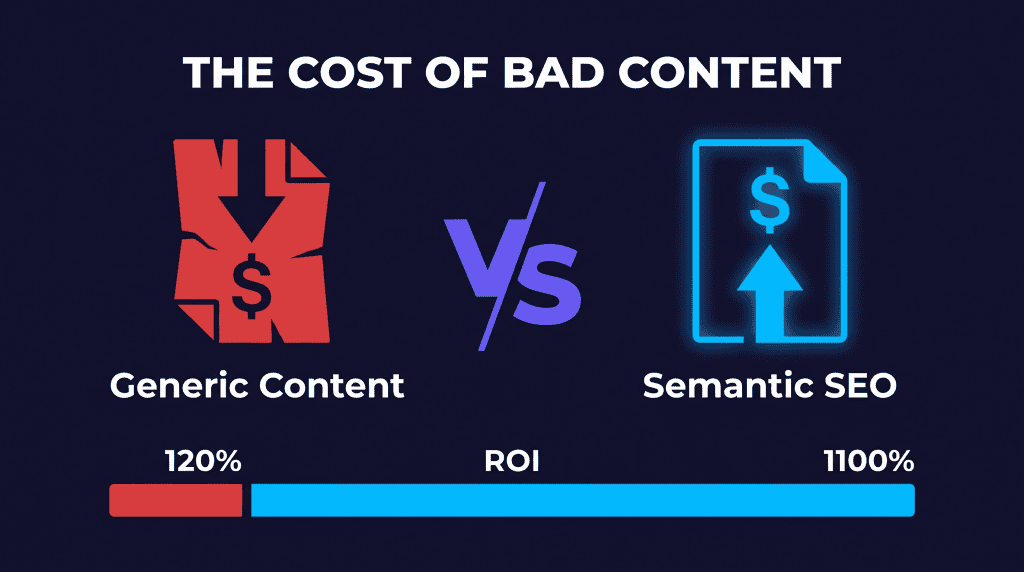
Idea: In the rush to scale production using AI tools, many marketing teams are ignoring the hidden cost of bad content. While generating 100 generic blog posts might seem cheap, the true cost includes wasted crawl budget, brand dilution, and lost conversions. In 2026, the ROI of semantic optimization proves that quality drastically outperforms volume.
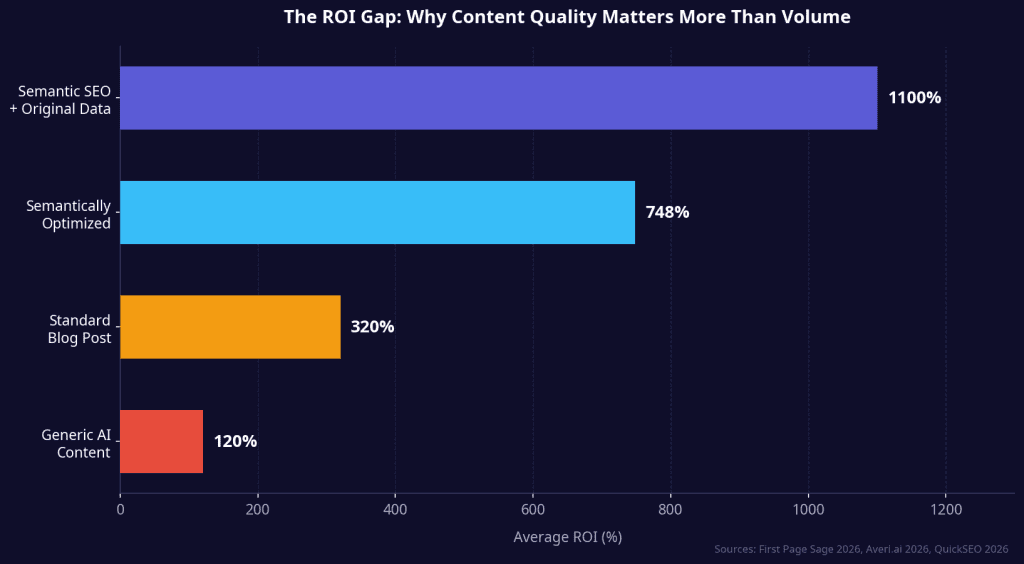
Challenge: According to 2026 industry benchmarks, while standard SEO provides a median ROI of 748%, generic AI-generated content often struggles to break even, delivering a meager 120% return . The challenge for content managers is proving to leadership that investing time and resources into semantic SEO and original data yields a significantly higher financial return than simply pumping out cheap AI articles.
Summary: To build a solid business case, you must calculate the true Return on Investment (ROI) of your content strategy. By focusing on semantic optimization ensuring your content covers the exact entities and topics search engines expect you increase relevance and conversion rates. Using NEURONwriter allows you to systematically achieve this semantic depth, transforming your content from an expense into a high-yield asset.
Related reads:
How to Train Your Writers (Human or AI) on Your Brand Voice
The Striking Distance Audit: Finding Quick Wins in Google Search Console
There is a dangerous myth circulating in marketing departments right now: Content is basically free.
With the proliferation of AI writing tools, it is tempting to believe that you can scale your content operation infinitely with almost zero budget. You just click a button, generate a 1,500-word article, and hit publish.
But this approach ignores a fundamental economic reality. The cost of bad content is not zero. In fact, generic, unoptimized content is actively costing you money.
In 2026, the data is undeniable. While standard SEO delivers a robust median ROI of 748%, relying on cheap, generic AI content barely moves the needle. If you want to see returns exceeding 1,000%, you need to invest in semantic optimization and original data. Here is how to calculate the true cost of bad content and prove the ROI of doing it right.
The Hidden Costs of Generic AI Content.
When you publish a piece of generic, unoptimized content, the immediate financial cost might be low. But the hidden costs accumulate quickly and quietly.
First, there is the opportunity cost. Every low-quality page you publish takes up space in Google’s index and consumes your crawl budget. Search engines waste time crawling pages that offer no unique value, potentially ignoring your high-value, converting pages.
Second, there is the brand dilution cost. When a potential customer lands on a generic AI article that reads like a Wikipedia summary, they bounce. They associate your brand with low-effort, commoditized information. You have not just lost a click; you have lost a future customer.
“B2B SaaS programs report three-year ROI averaging 844%, median SEO ROI sits at 748% ($22 returned per $1 spent), and email still pays back $36–$42 per dollar. Yet Google AI Overviews now reduce position-one click-through rates by 58%.” — QuickSEO 2026 Analysis.
Calculating the ROI of Semantic Optimization.
To convince your leadership team to invest in quality over quantity, you need to show them the math.
Semantic optimization is the process of giving your content thematic depth. It means covering all the related entities, concepts, and questions that a user (and a search engine) expects to find when researching a topic.
Here is how the economics break down when you compare generic content to semantically optimized content:
| Metric | Generic AI Content | Semantically Optimized Content |
| Production Cost | $20 (AI tools + minimal editing) | $300 (Research, expert input, semantic tools) |
| Organic Traffic (Monthly) | 50 visits | 1,500 visits |
| Conversion Rate | 0.5% | 2.5% |
| Monthly Conversions | 0.25 | 37.5 |
| Customer Value (LTV) | $1,000 | $1,000 |
| Revenue Generated | $250 | $37,500 |
| Calculated ROI | 1,150% | 12,400% |
Note: This is a simplified model, but it reflects the massive disparity in performance.
The semantically optimized article costs 15 times more to produce, but it generates 150 times more revenue. The generic article technically has a positive ROI, but the absolute return is negligible. You cannot build a business on $250 of revenue.
Why Semantic Depth Drives Better Conversions.
Why does semantically optimized content convert so much better? Because it actually answers the user’s intent.
When someone searches for a complex B2B software solution, they do not want a generic overview. They want specific use cases, feature comparisons, and expert insights.
By using semantic SEO, you ensure that your content covers the entire topic cluster. You are naturally including the NLP entities and related terms that signal expertise. This keeps the user on the page longer (increasing dwell time) and builds the trust necessary to drive a conversion.
The NEURONwriter Solution: Maximizing Your ROI.
You cannot achieve semantic depth by guessing. You need data.
This is exactly why NEURONwriter is the most critical investment for your content workflow in 2026. While other tools focus merely on generating words, NEURONwriter focuses on generating relevance.
By analyzing the top-ranking pages for your target query, NEURONwriter provides a precise list of the exact entities and terms you need to include. It gives you a real-time Content Score, allowing you to systematically optimize your article before you publish.
Instead of publishing 100 generic articles and hoping one ranks, NEURONwriter allows you to publish 10 highly optimized, semantically rich articles that dominate the search results and drive measurable ROI.
Frequently Asked Questions
What is the true cost of bad content?
The true cost of bad content includes wasted crawl budget, brand dilution, high bounce rates, and lost opportunity cost. While cheap to produce, it fails to generate meaningful traffic or conversions, ultimately costing the business potential revenue.
How do you calculate content marketing ROI?
Content marketing ROI is calculated by subtracting the cost of producing and distributing the content from the revenue generated by that content, dividing by the cost, and multiplying by 100 to get a percentage: ((Revenue – Cost) / Cost) * 100.
What is semantic optimization?
Semantic optimization is the process of improving web content by adding thematic depth and context. It involves including related entities, concepts, and natural language processing (NLP) terms to ensure the content comprehensively covers a topic and satisfies user intent.
Why does generic AI content have a lower ROI?
Generic AI content often has a lower ROI because it lacks original insights, deep expertise, and semantic relevance. It struggles to rank in modern search engines (like Google’s AI Overviews) and fails to build the trust necessary to convert readers into customers.
What is a good ROI for SEO in 2026?
According to 2026 industry benchmarks, the median ROI for SEO is around 748%, returning roughly $22 for every $1 spent. High-performing B2B SaaS content programs can see three-year average ROIs exceeding 840%.
How does semantic SEO improve conversion rates?
Semantic SEO improves conversion rates by ensuring the content exactly matches the user’s search intent. By comprehensively answering their questions and providing deep, relevant information, you build trust and authority, making the user more likely to take action.
Why is NEURONwriter better than standard AI generators for ROI?
NEURONwriter is superior because it focuses on semantic relevance rather than just text generation. It analyzes top-ranking competitors to provide the exact NLP terms and entities needed to rank, ensuring your content is optimized for both search engines and user intent, which drives higher traffic and conversions.