
How to Train Your Writers (Human or AI) on Your Brand Voice
Semantic Summary
Idea: Teaching writers how to capture your brand voice is the hardest part of scaling content. In 2026, the challenge has doubled because marketing teams must now train both human freelancers and AI content generators. Without a systematic training framework, your content quickly becomes generic, eroding reader trust and brand identity.
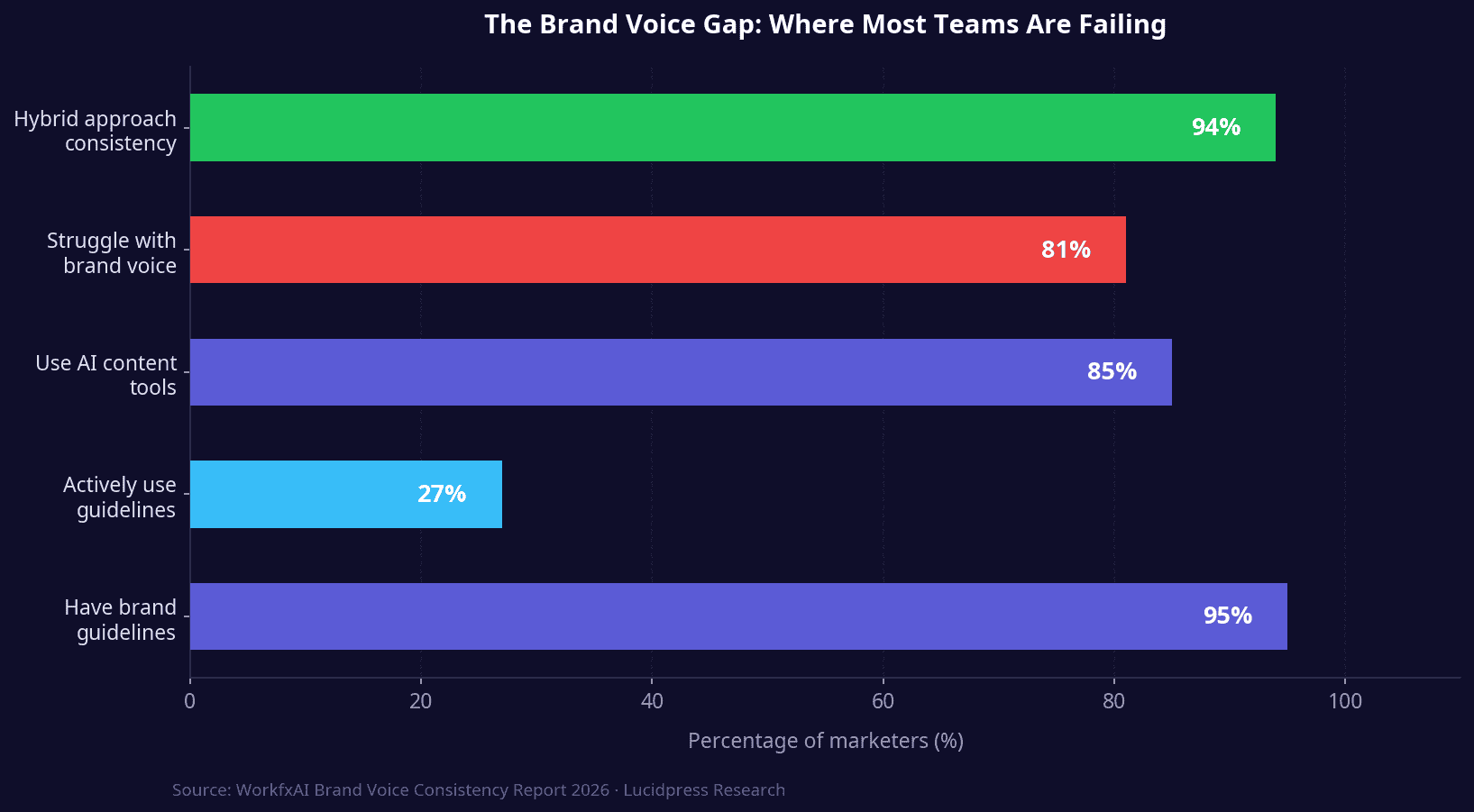
Challenge: According to 2026 research, while 95% of organizations have brand guidelines, only 27% actively use them [1]. Furthermore, as 85% of marketers adopt AI writing tools, a staggering 81% struggle with off-brand content creation. Traditional PDF style guides are too complex for daily use, and generic AI prompts fail to capture emotional authenticity.
Summary: To fix this, you must move from passive documentation to active training. For humans, this means providing a “Voice Audit” with clear before-and-after examples. For AI, it requires building a structured voice prompt that defines vocabulary, rhythm, and tone. Finally, using NEURONwriter ensures that while your voice remains authentic, the underlying semantic structure remains perfectly optimized for search engines.
Related reads:
Content Syndication in 2026: Safe Strategies That Won’t Trigger Duplicate Penalties
Author Entities: How to Connect Your LinkedIn Profile to Your SEO Strategy
Every content manager knows the feeling. You hire a talented new writer, hand them your beautiful 40-page brand guidelines PDF, and wait for the magic to happen.
A week later, they submit their first draft. The grammar is flawless. The research is solid. But it just does not sound like you.
In 2026, this problem has scaled exponentially. You are no longer just onboarding human freelancers; you are also trying to coax ChatGPT, Jasper, and Claude into sounding like your brand.
The data is clear: 81% of companies struggle with off-brand content creation. If your content sounds like everyone else, you lose the trust that drives conversions. Here is the exact framework to train any writer carbon-based or silicon-based to nail your brand voice every single time.
Why Traditional Brand Guidelines Fail.
The reason your writers are missing the mark is not because they are bad writers. It is because your brand guidelines are built for designers, not copywriters.
Most guidelines spend twenty pages on logo spacing and hex codes, and exactly one paragraph on voice, usually saying something unhelpful like: “We are professional but fun, authoritative but approachable.”
That means absolutely nothing to a writer staring at a blank page.
To train writers effectively, you need to translate abstract adjectives into concrete writing rules.
The 3-Step Framework for Human Writers.
Humans learn through context and contrast. Do not give them a list of adjectives; give them a map of boundaries.
1. Create the “This, Not That” Matrix
The fastest way to calibrate a human writer is to show them exactly where the boundaries lie. Create a simple table that contrasts your desired tone with the common mistakes writers make in your industry.
If you are a B2B SaaS company, your matrix might look like this:
| We Are… | But We Are Not… | Example (Do This) | Example (Not That) |
| Authoritative | Arrogant | “Here is how the data suggests you should approach this.” | “If you aren’t doing this, you’re failing.” |
| Conversational | Slangy | “Let’s look at why this matters.” | “Check out why this is totally lit.” |
| Simple | Dumbed-down | “This tool automates your tax reporting.” | “This tool does the hard math stuff for you.” |
2. Provide the “Golden 5” Swipe File.
Writers need to hear the music before they can play it. Curate a document containing your five best pieces of content the articles or emails that perfectly capture the soul of your brand.
More importantly, annotate why they are good. Highlight specific sentences and add comments like: “Notice how we use short, punchy sentences here to build momentum,” or “See how we explain a complex technical concept using a simple coffee shop analogy.”
3. Implement the Feedback Loop
Your first three edits with a new writer should focus entirely on voice, not structure or SEO. When you correct a sentence, explain the brand reason behind the change.
“AI content tools excel at consistently applying documented brand voice rules across unlimited content volume, but human writers naturally incorporate emerging cultural trends into brand voice expression.” — WorkfxAI 2026 Report
How to Train AI to Write in Your Voice.
Training an AI language model requires a completely different approach. AI does not understand “vibes.” It understands patterns, constraints, and explicit instructions.
If you tell an AI to “write in a fun, professional tone,” it will output generic, cringeworthy corporate speak. You have to engineer the prompt.
The Perfect AI Voice Prompt Structure.
To get an AI to sound like your brand, you must feed it a structured voice profile before you ever ask it to write a draft. Use this exact prompt framework:
- Role and Persona: “You are the senior copywriter for [Brand Name]. Our brand voice is [Adjective 1], [Adjective 2], and [Adjective 3].”
- Vocabulary Constraints: “Always use words like [approved terms]. Never use words like [banned jargon, e.g., ‘synergy’, ‘leverage’, ‘unlock’].”
- Rhythm and Formatting: “Write in short paragraphs (maximum 3 sentences). Alternate between short, punchy sentences and longer, explanatory ones. Use bullet points for lists. Do not use exclamation points.”
- The Reference Data: “Analyze the following text to understand our exact tone, sentence structure, and vocabulary. Match this style perfectly in all future responses: [Paste 500 words of your best content].”
When organizations use this hybrid approach of detailed prompting and human oversight, brand consistency scores jump to 94%.
The NEURONwriter Advantage: Separating Voice from SEO.
The biggest mistake content teams make is forcing writers to worry about brand voice and SEO at the exact same time. This leads to robotic writing where keywords are stuffed awkwardly into sentences.
Brand voice and semantic SEO should be two separate steps.
This is where NEURONwriter transforms your workflow.
First, let your human writers or AI tools draft the content focusing only on nailing the brand voice, the storytelling, and the emotional connection.
Once the draft sounds perfectly on-brand, paste it into the NEURONwriter Content Editor. The tool will instantly analyze your text against the top-ranking competitors and highlight the missing NLP entities and semantic terms.
Because NEURONwriter gives you the exact terms Google expects to see, your editor can naturally weave those terms into the existing text without breaking the brand voice. You get the emotional resonance of a perfectly trained writer, combined with the mathematical precision of semantic SEO.
FAQ
Why is brand voice consistency so difficult to maintain?
Brand voice consistency is difficult because most companies rely on abstract adjectives (like “professional but fun”) rather than providing concrete examples, “This, Not That” matrices, and annotated swipe files that clearly define the boundaries of the brand’s tone.
How do I train a new freelance writer quickly?
The fastest way to train a freelancer is to provide a “Golden 5” swipe file a document containing your five best pieces of content with annotations explaining exactly why the tone, sentence structure, and vocabulary work for your brand.
Can AI writing tools actually replicate a unique brand voice?
Yes, but only if they are prompted correctly. Generic prompts produce generic text. To replicate your voice, you must feed the AI a detailed voice profile that includes vocabulary constraints, sentence rhythm instructions, and a 500-word sample of your best writing to analyze and mimic.
What is a “This, Not That” matrix?
It is a simple table used to train writers by showing contrast. It lists a brand attribute (e.g., “Authoritative”), shows what it looks like when done right (“Here is what the data suggests”), and contrasts it with what it looks like when taken too far (“If you aren’t doing this, you’re failing”).
Why does AI content often sound robotic or generic?
AI content sounds generic when it defaults to its baseline training, which relies on predictable phrasing and corporate jargon. It lacks emotional authenticity and lived experience, which is why it often uses phrases like “we are excited to announce” instead of original storytelling.
How do I balance brand voice with SEO requirements?
You should separate the two processes. First, write the draft focusing entirely on flow, storytelling, and brand voice. Then, use a semantic SEO tool to identify missing entities and naturally weave them into the finished text without disrupting the tone.
How does NEURONwriter help with brand voice?
NEURONwriter allows you to focus on your brand voice first. Once your draft sounds authentic, you paste it into NEURONwriter to see exactly which semantic terms and NLP entities are missing, allowing you to optimize for Google without compromising your unique style.