
Content Syndication in 2026: Safe Strategies That Won’t Trigger Duplicate Penalties.
📍 Semantic summary
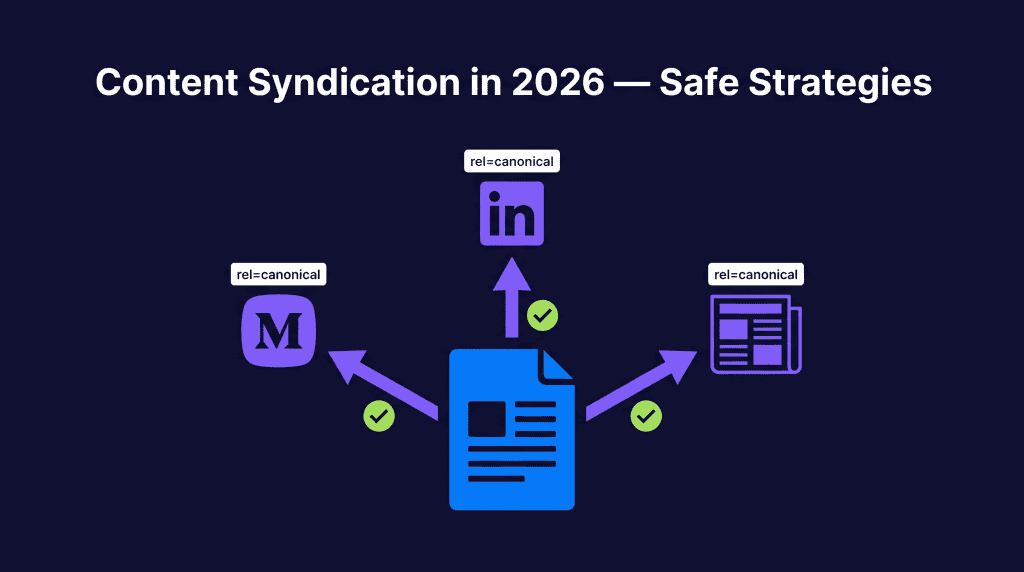
Idea: Content syndication means taking an article you already wrote and publishing it again on other platforms like Medium, LinkedIn, or industry websites. It is one of the easiest ways to reach more readers without creating new content. Many marketers avoid it because they fear a so-called “duplicate content penalty.” In 2026, that fear is largely a myth. The real key to safe syndication is one simple technical step: the canonical tag.
Challenge: If you cross-post your article without the right setup, search engines may rank the other platform instead of your own website. Imagine writing a great post, publishing it on Medium, and then watching Medium outrank your blog for your own content. That is the real risk not a penalty, but losing your own traffic to a third-party site.
Summary: Safe syndication comes down to three things: use a canonical tag, wait until your original article is indexed, and only syndicate your best content. Tools like NEURONwriter help you make sure your original article is strong enough to hold the top spot even after it spreads across the web.
Related reads:
The Attribution Crisis: Why “Direct/Unknown” Traffic is Actually Your Best SEO Win
Digital PR for SEO: Earning Citations Without Asking for Links
You write a great article. You spend hours on it. Then a friend suggests: “Why not post it on Medium too? More people will see it.”
Good idea but if you do it wrong, Medium might start ranking higher than your own blog for the exact article you wrote. Your readers end up on someone else’s platform. Your website gets nothing.
This is the real problem with content syndication done badly. And it is entirely avoidable.
What is Content Syndication?
Content syndication simply means republishing your article on another website. The other site gets fresh content. You get exposure to a new audience. Done right, it is a win for everyone.
The most common places people syndicate to are Medium, LinkedIn Articles, and industry publications. Some do it for free through partnerships. Others pay distribution networks to spread their content wider.
The key rule is simple: the other site must credit your original article as the source. Without that, search engines get confused about who wrote what first.
| Original Publishing | Safe Syndication | Unsafe Cross-Posting | |
| Where it lives | Your website | Partner site, Medium, LinkedIn | Anywhere |
| Technical setup | None needed | Canonical tag pointing to your site | No canonical tag |
| What Google does | Indexes and ranks your page | Sends all ranking signals back to you | Picks whichever version it prefers |
| Result for you | Full traffic | Brand reach + referral traffic | You compete against yourself |
The One Thing That Makes Syndication Safe.
The tool that makes everything work is called a canonical tag.
Think of it as a label that says: “This article also exists on my blog — that is the original. Please rank that one.”
When a partner site adds a canonical tag to your republished article, it points all the SEO value back to your website. Search engines follow that signal. Your blog gets the ranking. The partner site gets the visibility. Everyone wins.
Without the canonical tag, search engines have to guess. And they often guess wrong especially when the partner site is bigger and more authoritative than yours.
3 Simple Rules to Syndicate Safely
1. Always Wait Before Syndicating
Never publish your article and syndicate it on the same day.
Google needs time to find and index your original post first. If a bigger platform publishes your content before Google has seen your version, Google may think the bigger platform wrote it first.
Wait at least 48 to 72 hours after publishing. Then check in Google Search Console that your article is indexed. Only then push it to other platforms.
2. Pick Platforms That Play by the Rules
Not every platform handles canonical tags the same way.
Medium is one of the safest options. It has a built-in “Import a story” feature that automatically adds the canonical tag pointing back to your blog . You do not need to do anything technical.
LinkedIn Articles are trickier. LinkedIn does not let you set a custom canonical tag. If you paste your full article there, LinkedIn might outrank your blog. The safer move is to post a short summary on LinkedIn and add a link back to the full article on your website.
3. Only Syndicate Your Best Work
Do not republish every article you write. Focus on your strongest, most evergreen content the kind that stays relevant for months or years.
Quick news posts and trend updates are not worth syndicating. They lose value fast. Save syndication for your comprehensive guides, original research, and thought leadership pieces that people will keep searching for.
Why Your Original Article Needs to Be Strong First
Syndication can bring your content to thousands of new readers. But if your original article is weak thin on substance, missing key topics, poorly structured no amount of distribution will save it.
This is where NEURONwriter makes a real difference. Before you syndicate anything, use NEURONwriter to make sure your original article covers the topic completely. NEURONwriter shows you exactly which terms, concepts, and entities search engines expect to see in a high-ranking article on your subject.
Syndication spreads your content. NEURONwriter makes sure what you spread is worth ranking.
When you eventually push that well-optimized article to Medium or a partner site, the canonical tag funnels all the authority back to a page that is already built to win. That is how you dominate a topic, not just appear in it.
FAQ
What is content syndication?
Content syndication means republishing your original article on other websites like Medium, industry blogs, or partner publications to reach a wider audience without writing new content from scratch.
Will I get penalized for cross-posting my articles?
No. There is no official duplicate content penalty. However, if you cross-post without a canonical tag, search engines may rank the other platform instead of your website, which means you lose the traffic you earned.
What is a canonical tag?
A canonical tag is a small piece of code that tells search engines: “The original version of this article lives at this URL.” It makes sure all ranking signals go to your website, not the syndicated copy.
How long should I wait before syndicating?
Wait at least 48 to 72 hours after publishing your original article. Use Google Search Console to confirm it has been indexed before you syndicate it anywhere else.
Is it safe to cross-post to Medium?
Yes if you use Medium’s “Import a story” feature. It automatically adds the canonical tag pointing back to your blog, making it one of the safest syndication options available.
Can I syndicate to LinkedIn?
You can, but with caution. LinkedIn Articles do not support canonical tags, so publishing your full article there can create a ranking conflict. Instead, post a short excerpt or summary on LinkedIn and link back to the full article on your site.
Which articles are worth syndicating?
Focus on your best evergreen content comprehensive guides, original research, and in-depth explainers. Avoid syndicating short news posts or trend updates, as they lose value quickly and rarely drive meaningful traffic from partner platforms.