The Attribution Crisis: Why “Direct/Unknown” Traffic is Actually Your Best SEO Win.
📍 Semantic Summary
- Idea: The SEO industry is facing a severe attribution crisis. Traditional metrics like organic traffic and last-click attribution are failing to capture the true value of content. In 2026, the most valuable buyer journeys happen in the dark funnel, where influence is invisible to Google Analytics 4 (GA4 ).
- Challenge: Because modern buyers discover brands through AI search engines, private communities, and word-of-mouth, they often bypass clicking trackable links. Instead, they verify the brand via branded search or type the URL directly into their browser. Consequently, GA4 categorizes these high-intent visitors as “Direct” or “Unassigned” traffic, making it look like your SEO strategy is failing when it is actually driving revenue.
- Summary: To survive the attribution crisis, marketers must shift their focus from demand capture (trackable clicks) to demand creation (untrackable influence). By using NEURONwriter to build deep topical authority, you create the kind of memorable, high-signal content that fuels the dark funnel. The resulting spikes in branded search volume and direct traffic are not tracking errors they are proof that your SEO is working.
Read the full guide below, or explore related topics:Dark Social & SEO · Why Third-Party Keyword Tools Are Failing
If you are an SEO professional or a B2B marketer in 2026, you have likely had this uncomfortable conversation: You walk into a quarterly review, and the executive team points out that organic traffic is down 20%. They want to know why the SEO budget shouldn’t be cut. You know the content is working. You can see pipeline growing. But the dashboard says otherwise.
Welcome to the attribution crisis. The metrics that built the SEO industry organic sessions, average position, and last-click conversions are actively misleading decision-makers. As Search Engine Land recently noted, sticking with outdated measurements puts your strategy and budget at severe risk
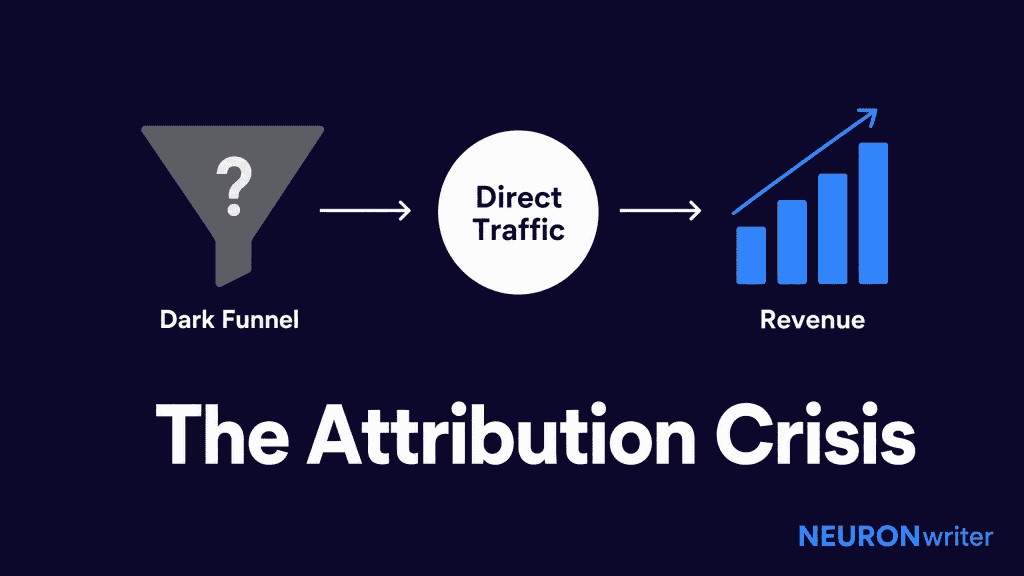
The truth is, if you are doing modern SEO correctly, your biggest wins will not show up under the “Organic Search” channel in GA4. They will show up as Direct traffic, Unassigned traffic, and branded search. Here is why.
The Reality of the Dark Funnel.
To understand the attribution crisis, you must understand the dark funnel.
The dark funnel refers to all the buyer activity, research, and content sharing that happens in channels invisible to traditional analytics software
This includes:
- Private Slack and Microsoft Teams channels.
- Direct messages on LinkedIn.
- Word-of-mouth recommendations.
- Podcast mentions.
- Discovery via AI tools like ChatGPT or Perplexity
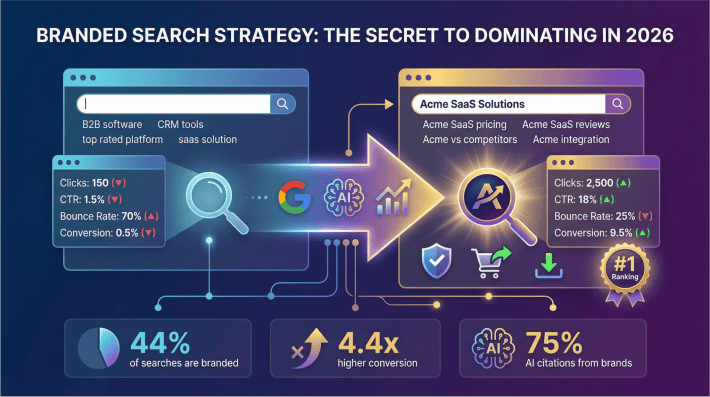
In B2B tech, the dark funnel is the primary driver of high-intent leads. A prospect might hear your CEO on a podcast, ask an LLM about your product, and discuss it with a colleague on Slack. When they are finally ready to buy, they don’t click a trackable UTM link. They type your company name into Google (branded search) or type your URL directly into their browser (Direct traffic).
According to B2B buyer research, 94% of buyers now use LLMs during their buying process, and they use these tools to discover vendors before turning to Google to confirm what they’ve learned.
Why “Direct” Traffic is Not a Glitch.
When GA4 receives a visitor without a referrer (because they typed the URL, used a bookmark, or clicked a link in a private app that stripped the tracking data), it dumps them into the “Direct” bucket.
For years, marketers viewed high Direct traffic as a tracking error. In 2026, it is a badge of honor. If your Direct traffic is growing alongside your revenue, it means your demand creation efforts are working. You are creating content so memorable and authoritative that people are seeking you out by name, rather than stumbling upon you via a generic keyword search.
As Search Engine Land points out, modern customer journeys are messy. A prospect might discover you via organic search, return through a paid ad, sign up for your email list, and finally convert through direct traffic. If you use last-click attribution, SEO looks ineffective, even though the conversion never would have happened without it
Demand Creation vs. Demand Capture.
The attribution crisis forces us to split SEO into two distinct categories:
Demand Capture (The Old Way).
This is traditional SEO. You target a high-volume keyword like “best CRM software,” rank in the top 3, and capture the demand of people actively searching for a solution. This is highly trackable, but increasingly difficult as AI Overviews consume zero-click searches.
Demand Creation (The New Way)
This is where the dark funnel lives. You publish a highly opinionated, deeply researched thought leadership piece. It gets shared in private communities. It doesn’t rank for a high-volume keyword, but it influences buyers. This is demand creation. It is highly lucrative, but completely untrackable by standard attribution models. The risk in 2026 is over-investing in demand capture just because it is measurable, and under-investing in demand creation because it is “dark”
How to Measure Success in the Attribution Crisis.
If you can’t rely on organic traffic graphs, what do you measure?
1. Branded Search Volume.
People searching for your brand by name signals trust and recognition. If your branded search volume is increasing, your dark funnel and demand creation strategies are working.
2. Hybrid Attribution (Self-Reported Data).
Do not rely solely on software. Implement hybrid attribution by adding a “How did you hear about us?” open-text field to your high-intent forms
You will be shocked by how many people write “a colleague shared your article on Slack” or “ChatGPT recommended you” — touchpoints GA4 would simply label “Direct.”
3. Revenue and Pipeline Contribution.
Stop tracking traffic for traffic’s sake. Track qualified leads and pipeline revenue. If organic traffic is down 20% but pipeline from organic and direct sources is up 30%, you are winning.
Building the Ultimate Demand Creation Engine with NEURONwriter.
To succeed in the dark funnel, your content cannot be average. It must possess high Information Gain and deep semantic relevance.
This is why NEURONwriter is the ultimate tool for navigating the attribution crisis. While other tools focus on churning out generic AI content to chase vanity traffic metrics, NEURONwriter is built for topical authority.
By using the Content Editor to ensure your articles cover every relevant NLP entity and semantic concept, you create the definitive, expert-level resources that buyers actually want to share in their private networks.
When you use NEURONwriter to build a comprehensive content moat, you stop worrying about whether a click came from an organic search or a dark social share. You simply watch your branded search, your Direct traffic, and your revenue grow.
FAQ.
What is the SEO attribution crisis?
The attribution crisis refers to the growing inability of traditional analytics tools (like GA4) to accurately track where website traffic and conversions come from. Because of privacy features, dark social sharing, and AI search engines, many organic touchpoints are lost, making SEO appear less effective than it actually is.
What is the dark funnel?
The dark funnel encompasses all the buyer research, conversations, and content sharing that happen in untrackable channels. This includes private messaging apps (Slack, Teams), direct messages, word-of-mouth, and interactions with AI assistants.
Why is my Direct traffic increasing while Organic is flat?
An increase in Direct traffic often means your content is being shared in the dark funnel. When users click links in private apps or privacy-focused browsers, the referral data is stripped. GA4 doesn’t know where they came from, so it labels the visit as “Direct.”
Is Direct traffic a bad metric?
No. In 2026, growing Direct traffic (especially to deep blog post URLs) is a strong indicator of brand strength and successful demand creation. It means people are seeking out your content specifically, rather than just clicking the first link on Google.
What is hybrid attribution?
Hybrid attribution is a measurement strategy that combines software-based tracking (like GA4) with self-reported attribution. It usually involves asking customers directly, “How did you hear about us?” via an open-text form field, which captures dark funnel touchpoints that software misses.
Why is branded search important for SEO?
Branded search (when users search for your company name) is the ultimate proof of demand creation. It indicates that your content and brand presence in the dark funnel have successfully built trust, prompting users to seek you out directly.
How does NEURONwriter help with the attribution crisis?
NEURONwriter helps you focus on what actually drives revenue: high-quality, semantically rich content. By ensuring your content has deep topical authority and covers all necessary NLP entities, you create resources that people naturally share in the dark funnel, driving both branded search and high-intent Direct traffic.