Dark Social & SEO: Measuring the Invisible Traffic of 2026
📍 Semantic Summary
- Idea: The way people discover and share content has fundamentally changed. Today, massive volumes of organic traffic are driven by dark social private sharing through encrypted messaging apps, Slack communities, Discord servers, and Direct Messages (DMs ).
- Challenge: Traditional analytics platforms like Google Analytics 4 (GA4) cannot track the source of these private shares. When referral data is stripped away by privacy features or app-to-browser jumps, GA4 dumps this valuable traffic into the dreaded “Direct” bucket. This creates an attribution crisis for SEO and content teams, who struggle to prove ROI when their best-performing content appears to generate no attributable search traffic.
- Summary: To survive the GA4 attribution crisis in 2026, brands must stop relying solely on traditional channel tracking. By triangulating data through UTM governance, self-reported attribution, and semantic optimization with NEURONwriter, you can capture demand from dark social while building an undeniable topical authority moat that drives both visible and invisible traffic.
Read the full guide below, or explore related topics: Why Third-Party Keyword Tools Are Failing · The Difference Between SEO, GEO, and AEO
Imagine this scenario: Your team publishes a highly researched, 3,000-word guide. You check your analytics a week later. The organic search traffic is flat. But mysteriously, your “Direct” traffic has spiked by 400%, and you have generated a dozen high-quality leads.
Did those users magically guess your exact URL? No. Your content went viral in a private Slack community or a WhatsApp group chat.
This is dark social. In 2026, it is the most powerful driver of content discovery, and it is completely invisible to your standard analytics setup. As traditional search traffic declines due to the rise of AI Overviews, mastering the intersection of dark social and SEO is no longer optional it is a matter of survival.
The GA4 Attribution Crisis.
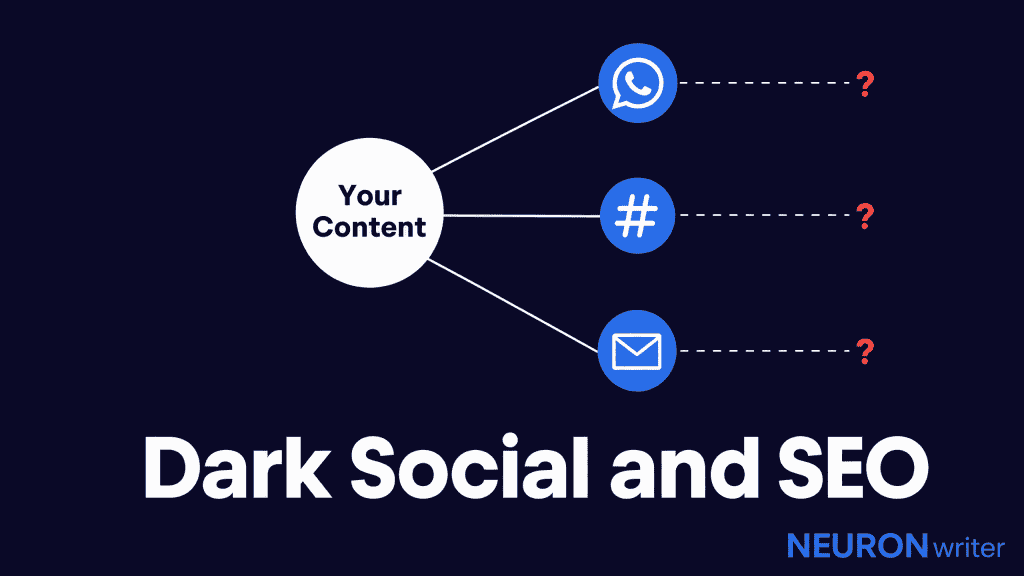
Dark social is not a glitch; it is how modern sharing works. It encompasses any web traffic that comes from outside sources where the referral data is absent.
According to recent data from SparkToro, up to 100% of visits originating from platforms like TikTok, Slack, Discord, and WhatsApp arrive with absolutely no referrer data. When a user clicks a link in one of these private channels, their device often opens an in-app browser or a privacy-focused browser that strips the origin data.
When GA4 receives a visitor without a referrer, it does not know what to do. So, it dumps them into the “Direct” or “Unassigned” bucket “GA4 ‘Direct’ is an error state, not a channel—it includes dark social shares, in-app browsers, stripped referrers, and AI-assisted brand discovery.” — SearchSignal
This creates a massive problem for SEO professionals. You are creating demand, but because the attribution handshake breaks, you cannot prove which piece of content drove the result.
Why Dark Social is Exploding in 2026.
The shift toward dark social has been accelerating for years, but three factors have made it the dominant force in 2026:
1.The Death of the Public Newsfeed: Users are exhausted by algorithmic feeds on public social media. Real, high-trust conversations have migrated to gated communities (Slack, Discord, private subreddits) and group chats.
2.AI-Assisted Discovery: When users discover your brand through an AI summary (like ChatGPT or Perplexity) and then search your brand name or navigate directly to your site, the original discovery touchpoint is lost
3.Strict Referrer Policies: Modern browsers prioritize user privacy. The W3C Referrer Policy specification allows sites to downgrade or strip referrer data, making cross-origin tracking increasingly difficult
As traditional Google Search pageviews decline (falling by as much as 34% year-over-year for some publishers), dark social is filling the void. It is where trust is built and purchasing decisions are made.
How to Measure the Invisible.
You cannot force private apps to send you referrer data, but you can build an evidence layer to estimate your dark social impact.
Triangulate “Deep Direct” Traffic.
True direct traffic usually lands on your homepage or a login screen. If you see a sudden spike in “Direct” traffic to a deep, specific blog post URL, that is almost certainly dark social sharing
By filtering your GA4 reports to isolate Direct traffic landing on deep URLs, you create a reliable proxy metric for dark social performance.
Implement Strict UTM Governance.
The simplest fix for dark social attribution is to tag every link you control. You should use UTM parameters on:
- Links in employee email signatures.
- Links shared in your own Slack/Discord communities.
- Links in downloadable PDFs and slide decks.
- “Link-in-bio” URLs on social platforms
Note: Never use UTMs on internal links on your own website, as this will overwrite session attribution
Use Self-Reported Attribution.
The highest-signal attribution data comes directly from the customer. Add a simple, open-text field to your high-intent forms (like demo requests or contact forms): “How did you hear about us?”
An open text field captures nuance that GA4 cannot: “My colleague shared your guide in our marketing Slack channel.”
The NEURONwriter Approach: Content Built for Sharing.
How do you optimize for a channel you cannot see? By creating content that demands to be shared.
Generic, AI-generated fluff does not get forwarded in a WhatsApp group. Dark social thrives on Information Gain unique insights, strong opinions, and dense, highly structured knowledge.
This is where NEURONwriter becomes your competitive advantage. While traditional SEO tools focus solely on search volume (a metric that ignores dark social entirely), NEURONwriter helps you build topical authority.
By using the NEURONwriter Content Editor to ensure your content is semantically complete and covers all relevant NLP entities, you create the definitive resource on a topic. When your content is the most comprehensive answer available, it becomes the default link that industry professionals share in their private networks. You win the dark social battle by winning the semantic war.
FAQ
What is dark social?
Dark social refers to web traffic that originates from private sharing channels—such as direct messages, Slack, Discord, WhatsApp, and email—where referral data is stripped away. Because analytics platforms cannot see where the user came from, this traffic is typically miscategorized as “Direct.”
Why does dark social show up as Direct traffic in GA4?
Google Analytics 4 relies on a chain of signals (like referrer headers and UTM parameters) to attribute traffic. When a user clicks a link in a private app, privacy settings or in-app browsers often strip these signals. Without a referrer, GA4 defaults to classifying the visit as “Direct.”
How can I track dark social traffic?
While you cannot track it perfectly, you can estimate it by isolating “Deep Direct” traffic (Direct traffic landing on specific blog posts rather than your homepage). You should also implement strict UTM tagging on links you control and use self-reported attribution on your forms.
Is dark social more valuable than traditional SEO traffic?
Often, yes. Dark social traffic is driven by peer-to-peer recommendations, which carry a much higher level of trust than a standard search engine result. A link shared by a colleague in a Slack channel usually converts at a higher rate than an anonymous Google click.
How do AI search engines impact dark social?
AI search engines and assistants contribute to the attribution crisis. If a user asks an AI about a topic, sees your brand mentioned, and then types your URL directly into their browser, the AI touchpoint is lost, and the visit is recorded as Direct traffic.
What is UTM governance?
UTM governance is the strict, standardized practice of adding tracking parameters (source, medium, campaign) to all external links you control. Proper UTM tagging ensures that when your links are shared or clicked, GA4 can accurately attribute the traffic instead of dumping it into the Direct bucket.
How does NEURONwriter help with dark social strategy?
Dark social relies on people sharing highly valuable, definitive content. NEURONwriter helps you achieve high semantic density and topical authority. By ensuring your content covers all necessary NLP terms and entities, you create the kind of comprehensive, expert-level resources that professionals naturally want to share in their private networks.