The Difference Between SEO, GEO, and AEO: A 2026 Glossary.
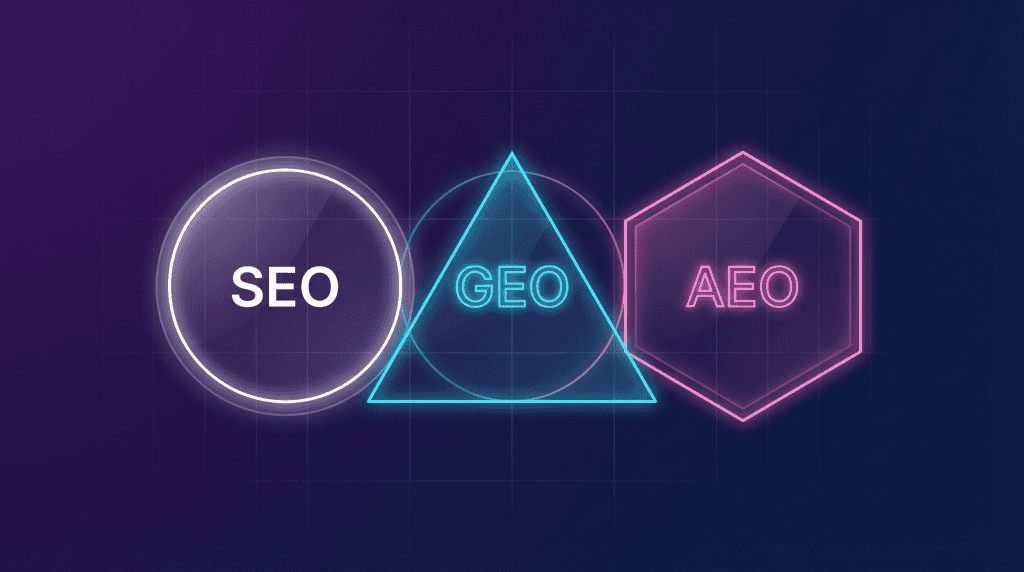
For years, the digital marketing industry relied on a single, universally understood acronym: SEO. Today, as we navigate the complexities of 2026, a new alphabet soup has emerged. SEO, GEO, and AEO are frequently thrown around in strategy meetings, often interchangeably. This confusion leads to wasted budgets, misaligned content strategies, and ultimately, lost revenue.
Understanding the real difference between these three disciplines is no longer an academic exercise; it is a business necessity. According to recent data, Google search traffic to traditional publishers has dropped by up to 33%, while AI-driven referrals convert at five times the rate of organic search.
The shift from traditional search engines to generative and answer engines is real, but understanding the shift is different from knowing what to do about it.
This comprehensive glossary and guide breaks down exactly what SEO, GEO, and AEO mean, how they overlap, how they differ, and which strategy your business should prioritize to dominate the search landscape in 2026.
SEO: Search Engine Optimization.
SEO (Search Engine Optimization) is the practice of optimizing web pages to rank high in traditional search engine results pages (SERPs) by matching user intent with authoritative, well-structured content and earning backlinks.
The Foundation of Digital Visibility.
SEO is the oldest and most established discipline, originating in the late 1990s. Its primary goal has always been straightforward: get your webpage to rank in the top 10 results (the “10 blue links”) for a specific target keyword on Google or Bing.
For example, if you run a SaaS company selling project management software, your SEO strategy involves creating a comprehensive landing page, optimizing your title tags and headers, ensuring fast page load speeds, and acquiring backlinks from reputable tech blogs. You measure success through keyword rankings, organic traffic volume, and click-through rates (CTR).
While the tactics have evolved dramatically over the decades from simple keyword density to complex Core Web Vitals and helpful content updates the fundamental mechanic remains the same. You optimize for a crawler, the crawler indexes your page, and the search engine algorithm ranks it based on relevance, authority, and user experience signals.
Why SEO is No Longer Enough.
However, in 2026, ranking #1 on Google does not guarantee visibility across all platforms. Research shows that only about 50% of pages ranking #1 on Google are also cited by AI search engines
The traditional SEO playbook is built for a world where users click through a list of links to find answers. In a world where AI models synthesize answers directly, traditional SEO must be augmented with new strategies. This is why SEO is no longer the only strategy you need, but rather the foundational layer upon which GEO and AEO are built.
AEO: Answer Engine Optimization.
AEO (Answer Engine Optimization) is the process of structuring content to appear as a direct answer to a user’s question, typically within Featured Snippets, voice search results, or knowledge panels.
The Shift Toward Zero-Click Search.
Coined around 2019 by experts like Jason Barnard, AEO anticipated the shift toward zero-click searches before generative AI became mainstream. The goal of AEO is not just to rank in a list of links, but to be the answer itself.
Consider a user asking their smart speaker, “How long do you boil an egg?” The user does not want a list of recipe blogs; they want a direct, immediate answer: “Boil an egg for 6 to 7 minutes for a soft center, or 9 to 12 minutes for a hard boil.”
To achieve this, AEO relies heavily on technical structuring:
- Structured data (Schema markup): Specifically FAQPage, HowTo, and QAPage schema.
- Inverted pyramid writing: Presenting the most critical information (the direct answer) immediately, followed by supporting details and context.
- Natural language targeting: Optimizing for conversational, question-based queries rather than disjointed keywords.
AEO as the Bridge to the Future.
AEO was the crucial stepping stone between traditional SEO and the AI-driven future. It taught marketers how to write for machines that extract facts rather than just indexing keywords. Today, AEO is largely being absorbed into the broader discipline of GEO, but its core principles—clarity, structure, and directness—remain vital for anyone looking to secure Featured Snippets or appear in voice search results.
GEO: Generative Engine Optimization.
GEO (Generative Engine Optimization) is the strategy of optimizing content and building brand authority to ensure your brand and information are cited by AI platforms like ChatGPT, Perplexity, Claude, and Google AI Overviews.
The New Frontier of AI Search
GEO is the newest and most expansive discipline, formalized in a 2024 research paper by researchers from Princeton, Georgia Tech, and the Allen Institute for AI
GEO encompasses the goals of AEO but applies them to the complex, nuanced world of Large Language Models (LLMs) and generative search engines.
The goal of GEO is to secure citations, brand mentions, and share of voice in AI-generated answers. This requires understanding that not all AI platforms work the same way. The Princeton study and subsequent research have identified three distinct types of generative engines:
1.LLM-Native Engines (e.g., Claude, ChatGPT without browsing): These models generate answers based purely on their training data. They do not perform real-time web searches. To be recommended here, your brand must be widely discussed across the web. Brand search volume and overall brand authority are the strongest signals
If your product is frequently mentioned in forums, reviews, and industry publications, it becomes part of the LLM’s “knowledge.”
2.Search-Augmented Engines (e.g., Perplexity, Google AI Overviews): These platforms perform real-time web searches (Retrieval-Augmented Generation, or RAG) before synthesizing an answer. To succeed here, your content must be crawlable, highly relevant, structurally sound, and factually dense.
3.Hybrid Engines (e.g., Gemini, Copilot): These combine trained knowledge with real-time retrieval, requiring a mix of strong brand presence and technically optimized, fresh content.
For instance, if a user asks Perplexity, “What is the best CRM for small businesses?”, a successful GEO strategy ensures that your CRM is not only mentioned in the AI’s response but also cited with a clickable link to your website.
Comparing the Three Disciplines.
To clarify the distinctions, here is a comprehensive breakdown of how SEO, AEO, and GEO differ across key dimensions:
| Feature | SEO (Search Engine Optimization) | AEO (Answer Engine Optimization) | GEO (Generative Engine Optimization) |
| Primary Target | Google, Bing (Traditional SERPs) | Featured Snippets, Voice Assistants | ChatGPT, Perplexity, AI Overviews |
| Main Goal | Rank #1 for target keywords | Provide the direct, extracted answer | Earn citations and brand mentions in AI outputs |
| Key Metrics | Organic traffic, Rankings, CTR | Featured Snippet wins, Voice appearances | Citation frequency, Share of Voice, Brand Mentions |
| Core Tactics | Backlinks, Keyword targeting, Technical SEO | Schema markup, FAQ formatting, Direct answers | Brand authority, Content density, llms.txt, Entity Salience |
| User Experience | User clicks a link and reads the page | User gets a quick answer without clicking | User engages in a conversational dialogue with AI |
| Content Style | Long-form, comprehensive guides | Concise, inverted pyramid, Q&A format | Fact-dense, highly structured, authoritative |
How to Measure Success in SEO, AEO, and GEO.
One of the biggest challenges marketers face is knowing how to track ROI across these different disciplines. You cannot use traditional SEO metrics to measure GEO success. Here is how you should measure each:
Measuring SEO Success
- Keyword Rankings: Tracking your position for target queries using tools like Google Search Console or Ahrefs.
- Organic Traffic: The volume of visitors arriving from traditional search engine results.
- Click-Through Rate (CTR): The percentage of users who click your link after seeing it in the SERPs.
- Conversions: The ultimate goal—leads generated or sales made from organic traffic.
Measuring AEO Success.
- Featured Snippet Ownership: Tracking how many “Position Zero” spots your content occupies.
- Voice Search Impressions: Monitoring appearances in voice assistant responses (often correlated with Featured Snippets).
- “People Also Ask” (PAA) Visibility: Tracking your presence in Google’s PAA dropdowns.
Measuring GEO Success.
- Citation Frequency: How often your brand or URL is linked as a source in AI-generated answers (tracked via specialized AI visibility tools or manual testing).
- Share of Voice in LLMs: The percentage of times your brand is recommended compared to competitors when users ask AI for recommendations in your category.
- Brand Search Volume: An indirect but crucial metric; as your GEO efforts increase brand awareness, you should see an uptick in users searching for your brand name directly.
- Referral Traffic from AI Bots: Tracking traffic sources like chatgpt.com or perplexity.ai in your analytics platform.
A Practical Action Plan: What to Do First.
Faced with three different optimization strategies, it is easy to feel overwhelmed. Here is a practical, phased approach to building a unified search strategy in 2026:
Phase 1: Build the SEO Foundation.
You cannot succeed in GEO if your site is not technically sound and crawlable. Start here:
1.Ensure your site speed (Core Web Vitals) is optimized.
2.Fix broken links and ensure a logical site architecture.
3.Create comprehensive, high-quality content that satisfies user intent for your core topics.
Phase 2: Implement AEO Tactics
Once your foundation is solid, structure your content to provide direct answers:
1.Add FAQ sections to your core pages, using natural language questions.
2.Implement FAQPage and Article schema markup.
3.Use the inverted pyramid writing style: put the direct answer at the top of the section, followed by the details.
Phase 3: Execute the GEO Strategy
With a structured, authoritative site, you can now focus on AI citations:
1.Focus on Information Gain: provide unique data, proprietary research, or expert insights that AI models cannot find elsewhere.
2.Increase your Entity Salience: ensure your content thoroughly covers all related concepts and entities associated with your topic.
3.Build Brand Authority: invest in digital PR, get mentioned in high-tier publications, and encourage reviews to build your presence in LLM training data.
4.Implement AI-specific technical signals like llms.txt to help autonomous agents parse your site easily.
How NEURONwriter Bridges the Gap Between SEO and GEO.
Navigating the transition from traditional SEO to GEO requires tools that understand semantic relevance and entity relationships.
Unlike older optimization tools that merely count keyword frequency and encourage “keyword stuffing,” NEURONwriter uses advanced NLP (Natural Language Processing) to analyze the semantic density of your content. When AI engines like Perplexity or Google AI Overviews scan the web for sources to cite, they do not look for exact-match keywords; they look for comprehensive entity coverage and factual density.
By using NEURONwriter Content Editor, you ensure that your article includes the precise terms, concepts, and related entities that LLMs associate with your topic. Furthermore, NEURONwriter built-in Draft & Outline builder helps you structure your content with the clear H2/H3 hierarchies and direct answers that are essential for both AEO and GEO success.
If you want your content to rank on Google and be cited by ChatGPT, NEURONwriter provides the semantic blueprint to achieve both, ensuring your brand remains visible no matter how the search landscape evolves.
FAQ: SEO, GEO, and AEO in 2026
What is the main difference between SEO and GEO?
SEO focuses on ranking web pages in traditional search engine results (like Google’s 10 blue links) to drive traffic. GEO focuses on getting your brand and content cited as a source in answers generated by AI platforms like ChatGPT and Perplexity.
Is AEO the same as GEO?
No. AEO (Answer Engine Optimization) is an older concept focused on providing direct answers for Featured Snippets and voice search. GEO (Generative Engine Optimization) is a broader, newer discipline focused on securing citations within complex, AI-generated responses from Large Language Models.
If I rank #1 on Google, will AI search engines automatically cite my content?
Not necessarily. Studies show that only about 50% of pages ranking #1 on Google are also cited by AI search engines. AI models prioritize brand authority, semantic density, and specific formatting over traditional ranking signals like backlinks.
Should my business focus on SEO or GEO first?
You should build a foundation with SEO and AEO first, ensuring your site is crawlable and well-structured. However, you must simultaneously invest in GEO by building brand authority and semantic relevance, as AI search continues to capture a larger share of user queries.
How does brand search volume affect GEO?
Brand search volume is one of the strongest signals for AI citations. If your brand is frequently searched for and discussed across the web, it creates stronger neural patterns in LLMs, making them more likely to recommend your products or cite your content.
What technical changes do I need to make for GEO?
Beyond traditional technical SEO, GEO benefits from clear semantic HTML structure, comprehensive Schema markup, high content density, and the implementation of AI-specific files like llms.txt and AGENTS.md to help autonomous agents parse your site efficiently.