AI Citation Tracking: How to Build Source Maps for AI Answers
Semantic Summary
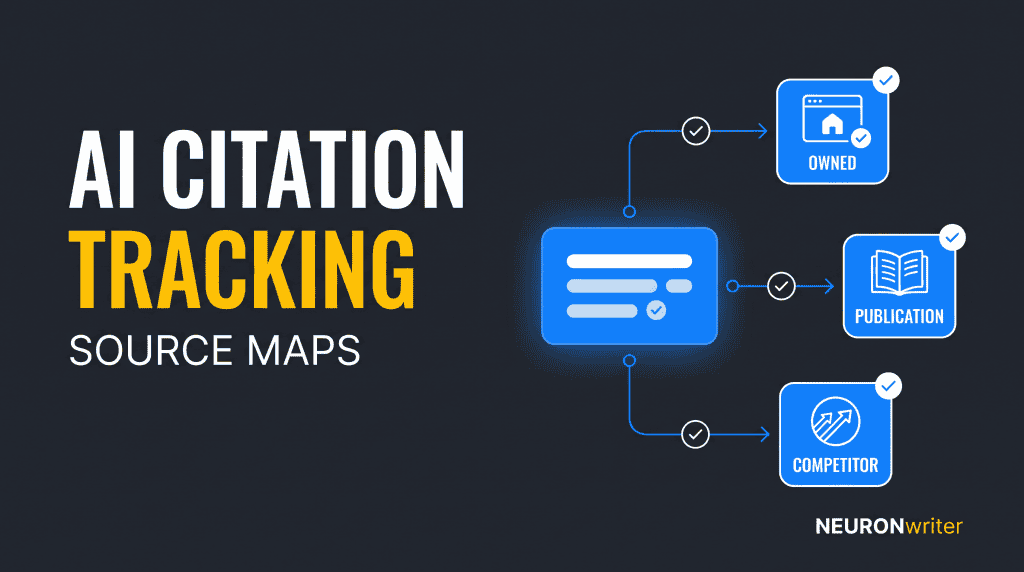
Idea: AI citation tracking tells you whether an AI engine cites or mentions a brand. A citation source map goes further: it records the prompt, the answer, each visible citation, the claim that citation appears to support, the relevant owned or third-party URL, and the action a team can justify.
Challenge: Citation frequency, citation share, and referral traffic from AI are useful signals, but they do not explain why one AI-generated answer uses a page or prove that changing a page will produce a particular result. Teams can easily mistake a dashboard observation for a causal finding.
Summary: Build an AI citation source map for one important prompt at a time. Capture the answer context, verify every source, match claims to evidence, map owned and competitor pages, assign a confidence level, and choose the smallest defensible action. This turns a citation gap into a reliable editorial, product, or brand decision.
Related reads:
How to Get Cited by AI: From Citation Gap to Content Brief
AI Visibility Measurement Framework for Content Teams
Brand Mentions vs. Backlinks: Why AI Search Changed the Rules
A team can see an AI citation and still not know what it means. A cited URL may support a definition, a single product fact, a comparison criterion, a price claim, or only one small passage in a much broader AI answer. A brand may be mentioned without a linked source. A competitor may be cited even when the answer presents incomplete information. And a referral visit may prove that someone clicked, but not how often the same source appeared across AI results.
A sound AI citation tracking programme therefore needs two connected views. The first is visibility monitoring: a stable prompt set, recurring checks across AI engines, and simple metrics such as citation frequency, citation rate, brand mentions, and citation share. The second is source mapping: a documented investigation when one high-value AI result needs explanation. Together, they help teams track citations without confusing an observed pattern with a proven cause.
That is why AI citation tracking needs a second layer: a source map. The map is a structured record for investigating one important answer. It helps a content, product, or brand team move from “we were not cited” to a more useful question:
Which claim is the AI answer making, what visible source is attached to that claim, what evidence does our owned content provide, and what action is proportionate to the gap?
This article is not another list of the best AI citation tracking tools. It is a practical framework for using the data those tools, manual checks, analytics, and SEO tools provide. The aim is to create a defensible explanation not to promise that a page edit will force ChatGPT, Perplexity, Google AI Overviews, or another AI platform to cite a particular URL.
What an AI Citation Source Map Is.
An AI citation source map is a claim-level record of the visible sources and relevant pages behind one observed AI answer.
It connects an input prompt to the answer shown at a particular moment, then records what the answer says, which source is visible, what the source actually supports, and how the finding should be handled.
A source map is deliberately narrower than a broad AI visibility dashboard. Dashboards are useful for monitoring many prompts across AI engines and comparing mentions and citations over time.
A map is used when one answer matters enough to inspect carefully for example, a buyer-stage comparison, an inaccurate product description, a market-specific availability claim, or a recurring category definition.
| Asset | Primary question | Best use | What it cannot establish alone |
| AI citation tracking dashboard | Is the brand or domain cited across selected prompts? | Trend monitoring, coverage, citation frequency, and competitive observation. | Why a specific page was selected or what edit will change a future answer. |
| AI visibility report | How visible is the brand across a defined prompt set? | Leadership reporting, opportunity review, and recurring planning. | Claim-level evidence for one controversial or high-risk response. |
| Citation source map | Which sources and claims shape one observed answer? | Careful diagnosis and assignment of one defensible action. | A universal model of every source an AI system considered. |
| Content brief | What should a creator or reviewer change next? | Producing a source-backed, original content action. | Replacing the evidence record that justified the brief. |
The final limitation is important. A visible citation is evidence that the source was displayed with an answer. It is not a complete audit log of every input an AI system used, nor a guarantee that the source alone caused the wording. Keep the map honest about what was observed and what was inferred.
Why Citation Tracking Alone Does Not Explain an AI Answer.
Tracking tells you what appeared; source mapping helps you investigate the context and decide what to do.
This distinction prevents a familiar mistake in AI search analytics: treating every metric as a direct explanation.
AI citation tracking tools can help teams track AI citations, mentions and citations, competitors, citation share, and citation frequency across AI systems. They can also support monitoring across ChatGPT, Perplexity, Google AI Overviews, Google AI Mode, and other AI engines. That data is valuable, especially for B2B marketing teams that need to monitor brand visibility across a stable set of buyer prompts.
However, an observation remains only one layer of evidence. A source may be cited because of its specific claim, its clear wording, the recency of its information, its domain-level authority, its availability in the system’s retrieval process, or a combination of factors that is not externally visible. This means the correct response to an AI citation gap is not automatically “create a competing blog post.”
| Signal | What it can suggest | What it does not prove | Better next step |
| A competitor URL is cited | The source may be useful for a visible claim or prompt context. | The competitor’s whole page is the only reason for the citation. | Verify the claim, source type, and missing owned evidence. |
| Your brand is mentioned but not cited | The brand has conversational visibility. | The mention will drive clicks or is supported by an owned source. | Check accuracy, source context, and whether a source gap matters. |
| Your URL is cited once | The page appeared in one observed answer. | Your citation rate is improving across AI engines. | Re-run a stable prompt set and log the observation. |
| Referral traffic from AI rises | Some AI results may be sending visitors. | Every prompt or citation has grown at the same rate. | Combine analytics with prompt-level monitoring and landing-page review. |
| Citation share changes | Relative visibility may have changed inside the monitored sample. | A wider market-wide ranking has changed. | Review the prompt sample, answer context, and measurement method. |
This is why a source map must preserve prompt context. The exact query, language, market, date, account state where relevant, and AI platform should all be attached to the record. An answer generated from “best AI citation tracking tools for B2B marketing teams” is not interchangeable with “how can I check whether ChatGPT cites my site?” even if both discuss citations.
Google advises publishers to focus on useful, people-first content rather than producing large volumes of pages aimed at specific query variations.
A source map supports that principle: it helps a team improve the most relevant canonical destination, source of truth, or product explanation instead of multiplying similar content.
The Five Layers of a Citation Source Map.
A strong citation source map separates observation from interpretation. The following five layers provide a practical structure that works in a spreadsheet, an issue tracker, or a governed AI visibility workflow.
1. Prompt and Answer Record.
The prompt-and-answer layer captures exactly what was observed. Start with the original prompt text. Do not shorten it into a keyword unless the original context is stored elsewhere. Record the AI engine, date, language, market, and any material conditions that could affect the output.
| Field | What to capture | Why it matters |
| Prompt ID | A stable identifier for the query. | Lets the team compare the same prompt across time. |
| Full prompt | Exact wording in natural language. | Preserves buyer context and constraints. |
| AI engine | ChatGPT, Perplexity, Google AI Overviews, Google AI Mode, or another named platform. | Results can differ across AI platforms. |
| Observation context | Date, language, country/market, and relevant session details. | Keeps one result from being misread as a universal result. |
| Answer capture | The displayed answer or a permitted evidence record. | Provides the text that sources and claims must be matched against. |
| Initial classification | Definition, comparison, procedure, objection, evidence request, or another prompt type. | Helps route the finding to the right owner. |
Use one prompt record per meaningful observation. If the wording changes substantially, treat the check as a new prompt. If the wording is stable but the answer changes, create a new observation under the same prompt ID. This is more reliable than overwriting an old result and losing the history.
2. Cited-Source Layer.
The cited-source layer records every source that is visible with the answer. A source may be an owned page, a competitor page, a publication, a directory, a review platform, a community thread, documentation, or another third-party URL.
Do not assume that a citation is authoritative simply because an AI engine displayed it. Open the page and read the relevant passage. Confirm that the URL is live, current, and relevant to the claim in the answer.
| Source field | Example | Review question |
| Displayed source URL | https://example.com/guide | Is this the exact URL shown in the answer? |
| Source type | Owned documentation, review site, editorial article, forum thread. | What kind of evidence does it provide? |
| Domain relationship | Owned, competitor, independent third party. | Who controls the source and what incentive may exist? |
| Publication or update signal | Visible date, release note, last updated statement. | Could the source be outdated for this claim? |
| Citation placement | Inline, sidebar, source list, card, or adjacent reference. | Which part of the answer appears connected to the source? |
| Access status | Public, gated, removed, redirected, or blocked. | Can a reviewer independently verify it? |
A citation source map does not need to judge every source as “good” or “bad.” It should describe what the source is, what it supports, and where uncertainty remains. This makes later review calmer and more useful than an unstructured screenshot archive.
3. Claim-to-Source Layer.
The Claim-to-Source Layer is the heart of the entire map. Its purpose is to verify whether every statement generated by AI is actually supported by the sources it cites.
The process begins by breaking the AI-generated answer into individual claims. Although an AI response may look like a single, coherent paragraph, it often contains several separate pieces of information, each of which should be verified independently.
For example, an AI answer about an AI search visibility platform might include four different claims:
- what the product does,
- who it is designed for,
- which features it offers,
- and why it is better than competing solutions.
Each claim is then evaluated by asking a simple set of questions:
- Did the AI provide a source for this claim?
- Does that source actually support the claim when you open it?
- How confident can you be that the claim is accurate?
This step is essential because a single citation rarely validates an entire AI-generated answer. A product feature page may confirm that a feature exists, but it does not prove that the product is the best choice on the market. Likewise, a third-party review reflects the author’s opinion rather than an objective fact.
| Claim ID | Visible claim in the AI answer | Source | Does the source support it? | Confidence | Notes |
| C-01 | “The platform tracks AI citations.” | Product feature page | Yes | High | The capability is clearly described in the documentation. |
| C-02 | “It supports a specific AI platform.” | Product documentation | Partly | Medium | Availability may depend on the subscription plan or market. |
| C-03 | “It is the best solution for enterprise agencies.” | Third-party review | Opinion rather than fact | Low–Medium | Preserve it as the reviewer’s opinion, not as product truth. |
| C-04 | “It replaces traditional SEO.” | Editorial opinion article | No | Low | This is an exaggerated claim that requires clarification. |
This analysis often reveals that the problem is not missing content. In many cases, the information already exists on the company’s website but is presented in a way that is ambiguous or difficult for AI systems to interpret. Sometimes the product documentation needs to be updated. In other cases, AI may rely on an independent third-party source that your brand should not attempt to replicate, but should instead understand as a trusted external reference.
By mapping every claim to its supporting evidence, the process replaces assumptions with verifiable facts. Instead of guessing why AI produced a particular answer, you can identify exactly which source influenced each statement and determine whether that evidence genuinely supports the conclusion.
4. Owned-Page and Competitive Context Layer.
The owned-page layer compares what the answer cites with the content your organisation already has. It should include the canonical page that best addresses the decision, any supporting pages, and any third-party source that strongly shapes the answer narrative.
This layer is not a backlink report and not a request to replicate a competitor’s URL structure. It is a content and evidence comparison. The team asks whether its existing assets make a clear, current, and source-backed contribution to the user’s question.
| URL role | What to map | Decision value |
| Owned canonical page | The best existing page for the prompt’s underlying task. | Prevents unnecessary new URLs and strengthens topic ownership. |
| Owned supporting page | Documentation, case study, feature page, FAQ, or help content. | Identifies where internal links or clarification can improve the evidence path. |
| Competitor cited page | The page visibly cited for a relevant claim. | Shows what type of source the AI answer displayed—not a guaranteed ranking formula. |
| Independent cited page | Review site, industry publication, community discussion, or other third party. | Reveals evidence and reputation gaps that owned content cannot solve alone. |
| Missing source type | A type of proof absent from the owned estate, such as a product fact, methodology page, or original example. | Guides a specific, non-duplicative content or documentation action. |
This comparison is especially useful when a brand has a citation gap but no obvious content gap. If AI answers repeatedly cite independent reviews, the next action may be to improve public product information, collect accurate third-party coverage, or correct an outdated statement—not to publish a self-promotional page that repeats the same claim.
5. Action and Confidence Layer.
The final layer converts the map into one accountable next step. A source map is not complete until the team distinguishes a confirmed observation from an interpretation and assigns the smallest action that the evidence supports.
| Confidence level | Meaning | Suitable action |
| High | The answer, source, and underlying claim are clear and independently verified. | Create a tracked task with an accountable owner. |
| Medium | The pattern is plausible but source scope, context, or repeatability needs more review. | Re-check stable prompts or request a fact review before publishing. |
| Low | The source is unclear, the answer is unstable, or the claim is interpretive. | Mark as observe only; do not build a content task around it. |
The action should name an owner and acceptance condition. “Improve AI visibility” is too vague. “Product marketing validates the feature description on the canonical AI Visibility page and documents scope by 15 September” is specific, reviewable, and appropriately limited.
How to Build a Source Map for One Important Prompt.
Start with a single decision that matters. A narrow map is faster to verify and more likely to produce a useful action. Avoid mapping a generic, low-risk question merely because it is easy to find in an AI citation tracking tool.
Capture the Prompt Context Before Interpreting the Answer.
Choose a prompt with a real business reason for investigation. This might be a buyer-stage comparison, a reported product misconception, a high-value market question, or a recurring question from sales and support.
Write down the prompt and context first. Then capture the answer and visible citations. Avoid rewriting the prompt after seeing the result; doing so makes later comparison harder. A stable prompt set is the foundation of meaningful AI visibility tracking.
Verify Each Citation and Claim.
Open each visible source. Read the cited page. Compare the claim in the AI answer with the actual text, context, date, and scope of the source. If the source is an owned page, check it against approved product facts. If it is a third-party page, separate its opinion from demonstrable facts.
This is where manual review remains essential. AI tools can surface citation data, but a human reviewer must verify important claims. A source map should make it easy to say “the answer is accurate,” “the answer is partly accurate,” “the source does not support this wording,” or “we cannot tell from the available evidence.”
Map Owned, Competitor, and Third-Party URLs.
Add the most relevant owned canonical page even if it was not cited. Add visible competitor and third-party URLs where they affect the decision. Keep the goal focused: you are mapping a narrative around one prompt, not auditing the entire internet.
| Observation pattern | Likely interpretation | Proportionate response |
| The AI cites an owned page for the correct claim. | The page may be contributing useful evidence for this prompt. | Preserve quality, review for factual currency, and monitor directionally. |
| The AI cites a competitor page for a claim your owned page covers weakly. | Your content may be unclear, unsupported, or less visible for this answer context. | Strengthen the canonical page only if it needs a real user-facing improvement. |
| The AI cites an independent review with an outdated feature claim. | The reputation or third-party information layer may be incomplete. | Request correction through the appropriate relationship; do not rely only on owned content. |
| The AI mentions the brand but cites no owned URL. | The brand may have awareness without a visible source path. | Inspect product facts, public proof, and content clarity; avoid assuming a single fix. |
| No relevant source is visible. | The answer may not expose enough evidence to diagnose confidently. | Record low confidence and re-check later rather than guessing. |
Assign One Evidence-Backed Action.
Finish each map with one decision. Possible actions include: refresh an outdated product fact, add a clear evidence section to a canonical guide, improve a relevant internal-link path, create a source-backed content brief, request correction of a third-party inaccuracy, or observe again after a specified review date.
The How to Get Cited by AI workflow is useful when the evidence shows a genuine content opportunity. Use it after not before you have identified the user decision, source gap, and canonical route.
AI Citation Tracking Metrics: Reading Citation Patterns Without Overclaiming.
Citation data becomes more useful when teams distinguish reach, evidence, and impact.
A dashboard can report citation frequency and citation share. An analytics platform can report referral traffic from AI. A source map can show whether visible sources support important claims. None of these measures should be presented as a complete ranking system for all AI engines.
| Measure | Practical definition | Responsible interpretation |
| Citation frequency | How often an observed source or brand appears as a citation in the monitored prompt sample. | A directional measure of presence in that sample. |
| Citation rate | The share of tracked answers in which a source is cited. | Useful only when the prompt set, engine, and method are clearly defined. |
| Citation share | The relative share of citations among tracked brands or domains. | A competitive comparison inside the selected sample, not market share. |
| Brand mention | A visible name reference without an attached source URL. | Conversational visibility; it may not create a click or prove source influence. |
| Referral traffic from AI | Visits attributed to identifiable AI or answer-engine referrals. | Evidence of clicks, not a count of all citations or answer impressions. |
| Citation impact | A documented connection between a citation pattern and a business outcome. | Requires cautious attribution and more than one dashboard signal. |
You can combine information from AI citation tracking, website analytics, Google Search Console, and your SEO data to build a more complete picture of your online visibility. However, these metrics should not be merged into a single score unless you clearly explain how it was calculated. Search rankings, AI citations, website traffic, and conversions each measure a different stage of the customer journey.
This is especially important when reporting results to managers or clients. A good report explains what changed, how it was measured, what it might mean, and what is still uncertain. This approach is much more trustworthy than assuming that a single AI citation or competitor mention explains every change in visibility.
A simple AI citation tracking scorecard should include:
- the number of queries being monitored,
- how often your brand was cited,
- the percentage of answers that cited your brand,
- your share of all citations,
- how often your brand was mentioned,
- the type of sources AI used,
- the AI platform where the citation appeared,
- and, where possible, the amount of website traffic coming from AI tools.
If you notice a significant increase or decrease in visibility, link it to your source map. This makes it easier to understand why the change happened, rather than simply seeing that it happened.
How AI Citation Tracking Tools Fit Into a Citation Source Map.
AI citation tracking tools and AI visibility monitoring platforms answer different questions from a source map.
A citation tracking tool can help a team monitor AI citations, brand citations, mentions and citations, citation frequency, citation rate, and citation share across AI engines. It may also show visibility across ChatGPT, Perplexity AI, Google AI Overviews, and Google AI Mode. That is valuable citation data for B2B marketing teams, but it is only the observation layer.
A source map uses that observation to perform citation analysis on one AI-generated answer. It tests whether the citation source supports a meaningful claim, whether the source is owned or third party, and whether an action would improve the user’s experience. The map should not be used to declare that a URL has a guaranteed ranking advantage inside AI systems.
| Data or tool category | What it is good for | What the source map adds |
| AI citation monitoring | Tracking across AI engines, including citation behavior, brand mentions, and citations across ChatGPT or Perplexity. | The prompt context, claim-to-source match, confidence level, and documented action. |
| Citation tracking tool | Monitoring citation frequency, citation rate, and citation share for a defined set of queries. | A check of whether one visible citation actually supports a critical claim. |
| SEO tools and traditional SEO analytics | Studying keyword demand, organic search visibility, backlinks, rankings, and content gaps. | A separate view of citations inside AI results, which traditional SEO data cannot fully explain. |
| Web analytics | Measuring referral traffic from AI, landing-page behaviour, conversions, and assisted outcomes. | A bridge from the clicked URL to the answer and source context that preceded the visit. |
| Manual audit | Reviewing a specific AI answer, source, and visible citation. | A repeatable structure so the review can be compared, assigned, and checked again. |
When comparing lists of the best AI citation tracking tools, check what the platform actually observes: an AI answer, an AI citation, a brand mention, citation data, referral traffic, or a combination. Do not assume an AI bot exposes its entire retrieval process to the tool. Likewise, do not assume that a visible source proves a hidden citation ranking formula. A careful map keeps AI search visibility work evidence-led.
How NEURONwriter Supports Citation Source Mapping.
NEURONwriter helps teams monitor AI visibility across selected prompts; a source map gives those observations an evidence and action layer. The AI Visibility module can help teams review brand mentions, website citations, competitors, opportunities, and AI readiness across AI-generated answers and supported platforms.
Use the platform to identify a prompt worth investigating, then build a map around that prompt. A content strategist can examine a citation gap. A product marketer can verify a feature claim. An agency can identify whether a client’s issue is an owned-content problem, a third-party reputation problem, or an observation that needs more data.
The map also supports better internal collaboration. It connects the answer’s wording to a source, the source to a claim, the claim to an owned page, and the page to an accountable decision. This makes AI citation monitoring less like a list of alerts and more like a controlled content operations workflow.
Frequently Asked Questions.
What is AI citation tracking?
AI citation tracking is the practice of monitoring whether AI systems cite a domain, page, or source when answering selected prompts. It can also track brand mentions, competitor citations, citation frequency, and other AI visibility signals across a defined prompt sample.
What is an AI citation source map?
An AI citation source map is a claim-level record for one important AI answer. It connects the prompt, answer, visible citations, supported claims, relevant owned and third-party URLs, confidence level, and next action. It is designed for diagnosis, not as proof of a platform’s hidden ranking algorithm.
Are AI mentions and AI citations the same thing?
No. A brand mention means the brand appears in an answer. An AI citation usually includes a visible source reference or linked URL. Both can matter for brand visibility, but citations provide a clearer starting point for reviewing source context and possible referral traffic.
Can a citation source map prove why an AI engine cited a page?
No. A source map records what was visible in an observed answer and whether the source supports the related claim. It cannot reveal every source an AI system considered or prove that a single page caused the answer. Use confidence labels and avoid causal claims that the evidence cannot support.
Which prompts should a team map first?
Start with prompts that affect a material decision: buyer-stage comparisons, high-value product claims, recurring misconceptions, market-specific availability questions, or support issues. A broad low-risk definition often needs monitoring, but it may not justify a full source-map investigation.
How often should a team update an AI citation source map?
Review it when the product, source, market, or answer changes materially, and re-check stable high-priority prompts on a documented cadence. The right schedule depends on the risk and volatility of the claim, not on a fixed universal frequency.
Should every citation gap become a new content page?
No. Many citation gaps are best addressed by improving a canonical page, clarifying documentation, correcting a third-party source, strengthening internal links, or observing the answer again. Create a new URL only when it serves a materially distinct user task with unique evidence.
Can NEURONwriter help with AI citation source maps?
NEURONwriter can help teams monitor selected prompts, citations, mentions, competitors, and AI visibility opportunities. The source map is the operating layer that documents what the observation means, which evidence supports it, and which person should decide the next action.