
Purpose and Marketing Positioning
The Competitors module helps users understand which brands, domains, and pages are winning visibility in AI-generated answers. It moves the conversation from “How visible are we?” to “Who is AI recommending, mentioning, or citing instead of us?” In the inspected interface, the module included sub-tabs for Summary, Most cited pages, Most cited domains, and Competing brands.
From a marketing perspective, this module is essential because AI visibility is competitive by nature. A brand may have useful content and strong SEO performance, but if AI systems consistently mention competitors, cite competitor domains, or source third-party pages instead, the brand may lose influence during the customer’s decision process. The Competitors module helps teams identify where competitors have stronger authority, better topical coverage, more frequent mentions, or more citation-worthy content.
|
Competitor View |
Marketing Question It Answers |
How Teams Can Use It |
|
Summary |
Which domains and brands dominate the monitored AI visibility landscape? |
Use it for an executive-level competitor snapshot. |
|
Most cited pages |
Which specific URLs are AI systems using as sources? |
Analyze page formats, content depth, and authority signals. |
|
Most cited domains |
Which websites are repeatedly cited in AI answers? |
Identify publishers, communities, and competitor domains with strong source presence. |
|
Competing brands |
Which brands are mentioned in AI responses? |
Compare brand awareness and recommendation frequency. |
The Competitors module should be used as the competitive intelligence layer for AI visibility. It shows not only whether the monitored brand is visible, but also which alternatives are shaping the market conversation.
Understanding the Summary View
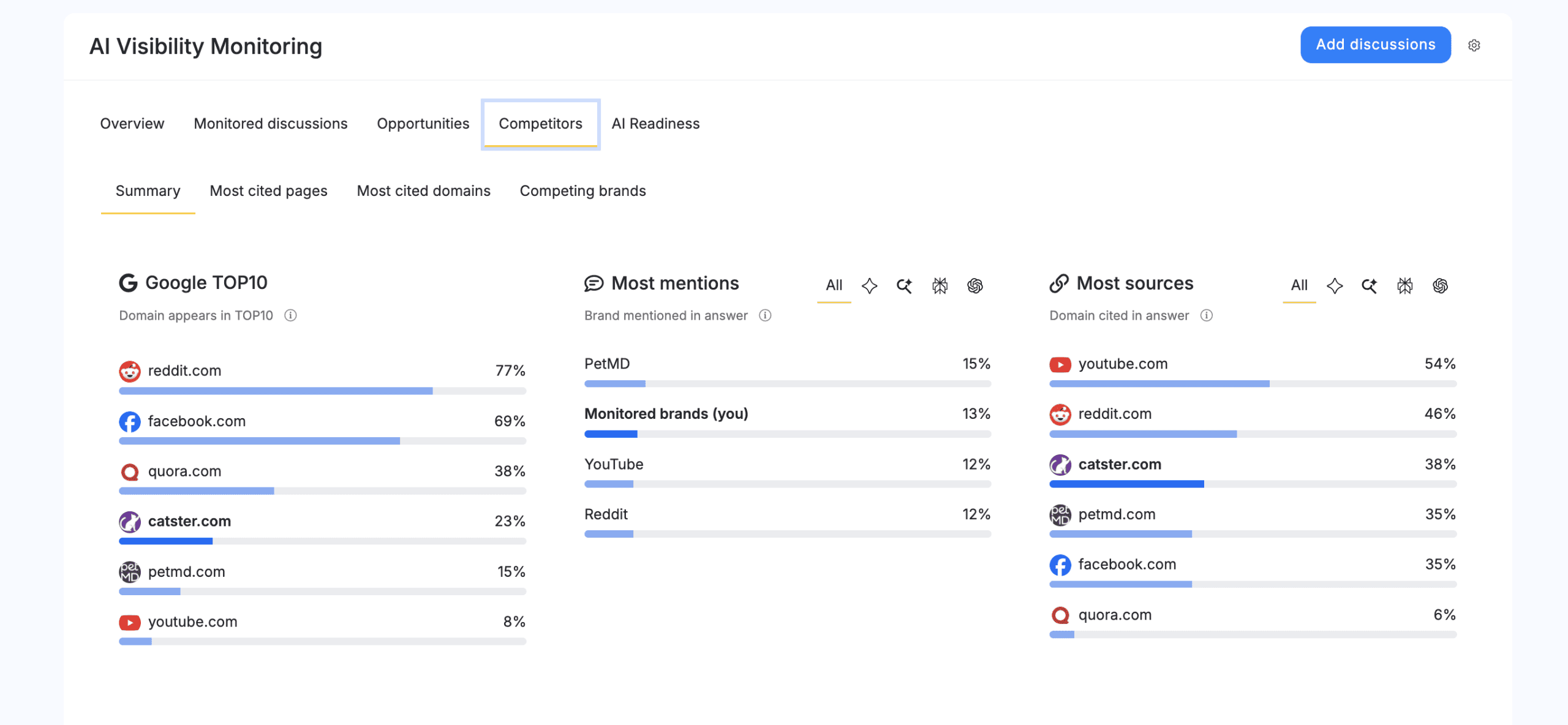
The Summary view presents three high-level panels: Google TOP10, Most mentions, and Most sources. Each panel gives a different view of competitive strength. Google TOP10 reflects classic search result presence, Most mentions shows brands that appear in AI answers, and Most sources shows domains cited by AI answers.1
|
Panel |
What It Measures |
Marketing Interpretation |
|
Google TOP10 |
Domains appearing in Google’s top organic results for monitored discussions. |
Strong organic search visibility may support AI visibility and topic authority. |
|
Most mentions |
Brands mentioned directly in AI-generated answers. |
These are the brands AI systems may recommend, compare, or reference. |
|
Most sources |
Domains cited as sources in AI-generated answers. |
These sites may be trusted or frequently used as evidence by AI systems. |
In the inspected project, the Summary view showed domains such as reddit.com, youtube.com, seoclarity.net, developers.google.com, and moonello.com in the Google TOP10 panel. The Most mentions panel included brands such as CentrumRowerowe, BikeWorld, Decathlon.
Step-by-Step: How to Use the Competitors Module
- Open AI Visibility and select the Competitors tab. The module will display competitor-related data for the monitored AI discussions.
- Start with the Summary sub-tab. This gives a fast overview of domains that rank, brands that are mentioned, and sources that AI systems cite.
- Review Google TOP10 first. This panel helps determine whether competitors or third-party sources already dominate traditional search results for the monitored topics. If the monitored brand is absent here, SEO improvements may be needed alongside AI visibility work.
- Review Most mentions. This panel shows which brands are frequently named in AI-generated answers. If competitors are mentioned more often than the monitored brand, the team should review their positioning, content depth, reviews, comparisons, and broader market visibility.
- Review Most sources. This panel identifies domains that are cited in AI answers. If non-competitor publishers or communities are cited frequently, they may represent outreach, partnership, or content placement opportunities. If competitor domains are cited, their content may be more useful, authoritative, or accessible to AI systems.
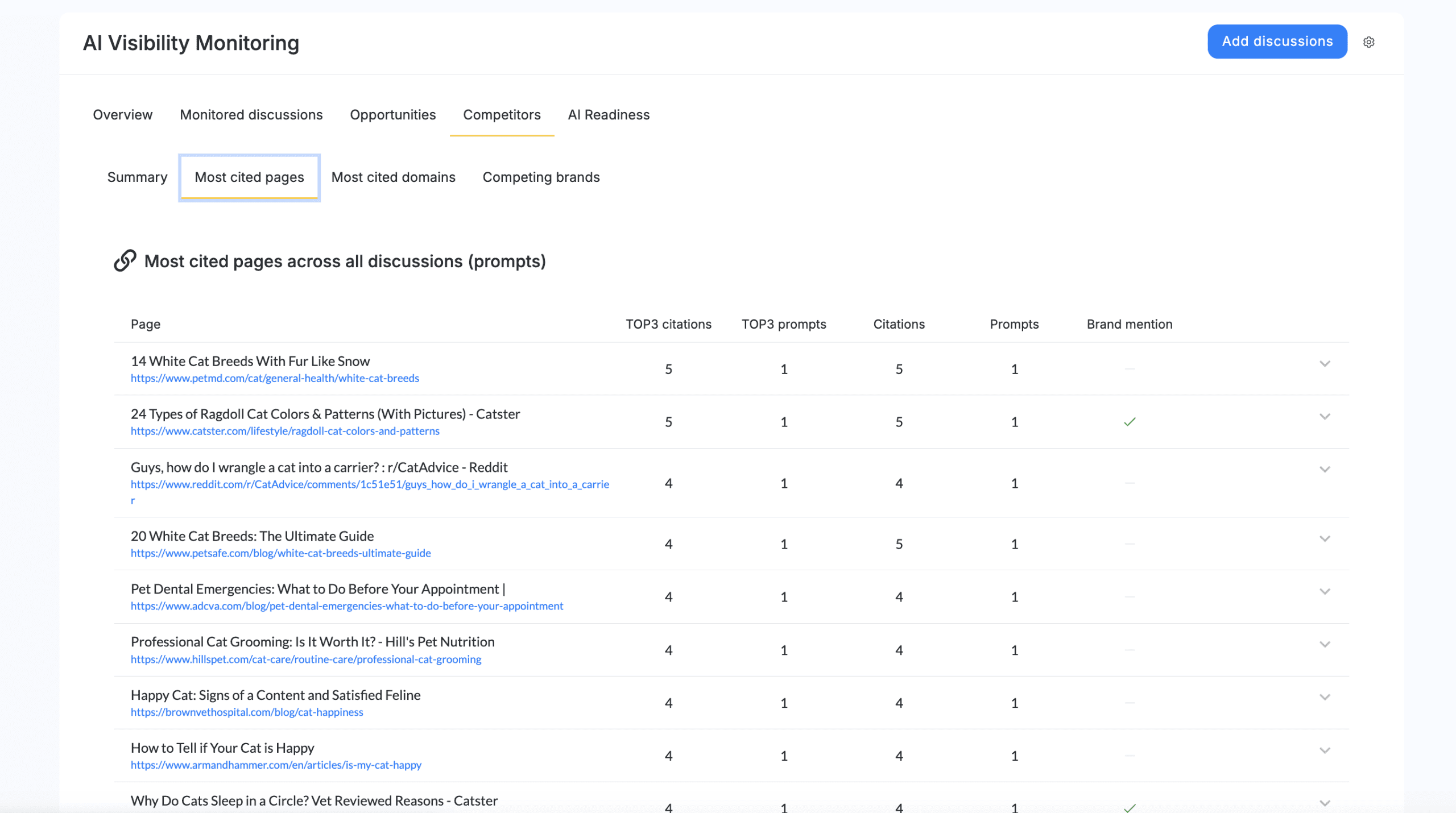
- Open Most cited pages to inspect individual URLs. This view is useful when the team wants to understand which exact pages AI systems use as sources. Analyze these pages for structure, topic coverage, credibility signals, freshness, and answer clarity.
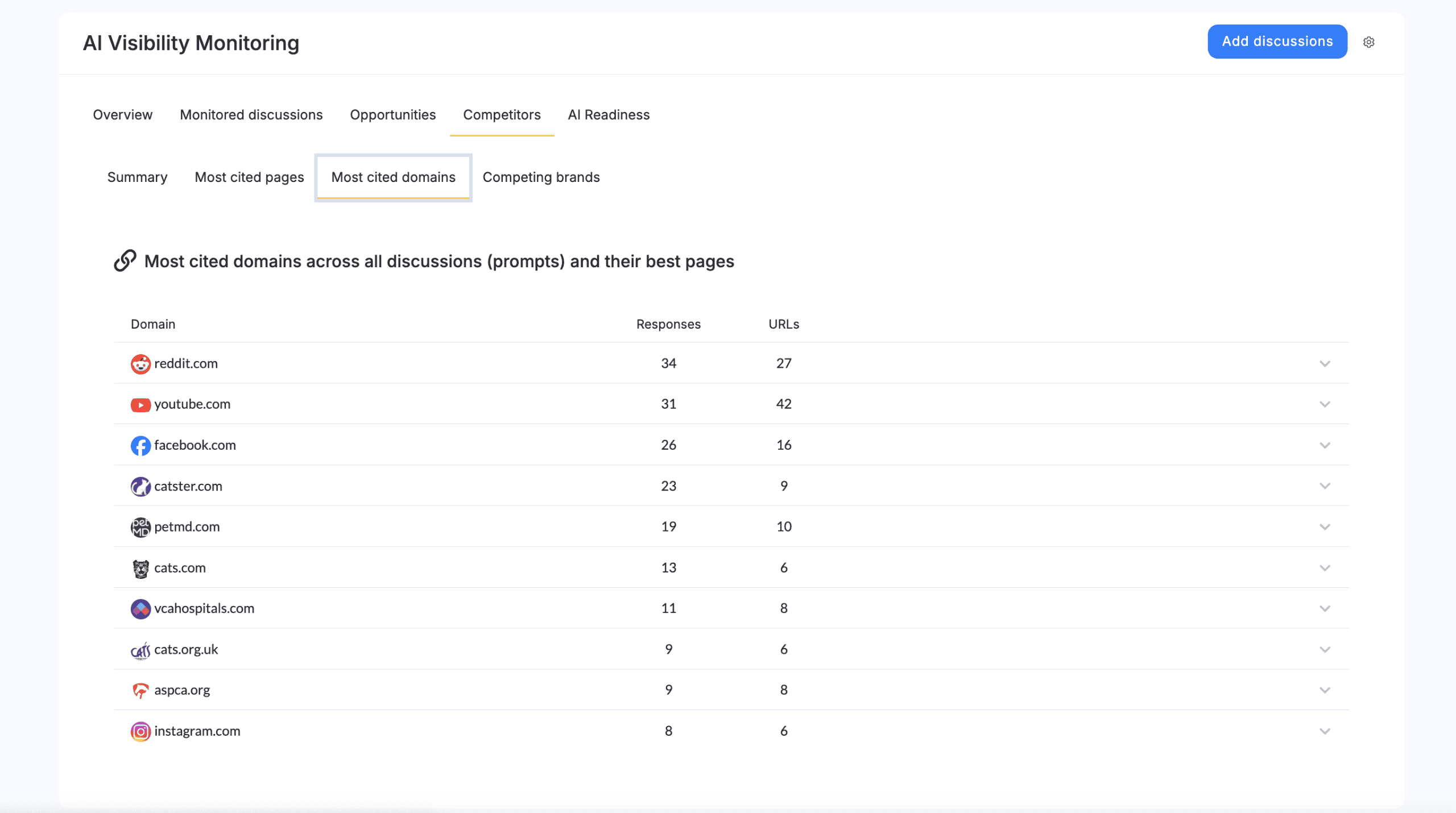
- Open Most cited domains to identify recurring source domains. This view is useful for understanding the authority landscape around the monitored discussions.
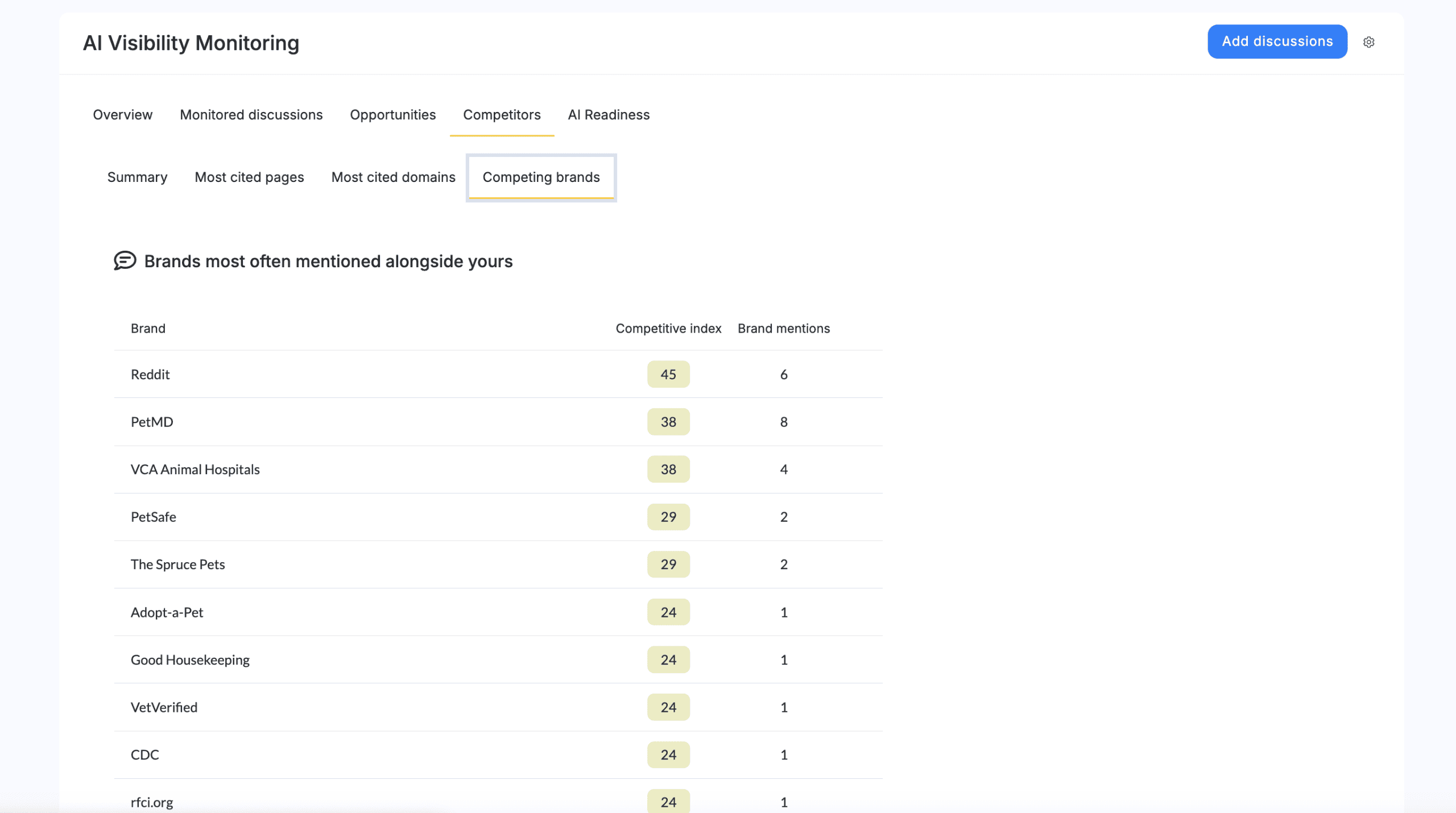
- Open Competing brands to review brand-level visibility. This helps distinguish between source authority and brand awareness. A brand can be mentioned frequently even if its website is not the most cited domain.
- Convert competitor insights into actions. If a competitor is frequently mentioned, create or improve comparison content. If a third-party domain is frequently cited, evaluate whether a mention or listing could be earned. If competitor pages are cited, study their structure and improve your own content accordingly.
Recommended Competitive Analysis Workflow
The Competitors module works best when used after the Overview and Monitored discussions modules. First identify weak visibility metrics, then identify the prompts where performance is weak, and finally use Competitors to understand who is winning that space.
|
Analysis Step |
Module |
Output |
|
Identify overall weakness |
Overview |
Low Share of Voice, low brand mentions, or low domain citations. |
|
Identify prompt-level weakness |
Monitored discussions |
Specific questions where the brand is absent or underperforming. |
|
Identify who is winning |
Competitors |
Brands, domains, and pages occupying the AI visibility space. |
|
Define actions |
Opportunities |
Mention, content, and optimization tasks. |
|
Validate technical readiness |
AI Readiness |
Confirmation that important pages can be processed by AI crawlers and bots. |
How to Interpret Competitor Signals
Competitor data should not be read as a simple leaderboard. A competitor may rank well in Google, but a different source may be cited in AI answers, and another brand may be mentioned most often. These differences matter because AI visibility depends on a mix of search visibility, brand awareness, source credibility, and answer usefulness.
|
Signal Pattern |
Possible Interpretation |
Recommended Action |
|
Competitor ranks in Google TOP10 and is mentioned often. |
The competitor has both SEO visibility and brand recognition. |
Improve topic authority and create stronger category or comparison content. |
|
Third-party domains are cited more often than brand domains. |
AI systems may trust publishers, forums, or educational resources more than vendor pages. |
Pursue earned mentions and improve neutral, educational content. |
|
Brand is mentioned but domain is not cited. |
The brand has awareness but the website is not used as a source. |
Improve citation-worthy pages and technical accessibility. |
|
Competitor domains are cited frequently. |
Competitors may offer clearer, more authoritative, or more crawlable content. |
Analyze cited pages and upgrade equivalent content. |
|
Communities such as Reddit appear strongly. |
AI systems may rely on user-generated discussion for the topic. |
Monitor community perception and consider ethical community engagement. |
Practical Example
In the inspected project, decathlon.pl appeared strongly in Google TOP10, and it is highly visible among cited sources. Competitor brands such as Allegro, Sportano and 8A appeared in the Most mentions panel. A marketing team could interpret this as a signal that AI answers in this market are influenced not only by direct competitors, but also by third-party publishers, platforms, and community or multimedia sources.