
Purpose and Marketing Positioning
The AI Readiness module helps users verify whether an important page is technically prepared for AI model crawlers and bots. In the inspected interface, the module contained a URL input field, an Audit now button, and an explanation stating that the audit examines a page’s technical configuration to verify correct processing by AI model crawlers and bots.
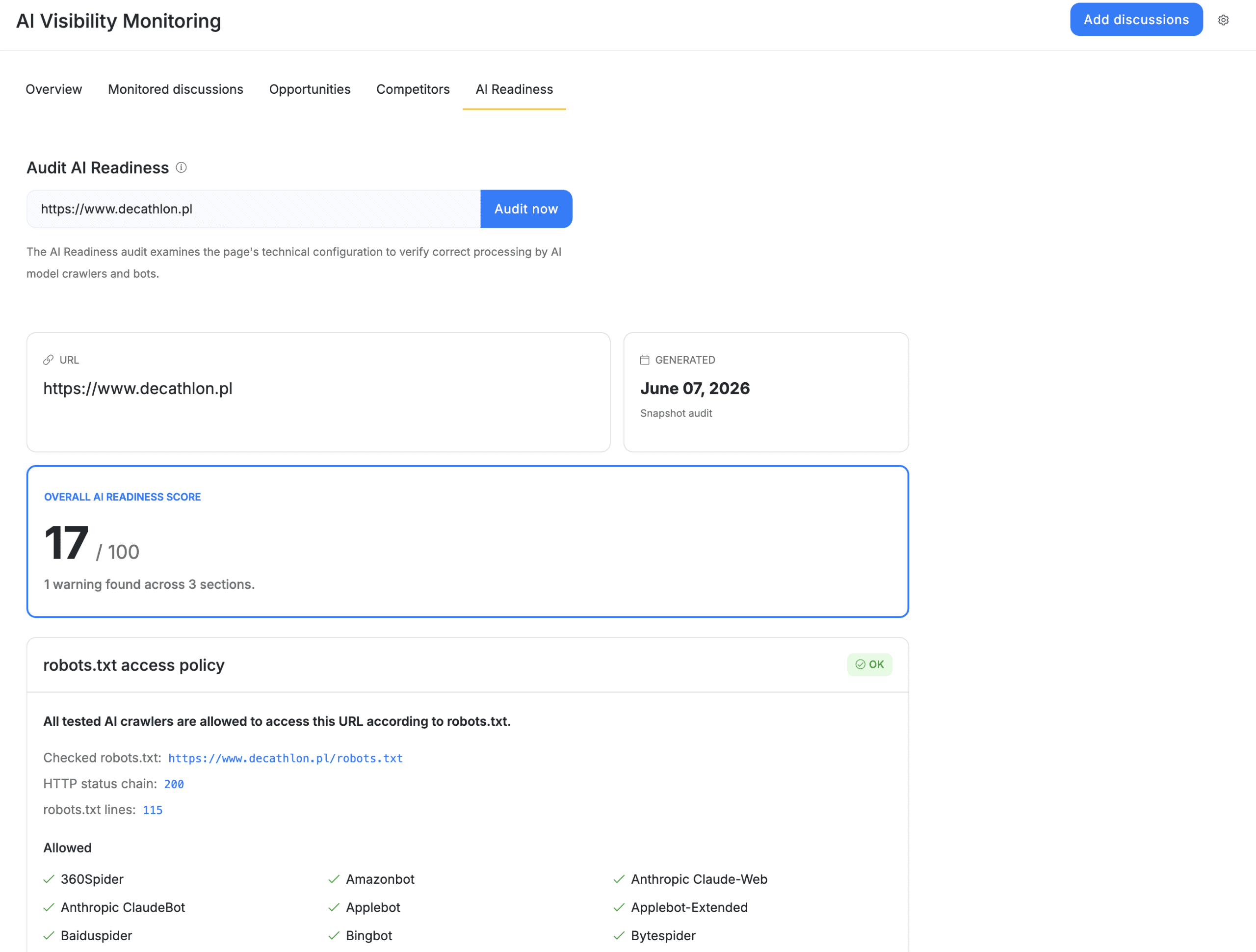
From a marketing perspective, this module addresses a critical foundation of AI visibility: a brand cannot be reliably cited by AI systems if important pages are difficult to access, process, or interpret. Content quality and brand authority matter, but they must be supported by technical readiness. AI Readiness helps marketing and SEO teams confirm whether a page is structurally suitable for AI-driven discovery and evaluation before they invest heavily in content promotion or AI visibility campaigns.
|
Marketing Challenge |
How AI Readiness Helps |
Practical Outcome |
|
The brand is mentioned but the domain is not cited. |
Tests whether important URLs are technically processable by AI crawlers and bots. |
Helps identify whether technical barriers may be limiting citation visibility. |
|
Content exists but does not appear in AI answers. |
Provides a technical audit entry point for the specific URL. |
Helps separate content-quality problems from accessibility problems. |
|
Teams need to validate landing pages before campaigns. |
Allows a URL to be audited before promotion. |
Reduces the risk of promoting pages that AI systems cannot process effectively. |
|
SEO and AI visibility teams need a shared diagnostic step. |
Converts technical readiness into a clear workflow. |
Supports collaboration between marketing, SEO, content, and technical teams. |
The AI Readiness module should be used as the technical validation layer for AI visibility. It helps confirm whether the website foundation supports the visibility goals shown in the other modules.
When to Use AI Readiness
Use AI Readiness whenever the team wants to understand whether a specific page is suitable for AI visibility work. This is especially important before launching new content, after changing important pages, when domain citations are low, or when competitors are being cited more often than the monitored domain.
The module is also valuable when the Overview shows brand mentions but few or no domain citations. In that situation, the brand may have market awareness, but the website may not yet be a strong, accessible, or trusted source for AI-generated answers. AI Readiness provides a starting point for diagnosing whether technical processing is part of the problem.
Step-by-Step: How to Use the AI Readiness Module
- Open the relevant project and select AI Visibility from the project navigation. Then choose the AI Readiness tab from the AI Visibility Monitoring module navigation.
- Review the prefilled URL. In the inspected project, the field was prefilled with https://decathlon.pl. Users should replace this with the exact page they want to audit if they need to test a specific landing page, article, product page, or documentation page.
- Enter the full URL to audit. Use the canonical public URL whenever possible. Avoid internal draft URLs, staging URLs, redirected URLs, or URLs that require authentication, because these may not represent what AI crawlers and bots can actually access.
- Click Audit now. The system will start an AI Readiness audit for the entered page. The visible interface explains that the audit checks the page’s technical configuration for correct processing by AI model crawlers and bots.
- Review the audit results once they are available. Look for signals that suggest whether the page can be accessed, processed, and interpreted properly. If the audit identifies blockers, treat them as technical tasks before expecting improved AI citations.
- Share the results with the appropriate team. Technical blockers should go to SEO, development, or web operations teams. Content clarity issues should go to content or product marketing teams. Authority and citation issues may require PR, partnerships, or content distribution work.
- Re-run the audit after changes. AI readiness is not a one-time check. Important pages should be audited again after technical fixes, CMS changes, content updates, robots directives changes, or major site migrations.
- Connect the result back to the other AI Visibility modules. If readiness improves, monitor whether Domain citations, Most sources, and prompt-level performance improve over later data refreshes.
Recommended Audit Targets
AI Readiness should not be used only for the homepage. The best audit targets are pages that directly support monitored prompts, competitor comparisons, product category visibility, and high-intent decision journeys.
|
Page Type |
Why It Should Be Audited |
Example Use Case |
|
Homepage |
Establishes baseline brand accessibility and technical processing. |
Confirm that the main domain is usable by AI crawlers. |
|
Product or feature pages |
Supports commercial visibility and product recommendations. |
Audit a page that should be cited when users ask about a product category. |
|
Educational articles |
Supports early-stage AI answers and informational prompts. |
Audit a guide that explains a category, problem, or workflow. |
|
Comparison pages |
Supports prompts that compare tools or alternatives. |
Audit a page intended to appear for “best tool” or “alternative” questions. |
|
Case studies or proof pages |
Supports credibility and evidence-based answers. |
Audit pages that demonstrate results, examples, or customer outcomes. |
|
Documentation pages |
Supports technical and implementation-related AI answers. |
Audit pages that AI systems may cite for product details or how-to answers. |
How to Interpret AI Readiness in a Marketing Workflow
AI Readiness should be interpreted together with the rest of AI Visibility Monitoring. A technically ready page does not automatically guarantee AI visibility, but an unreadable or blocked page can limit the value of content and authority work. Therefore, AI Readiness is best used as a diagnostic checkpoint before deeper content investment.
|
Observed Situation |
Possible Meaning |
Recommended Next Step |
|
Brand mentions are present, but domain citations are low. |
AI systems know the brand but may not use the site as a source. |
Audit the key pages that should be cited. |
|
Competitors are cited more frequently. |
Competitor pages may be more accessible, authoritative, or useful. |
Audit equivalent pages and compare content structure. |
|
A new page was published for an important prompt. |
The page may need validation before it can support AI visibility. |
Run AI Readiness before promoting the page. |
|
A site migration or CMS change occurred. |
Technical signals may have changed. |
Re-audit priority pages after the change. |
|
AI visibility does not improve after content optimization. |
Technical processing could still be a bottleneck. |
Use AI Readiness to check for crawl or processing issues. |
Practical Example
In the inspected project, the AI Readiness tab showed the URL https://decathlon.pl and an Audit now button. If the Overview shows Domain cited in answers at 0%, a user could begin by auditing the homepage and then audit the most important content pages connected to monitored prompts. If the pages pass technical readiness checks, the next focus should be content authority, source quality, and mention-building. If the audit reveals technical barriers, those should be resolved before expecting stronger AI citation performance.
Best Practices
Use AI Readiness as part of a repeatable technical-quality routine. Audit the homepage, high-value landing pages, and pages directly tied to monitored discussions. Record when each audit was run, what changed afterward, and whether AI visibility metrics improved in later reviews. This creates a clear link between technical optimization and AI visibility outcomes.
|
Best Practice |
Why It Matters |
|
Audit exact URLs, not only the root domain. |
AI systems may cite specific pages, not just the homepage. |
|
Test pages before and after major updates. |
Technical readiness can change after redesigns, migrations, and CMS updates. |
|
Combine readiness checks with content review. |
Technical accessibility does not replace useful, authoritative content. |
|
Prioritize pages tied to monitored prompts. |
This connects technical work to measurable AI visibility goals. |
|
Recheck after fixes. |
Validation confirms whether the issue was actually resolved. |