
10 things that still earn clicks in the age of AI search
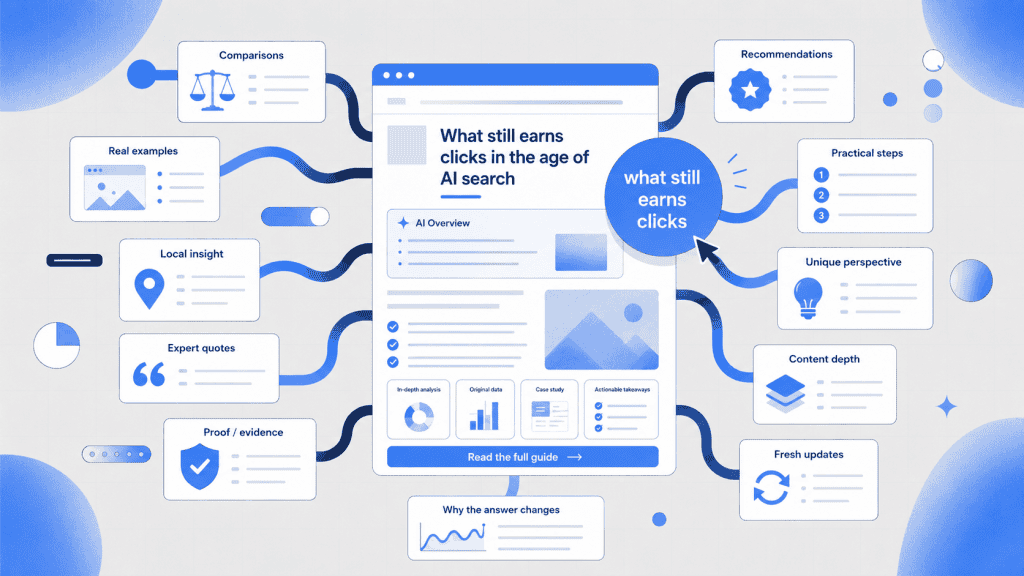
AI Overviews are good at the first layer of search.
They can define a category, list a few benefits, name familiar options and explain a basic process in seconds. That is useful for the searcher. It is less useful for a content team that built its traffic model around answering simple questions first.
The instinctive response is to fight the summary: add more keywords, make the article longer or cram every possible fact into the opening.
That rarely solves the real problem.
The pages still earning clicks tend to do something the overview cannot do well. They help a person choose. They explain where the answer changes. They show the details behind a recommendation. They bring in local knowledge, first-hand evidence or a practical perspective that cannot fit inside a short generated paragraph.
Here are 10 things SEO and content experts say still give readers a reason to click.
TL;DR
AI Overviews can answer the obvious question. People still click when they need:
- a recommendation for their specific situation;
- pricing, timing or implementation detail;
- a comparison that shows real trade-offs;
- local context and practical planning information;
- proof from someone who has done the work;
- a point of view that is more useful than a generic summary.
The aim is not to hide the answer. It is to make the rest of the page more valuable than the answer alone.
1. Decision support beats a broad explanation
A generic answer may satisfy curiosity. It rarely helps someone act.
Kelly Rossi, Founder and CEO of Marketing Magnitude, says her team stopped creating pages that only answer the first question and started building pages that help a reader make the next decision.
“AI can summarise an event, but parents still click when they need practical planning context.”
On her local events site, that meant moving beyond basic what, when and where information. Pages now cover best ages, parking, indoor or outdoor conditions, cost, what to bring and nearby alternatives.
That is the difference between a summary and a useful page.
The same principle applies in B2B. A searcher may not need another definition of customer data platforms. They may need to know if a platform fits a small team, what implementation will involve or what breaks when the data model is weak.
The click survives when the page helps someone make the decision that comes after the simple answer.
2. Real job outcomes give local content a reason to exist
Local service content has an advantage that AI summaries cannot fully flatten: the work happened somewhere, for someone, under real conditions.
Brian Childers, CEO of Foxxr Digital Marketing, says his team moved away from broad keyword targeting and built long-form pages around high-intent local questions that contractors actually receive.
“One change that worked was adding consistent, formatted sections on real job outcomes and timelines across our client sites.”
That matters because a general summary of water damage restoration cannot explain what happened in a specific type of property, how long a repair took, what delayed the work or what the homeowner needed to prepare for.
The page becomes useful when it shows a credible version of reality.
For local businesses, this can mean adding:
- real project photos;
- service-area-specific constraints;
- realistic timelines;
- common scenarios from past work;
- what the customer should expect before the job starts;
- the questions people ask after something goes wrong.
AI can describe the service. A local business can show what the service looks like in practice.
3. A clear brand stance can beat a safe, generic answer
AI Overviews tend to compress consensus. They are good at saying what most people already agree on.
That creates an opportunity for content with a defensible point of view.
Florian Radke, Founder and Strategist at The Brand Algorithm, says his team shifted from answering surface queries to publishing sharper frameworks built around a clear brand stance.
“AI Overviews flatten generic content but surface pieces that carry an unmistakable brand stance. Distinctiveness becomes the filter that earns the click.”
That does not mean forcing every article into a contrarian hot take. It means giving the reader an argument worth considering.
For example, a page about e-commerce conversion may not need to open with “What is conversion rate optimisation?” It can start with a more specific position:
Most product pages do not lose buyers because they lack information. They lose buyers because the useful information appears after doubt has already set in.
That kind of opening gives the reader a reason to continue. It creates a perspective, not just a definition.
4. Comparison pages still work when they explain fit
A generic list of tools is easy to summarise. A real comparison is harder.
People click comparison pages because they do not only want to know what exists. They want to know which option makes sense for their team, budget, workflow or level of complexity.
Zack Bowlby, CEO of ROI Amplified, says his team shifted from isolated keywords to intent clusters that cover the buyer journey around a service.
“Instead of just ‘personal injury lawyer SEO,’ I want pages answering pricing, timelines, case intake, local proof, and conversion questions around that buyer journey.”
The same logic applies to software comparisons.
A useful comparison should not stop at features. It needs to show:
- who each option suits;
- the setup effort involved;
- the likely cost as needs grow;
- what each option does poorly;
- which trade-offs matter most;
- what a buyer should check before committing.
An AI Overview may name the tools. The page earns the click when it helps the person choose between them.
5. Specific local information still needs a human source
AI can provide a general answer to a local question. It struggles more when the answer depends on geography, regulations, real operating hours or how people behave in one place.
John DeMarchi, CEO and Founder of Social Czars, says his team now thinks in entities, not just keywords.
“Make the company, founder, services, location, media mentions, and client type extremely clear, because Google’s AI needs confidence about who you are before it decides whether you belong in the answer.”
That is especially important for reputation, legal, healthcare and local service content. A reader often needs to know that the answer applies to their city, their situation or the precise service they are looking for.
A page becomes more valuable when it includes details that cannot be safely generalised:
- actual service areas;
- local process requirements;
- regional timelines;
- named experts;
- availability;
- local proof;
- the language customers use in that market.
The goal is not to repeat the city name in every paragraph. It is to make the local context visible enough that a searcher trusts the page applies to them.
6. Proof gives the reader a reason to leave the overview
The most valuable thing a page can do after a summary is show why its answer deserves trust.
Callum Gracie, Founder of Otto Media, says his approach is to format content for extraction while strengthening the proof around the answer.
“We now answer the main question early, use clearer subheadings, add short FAQs, include original examples and strengthen the proof around the answer.”
That proof might include local reviews, third-party mentions, expert commentary, customer examples or practical evidence from the work itself.
The key is proximity.
Do not make a bold claim in the opening, then leave the evidence buried 1,500 words later. Place supporting evidence close to the statement it supports.
For example, if an article claims that a certain migration path reduces implementation risk, show a realistic example of the process, a timeline or a short explanation of the conditions that make the claim true.
The overview can repeat a conclusion. The page can show its workings.
7. “What could go wrong?” content attracts better clicks
The easiest pages to summarise are often the ones that only list benefits.
But people making real decisions are not only looking for upside. They want to know what could delay the project, create extra costs or make the option a poor fit.
RHILLANE Ayoub, CEO of RHILLANE Marketing Digital, frames the challenge as earning the click twice.
“Google’s AI summary answers the easy version of the question for free, so the only people who click through are the ones who want more than the summary gave them.”
His agency responds by putting the direct answer at the top, then following it with the deeper material the summary cannot carry: worked examples, comparison logic and edge cases.
This is where “what could go wrong?” sections become useful.
They may cover:
- hidden implementation work;
- common setup mistakes;
- compliance gaps;
- budget assumptions;
- conditions that change the recommendation;
- where a popular option is likely to disappoint;
- what should happen before a buyer commits.
These sections do not weaken the content. They make it easier to trust.
8. The question behind the question still earns attention
Search queries are often shorter than the actual concern behind them.
Someone may search “virtual office” when what they really want to know is what a virtual office replaces for a growing company. Someone may search “best CRM” when the hidden question is how to keep follow-up consistent without adding more admin. The same applies in ecommerce. A retailer comparing an AI CRM Manager for retail, for example, may really be trying to understand how customer and purchase signals can determine who needs a replenishment reminder, a reactivation offer, or another retention action next.
Elliot Sterling, Web Content Writer at Opus Virtual Offices, says his team shifted from writing articles that answer a query to writing articles that answer “the question behind the question.”
“Rather than focusing on the question ‘what is a virtual office’, I restructured pages around ‘what does a virtual office actually replace for a growing business?’”
That reframing changes the page from a basic explainer into a decision-support resource.
A good content brief should ask:
- What concern sits behind this query?
- What is the reader trying to avoid?
- What decision are they close to making?
- What would make them hesitate?
- What information would they need before acting?
When a page answers the hidden question, it becomes more useful than an overview built around the literal wording alone.
9. Long-tail clicks often signal stronger intent
Broad terms can still bring attention. But the people most likely to act often arrive through specific, practical searches.
Peter Baraník, Founder and Publisher at ColorWee, says his team treated the loss of broad informational clicks as a signal, not a disaster.
“The missing clicks were informational. Google’s summary provided the answer for people and they moved on. The rest of our clicks were from users who wanted something tangible at the end of their search.”
The team moved direct answers higher on the page, then shifted from broad phrases to more intent-specific queries. A detailed search such as “free printable alphabet for preschool classroom” created a clearer need than a broad phrase such as “alphabet colouring pages.”
That is a useful reminder for content planning.
Long-tail terms often reveal:
- the context of use;
- the intended outcome;
- a practical constraint;
- the type of person searching;
- where the reader is in the decision process.
Search volume may be lower. The value of the visit can be much higher.
10. A useful page has to earn the second click
According to Jules Dupont, SEO manager at VioletDeer.com, “AI can handle the quick answer. The opportunity begins when the reader needs context they can apply: what the recommendation means for their budget, their team, their market or the next step they need to take. That is where a strong page earns the second click.”
This is the clearest way to think about content after AI Overviews.
The first click may be into the search result. The second click is the decision to leave the overview and choose a source.
A page earns that second click when it offers something the summary cannot safely compress:
- a useful recommendation;
- a clear trade-off;
- a practical example;
- a local or industry-specific constraint;
- a comparison that explains fit;
- first-hand proof;
- a decision framework the reader can use immediately.
The answer itself does not need to be hidden. In fact, it should appear early.
What matters is what the reader finds after it.
How NEURONwriter helps teams create pages worth clicking
The biggest risk in AI search is treating every query as though it needs the same type of content.
Some topics need a clean answer-first structure. Some need a comparison. Some need a decision tree, a proof layer or deeper coverage of the practical questions buyers ask later in the journey.
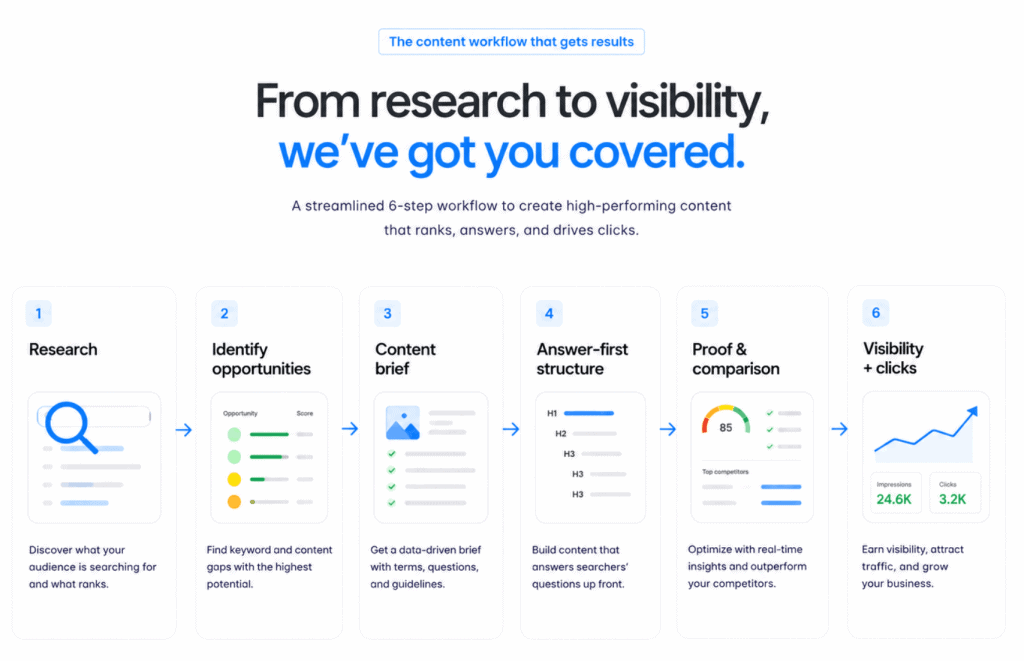
NEURONwriter helps teams begin with the current search landscape, not a blank page. It can support SERP research, topic and question discovery, content brief creation and editorial coverage checks so writers can see what the existing results cover and where they remain generic.
That creates a more useful workflow:
- Review the search result and identify the basic answer already available.
- Find the question behind the question.
- Map the trade-offs, proof and practical detail a reader still needs.
- Build the page around the decision, not only the definition.
- Use AI Visibility monitoring to identify where the brand is appearing in AI-generated answers and where stronger content could close the gap.
The goal is not to create longer pages. It is to create pages that give people a stronger reason to choose the source behind the answer.
Final thought
AI Overviews are not going to disappear because publishers dislike zero-click search.
The better response is to stop competing for questions that can be answered in one paragraph.
Build for the moment after that paragraph.
That is where people need judgment, context, proof and a clearer path forward. It is also where the best content still earns the click.