
Entity SEO: The Missing Link Between Content and AI Rankings
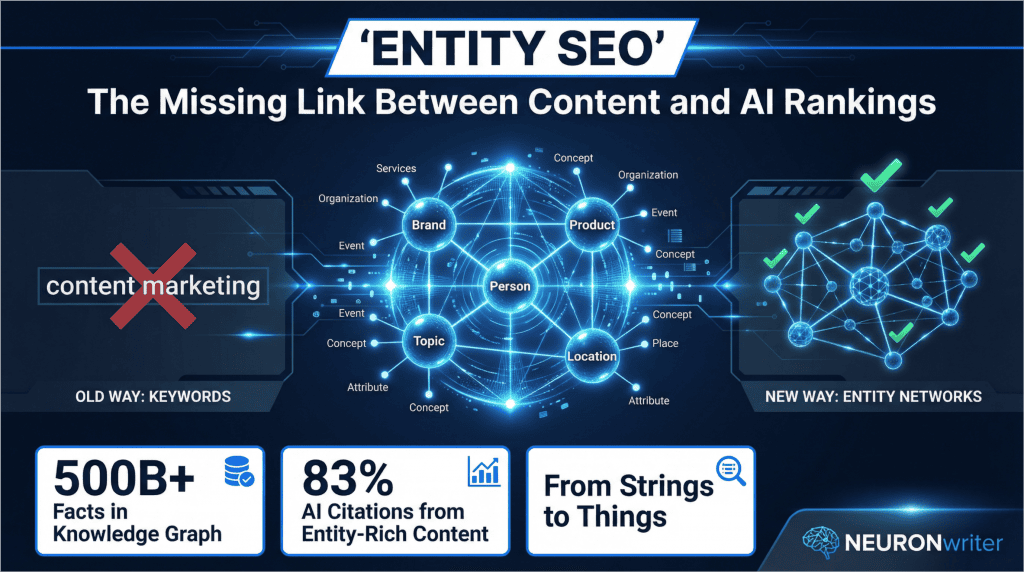
For years, SEO operated on a simple paradigm: match keywords to user queries. But in the age of AI-powered search, that model is no longer sufficient. Google, powered by systems like MUM and AI Overviews, no longer just matches words it understands meaning through entities and their interconnected relationships. This is a fundamental shift that redefines what it means to be visible in search.
Research from BrightEdge reveals that 83% of AI Overview citations come from pages beyond the top 10 organic results. This single data point exposes a seismic truth: entity clarity now outweighs traditional keyword rankings. If your content isn’t precisely defined as an entity, you become invisible to AI, regardless of your SERP position.
This guide explores the mechanics of Entity SEO why it matters, how AI systems process entity signals, and a practical four-step framework to optimize your content for Google’s Knowledge Graph and the AI-first search landscape.
What Is Entity SEO?
An entity is any unique, well-defined object or concept that exists in the real or virtual world a person, place, product, organization, or even an abstract idea. Google’s Knowledge Graph contains over 500 billion facts about 5 billion entities 2, forming a vast semantic network that underpins modern search.
Entity SEO is the process of optimizing content so that search engines can unambiguously identify, classify, and connect your pages to specific entities in their databases. Instead of asking “Does this page contain keyword X?”, Google now asks “Is this page an authoritative source about entity Y?”
This distinction has profound implications. A page optimized purely for keywords might rank for a query, but a page optimized as an entity becomes part of Google semantic understanding eligible to appear in AI Overviews, Knowledge Panels, and voice search results across multiple query variations.
“Entity clarity now determines whether your content is recognized as the right answer in AI Overviews and semantic search.” Search Engine Land.
The Three Pillars of Entity SEO.
Effective Entity SEO rests on three interconnected pillars that ensure your content is precisely understood by machines and authoritative in the eyes of AI systems.
| Pillar | Description | How to Achieve It |
| Precision | Every page should unambiguously represent one canonical entity. | Align title, H1, and mainEntityOfPage schema; use specific, factual language. |
| Coverage | Your entire site should comprehensively cover the entities and sub-topics defining your niche. | Build topical clusters (hub-and-spoke architecture) around core entities. |
| Connectivity | Entities gain authority through context and relationships with other entities. | Use internal linking, sameAs schema references, and co-citation patterns. |
These pillars work in concert. Precision without coverage leaves gaps that competitors fill. Coverage without connectivity creates isolated silos that AI systems cannot traverse. And connectivity without precision creates ambiguity that undermines trust signals. Building all three simultaneously is what separates entity-optimized sites from those still relying on keyword-first strategies.
How AI Systems Process Entity Signals
Understanding the technical mechanics of Entity SEO is essential for effective optimization. Three core processes govern how AI systems interpret and rank entity-rich content.
Named Entity Recognition (NER)
AI systems use Natural Language Processing (NLP) to identify and classify entities within text. They analyze phrases, context, and linguistic patterns, assigning labels such as ORGANIZATION, LOCATION, PRODUCT, PERSON, or CONCEPT. When content is ambiguous using generic language, inconsistent naming, or vague descriptions this classification process fails, and your content becomes semantically invisible.
The practical implication is significant: consistent entity naming across your content is not a stylistic choice, it is a technical requirement. If you refer to your product as “our platform,” “the tool,” and “the software” interchangeably, NER systems struggle to build a coherent entity profile. Every inconsistency is a signal that weakens your entity authority.
Entity Salience
AI systems don’t merely detect entities they evaluate their salience, meaning how centrally and prominently a given entity is represented on a page. Salience is not keyword density; it is semantic centrality. Key signals that influence salience include heading placement (entities in H2 headings carry significantly more weight than those buried in body paragraphs), early positioning (mentions in the first paragraph signal primary relevance), co-occurrence patterns (when “nursing program” consistently appears alongside “clinical hours,” “NCLEX pass rates,” and “accreditation body,” the semantic context reinforces entity classification), and attribute coverage (comprehensively addressing an entity’s attributes strengthens its salience score).
Google NLP API assigns salience scores from 0.0 to 1.0. For a page’s primary entity, a score above 0.10 indicates meaningful representation, while scores above 0.30 signal strong topical focus 4. Tools that analyze NLP term recommendations help identify which terms and attributes elevate entity salience in your specific competitive context.
GraphRAG and Multi-Hop Reasoning
Modern AI systems, including those powering AI Overviews, restructure information into knowledge graphs where entities become nodes and relationships become edges. This architecture enables multi-hop reasoning the ability to traverse connections to answer complex, layered queries.
Consider a query like: “Which universities offer architecture programs with a focus on sustainable design?” To answer this, an AI system must traverse multiple entity connections: university → program type → specialization → sustainability focus. If your page about an architecture program lacks a clearly defined relationship with the entity “sustainable design,” it is invisible to this query regardless of how well-optimized it is for individual keywords.
This is why topical authority and entity connectivity are inseparable in the AI search era. A site that comprehensively covers a topic domain, with clear entity relationships established through internal linking and schema markup, becomes a trusted node in the AI’s knowledge graph.
The 4-Step Entity SEO Framework
Step 1: Map Each Page to a Target Entity
Before optimizing, you need to know which entity each page represents. Conduct an entity audit of your existing content: identify the primary entity for each key page (product, service, topic, or concept), map entities to public identifiers such as Wikidata Q-IDs or Google Knowledge Graph entries, and identify gaps topics your site should cover but doesn’t, based on the entity landscape of your niche.
This mapping exercise often reveals that many pages are trying to serve multiple entities simultaneously, diluting their semantic authority. A page about “content marketing tools for small businesses” is trying to be about “content marketing,” “tools,” and “small businesses” at once a recipe for entity ambiguity. The solution is to choose one primary entity per page and address secondary entities only as supporting context.
Step 2: Optimize for Entity Precision
Once you’ve mapped your entities, optimize each page to be an unambiguous, authoritative source for its target entity. The contrast between weak and strong entity definition is stark:
Weak entity definition:
“Our nursing program prepares students for rewarding healthcare careers.”
Strong entity definition:
“The Bachelor of Science in Nursing (BSN) at Example University is a four-year, 120-credit undergraduate program accredited by the Commission on Collegiate Nursing Education (CCNE). Students complete 800+ clinical hours across 12 affiliated hospital systems in the metropolitan area.”
The second version provides specific, verifiable facts that AI systems can extract, classify, and connect to related entities (CCNE, BSN degree type, clinical hours as an attribute). This is what makes content citable in AI Overviews.
Implement Schema Markup to formalize entity relationships. The mainEntityOfPage property connects your page to a canonical entity definition, while sameAs links to its representation in public knowledge bases like Wikipedia or Wikidata. The about property declares related entities your content addresses, and isPartOf establishes hierarchical relationships between cluster pages and hub pages.
“AI systems can extract facts from entity-rich content. Marketing-speak and generalities give them nothing to work with.” ifactory.com 4
Step 3: Measure Semantic Relevance
Entity optimization requires measurement, not guesswork. Use NLP-based content analysis to evaluate how well your content covers the semantic scope of its target entity. Key metrics to track include entity salience scores for primary and secondary entities, semantic coverage (whether you’re addressing the key attributes, relationships, and sub-topics that define the entity in your competitive landscape), and Content Score relative to top-ranking competitors.
This is where semantic SEO optimization becomes a measurable discipline rather than an art. By comparing your entity coverage to pages that already appear in AI Overviews, you can identify specific gaps and prioritize content improvements with precision rather than guesswork.
Step 4: Refine Entity Coverage with Content Gap Analysis
The final step is iterative: continuously expand your entity coverage based on competitive analysis and search performance data. Analyze competitors who perform well in AI Overviews for your target entities. What aspects of the entity do they cover that you don’t? What attributes, relationships, or sub-topics are consistently present in top-cited content?
This analysis should inform both content expansion (adding depth to existing pages) and content creation (building new cluster pages for entity sub-topics). The goal is to make your site the most comprehensive, authoritative, and well-connected source for your target entity domain a status that compounds over time as AI systems increasingly rely on your content as a trusted reference.
Entity SEO in Practice: Content Architecture.
Entity SEO is not just about individual page optimization it requires a coherent content architecture that mirrors the structure of a knowledge graph.
The Hub-and-Spoke Model for Entity Coverage
A hub-and-spoke architecture maps directly onto entity relationships. The hub page covers the primary entity comprehensively (e.g., “Content Marketing Strategy”), while spoke pages address specific attributes, sub-entities, and related concepts (e.g., “Content Calendar Planning,” “Content Distribution Channels,” “Content Performance Metrics”).
Internal links between hub and spoke pages are not just navigational tools they are entity relationship declarations. When your hub page links to a spoke page with anchor text “content distribution channels,” you are telling AI systems that these two entities are related, and that your site covers this relationship authoritatively.
This is why internal linking strategy deserves the same strategic attention as external link building. In an entity-based search landscape, the connections you establish within your own site are as important as the connections established by external sources.
Schema Markup as Entity Relationship Language
Schema markup is the most direct way to communicate entity relationships to AI systems. Beyond basic Article schema, implementing sameAs links your entity to its canonical representation in public knowledge bases (Wikipedia, Wikidata, Google Knowledge Graph). The about property declares the entities your content addresses, while isPartOf establishes hierarchical relationships between cluster pages and hub pages. The mentions property identifies secondary entities referenced in your content.
These declarations transform your content from a collection of text into a structured knowledge resource that AI systems can confidently cite and traverse. When combined with entity-precise writing and comprehensive topical coverage, schema markup completes the technical layer of a robust Entity SEO strategy.
How NEURONwriter Supports Entity SEO
NEURONwriter is built around the principles of semantic SEO, making it a powerful tool for entity optimization across your content workflow.
The NLP Term Recommendations feature surfaces the entity signals and attribute terms that top-ranking pages use, helping you build entity salience through strategic term placement in headings and key positions. Rather than guessing which terms matter, you work from data derived from the actual competitive SERP for your target entity.
The Content Score measures semantic completeness a direct proxy for entity coverage. A high Content Score indicates that your page comprehensively addresses the entity’s attribute landscape as defined by the competitive SERP, giving you a quantifiable target for optimization.
SERP Analysis allows you to map the entity landscape of your target topic by analyzing what Google already considers relevant. This reveals which entities, attributes, and relationships are most valued for your specific query context, enabling you to align your content with Google’s existing semantic model rather than working against it.
The Content Editor facilitates precise entity placement in headings and structural positions, ensuring that primary entities appear where salience signals are strongest. And Internal Linking Suggestions help establish entity connectivity across your site, building the knowledge graph architecture that AI systems reward with citations and featured placements.
For teams implementing a comprehensive AI search optimization strategy, NEURONwriter provides the analytical foundation to move from keyword-based content to entity-based authority systematically and at scale.
The Future of Search Is Entity-Based.
The transition from keyword SEO to Entity SEO is not a trend it is the logical consequence of AI’s increasing ability to understand language at a semantic level. As Google’s AI systems become more sophisticated, the gap between entity-optimized content and keyword-optimized content will widen.
Brands that invest in entity clarity today are building a compounding advantage. Each piece of entity-rich content strengthens their position in Google’s Knowledge Graph, making them more likely to be cited in AI Overviews, more likely to appear in voice search results, and more resilient to algorithm updates that target keyword manipulation.
The question is no longer “How do I rank for this keyword?” but “How do I become the authoritative entity for this topic?” That shift in perspective from strings to things is the foundation of modern SEO and the key to sustainable visibility in an AI-first search landscape.
FAQ
What is the difference between entity SEO and keyword SEO?
Keyword SEO focuses on matching specific search terms to page content. Entity SEO focuses on establishing your content as an authoritative, well-defined source about a specific thing a person, place, product, or concept. Entity SEO is more durable because it aligns with how AI systems understand meaning, not just pattern-match text. A keyword-optimized page might rank for one query; an entity-optimized page can be cited across dozens of semantically related queries.
How do I find the entities Google associates with my brand?
Use Google’s Knowledge Graph Search API or the Google NLP API to analyze how Google currently classifies your brand and content. You can also search for your brand name in Google to see if a Knowledge Panel appears its presence and content reveal which entities Google associates with you. Analyzing the “People also ask” and “Related searches” sections for your core topics also surfaces the entity relationships Google considers most relevant.
Does schema markup directly improve rankings?
Schema markup is not a direct ranking factor, but it significantly improves how AI systems understand and classify your content. This improved understanding increases your eligibility for rich results, AI Overviews citations, and Knowledge Panel features all of which drive visibility and traffic. Think of schema as the language you use to speak directly to search engines, bypassing the ambiguity of natural language.
How many entities should a single page target?
Each page should have one primary entity and a limited number of closely related secondary entities. Trying to optimize for too many entities on a single page dilutes semantic authority and creates ambiguity. Use cluster pages to address entity sub-topics in depth, and ensure each cluster page links back to the hub page to reinforce the entity hierarchy.
How long does it take to see results from Entity SEO?
Entity SEO is a long-term investment. Initial improvements in AI Overview citations and Knowledge Panel features can appear within weeks of implementing schema markup and entity-precision optimizations. Broader authority signals, built through comprehensive topical coverage and internal linking, typically take three to six months to fully manifest in search performance. The compounding nature of entity authority means that early investments deliver increasing returns over time.