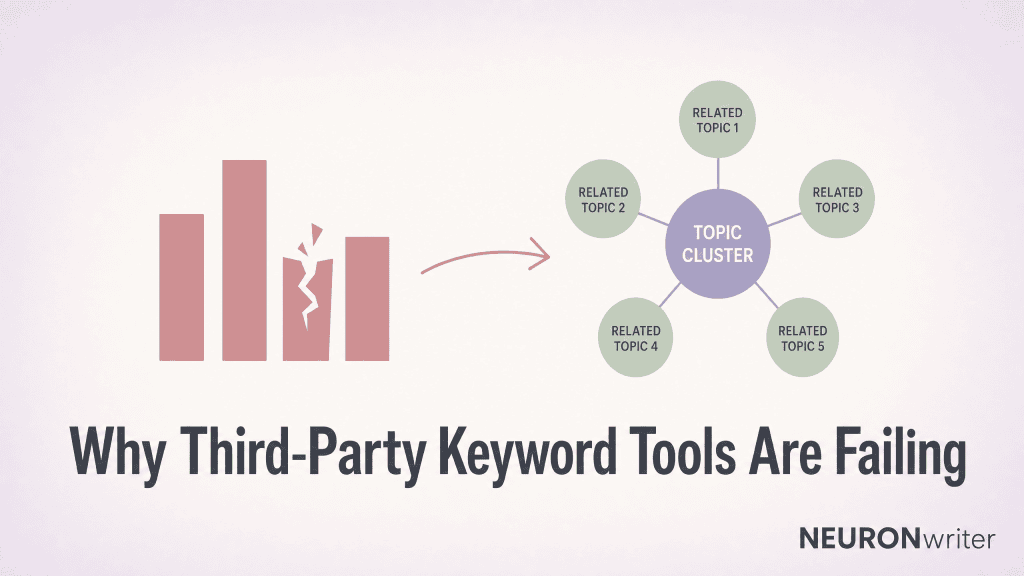
Why Third-Party Keyword Tools Are Failing (And What to Do Instead ).
📍 Semantic Summary
- Idea: For over a decade, SEO strategy was built on search volume and keyword difficulty metrics provided by third-party tools. In 2026, those metrics are fundamentally broken.
- Challenge: The rise of AI Overviews, conversational search queries, and zero-click search has rendered traditional keyword volume data highly inaccurate. Relying on these tools leads to optimizing for traffic that no longer exists or competing for keywords where the true intent is ignored.
- Summary: To succeed in 2026, content creators must abandon the single-keyword focus and adopt topic research. By understanding query fanout, semantic intent, and zero-click potential, you can build true topical authority. Integrating a semantic approach with NEURONwriter allows you to optimize for the broader context that AI engines actually use to evaluate content.
Read the full guide below, or explore related topics: Agentic Engine Optimization (AEO) · Podcast SEO Workflow · The “15k Token Limit”
For years, keyword research was a simple, predictable numbers game. You opened a third-party SEO tool, typed in a seed term, sorted the results by highest search volume and lowest keyword difficulty, and exported a spreadsheet. You handed that list to a writer, who then stuffed those exact phrases into a 1,000-word article.
In 2026, that approach is not just ineffective; it is actively harmful to your brand’s visibility.
The fundamental architecture of search has changed. Generative AI, conversational queries, and zero-click search have broken the core metrics that third-party keyword tools rely on. If your content strategy is still dictated by “Search Volume” and “Keyword Difficulty” scores, you are optimizing for a version of the internet that no longer exists.
The Illusion of Search Volume Accuracy.
The first hard truth to accept is that search volumes are not accurate, and they haven’t been for a decade. The numbers presented as absolute truth in major SEO software platforms are, at best, estimates with massive margins of error
Most search volume data originates from Google’s Ads Keyword Planner API. Crucially, while the API returns specific numbers, developers are instructed to interpret this data as a range
For example, a keyword might have a true search volume range of 1,000 to 10,000 per month a literal 10x variance
Yet, third-party tools often display a highly specific number, creating a false sense of precision.
“The Planner offers a 10x range, and the SaaS solutions have a 38.5% difference. You might reasonably pick this keyword over another with ‘2,000’ search volume, when in fact because of the margin of error the ‘lower’ volume keyword could, in reality, have more searches.” — Alex Denning, Ellipsis
To compensate, tools enrich Google’s data with clickstream data wholesale datasets tracking user activity across the internet. However, this method is hit-and-miss, especially for low-volume, high-intent topics
When you base your entire content calendar on these flawed metrics, you risk abandoning highly profitable niche topics simply because a tool incorrectly estimated their volume.
Conversational Search and “Query Fanout”.
The inaccuracy of volume metrics is compounded by how users actually search in 2026. The era of typing fragmented, robotic phrases (e.g., “best email marketing software”) is ending. Users now interact with AI search engines conversationally, asking complex, multi-part questions
According to Google, searches beginning with conversational prompts like “tell me about…” jumped 70% year-over-year in 2025
This shift creates a phenomenon known as Query Fanout
Query fanout occurs when one broad topic generates dozens or hundreds of highly specific, related search queries. Instead of searching for a single keyword, users explore a topic through multiple angles.
For example, instead of searching “email marketing software,” a user might ask an AI platform:
- How do I improve email deliverability for a SaaS startup?
- What’s the best time to send marketing emails to European clients?
- How do I segment my email list based on past purchase behavior?
Traditional keyword tools fail to capture the aggregate volume of these fanned-out queries. They treat each question as a separate, low-volume keyword, leading marketers to ignore them. However, AI platforms like ChatGPT and Google’s AI Overviews understand that all these queries relate to the same core topic.
The Devastating Impact of Zero-Click Search.
Even if a keyword tool accurately predicts that a term receives 10,000 searches a month, that number is irrelevant if those searches do not result in clicks to your website.
Welcome to the zero-click economy. According to recent data, nearly 80% of all Google searches in 2026 end without a single click to any website. Users receive their answers directly on the search results page via AI Overviews, featured snippets, or knowledge panels.
Furthermore, for queries where AI Overviews appear, organic click-through rates (CTR) have dropped by up to 61%.
When a third-party tool shows a high search volume, it does not tell you the click potential. Optimizing for a high-volume keyword that is fully answered by an AI Overview is a massive waste of resources. Your content will rank, but your traffic will remain zero.
Keyword Difficulty is a Broken Metric.
Just as search volume is misleading, “Keyword Difficulty” (KD) scores are increasingly irrelevant. Most third-party tools calculate KD almost entirely based on the backlink profiles of the top-ranking pages. They analyze how many referring domains the current top 10 results have and assign a difficulty score from 1 to 100.
This metric completely ignores the factors that actually drive rankings in 2026:
- Semantic Depth: Does the content cover the topic holistically?
- Information Gain: Does the page offer unique data or perspectives not found elsewhere?
- Topical Authority: Is the site recognized as an expert in this specific niche?
A keyword might have a high KD score because the ranking pages have many backlinks, but if those pages have thin, outdated content, a semantically dense, highly authoritative article can easily outrank them. Conversely, a low KD score might lure you into targeting a keyword where the top results perfectly satisfy user intent, making it nearly impossible to displace them regardless of your backlink profile.
The Solution: Shift from Keywords to Topics with NEURONwriter.
If third-party keyword tools are failing, what is the alternative? The answer is to shift from keyword research to topic research.
Instead of chasing individual phrases, you must build comprehensive topic clusters that establish your site as an authority on a broader subject. This is where NEURONwriter provides a massive competitive advantage over traditional keyword tools.
How NEURONwriter Replaces the Broken Keyword Playbook.
NEURONwriter is not built around flawed search volume estimates; it is built around semantic intelligence. It understands how AI engines evaluate content.
Here is how to pivot your strategy using NEURONwriter:
1.Focus on Semantic Context, Not Exact Matches: When you enter a topic into NEURONwriter, it doesn’t just give you a list of related keywords to stuff into your text. It analyzes the top-ranking content and extracts the critical NLP (Natural Language Processing) terms and entities associated with that topic. This ensures you cover the subject with the semantic depth that AI engines demand.
2.Build for Query Fanout: Because NEURONwriter guides you to include related entities and concepts, your content naturally answers the hundreds of long-tail, conversational queries associated with query fanout. You stop optimizing for one keyword and start optimizing for the entire topic cluster.
3.Analyze True Content Difficulty: Instead of relying on backlink-based KD scores, NEURONwriter’s Content Score evaluates the actual semantic quality of the competition. If the top-ranking pages have low Content Scores, you know there is an opportunity to outrank them by providing superior, more comprehensive information, regardless of what third-party tools say about difficulty.
4.Optimize for AI Citations: By creating highly structured, semantically dense content, you increase the likelihood that AI Overviews and LLMs will cite your page as a source, helping you survive the zero-click search landscape.
Stop guessing based on inaccurate volume estimates and broken difficulty scores. The future of SEO belongs to those who understand topics, context, and semantic relationships. Use NEURONwriter to build true topical authority and create content that AI engines trust and cite.
FAQ
Q1: Why are search volume estimates from SEO tools inaccurate?
A: Most tools pull data from Google’s Keyword Planner API, which provides data in broad ranges rather than exact numbers. Tools attempt to estimate specific volumes using clickstream data, but this introduces significant margins of error, sometimes up to a 10x variance.
Q2: What is query fanout?
A: Query fanout is the phenomenon where one broad topic generates dozens or hundreds of highly specific, related conversational search queries. Users explore a topic through multiple questions rather than a single keyword phrase.
Q3: How does conversational search impact keyword research?
A: Users now ask AI search engines complex, multi-part questions instead of typing fragmented keywords. Traditional tools fail to track the aggregate volume of these conversational queries, leading marketers to ignore valuable long-tail intent.
Q4: What is zero-click search?
A: Zero-click search occurs when a user’s query is fully answered directly on the search results page (e.g., via an AI Overview or featured snippet), resulting in no clicks to any external website. In 2026, nearly 80% of searches end without a click.
Q5: Why is the Keyword Difficulty (KD) metric flawed?
A: Most KD scores are based almost entirely on the backlink profiles of ranking pages. They fail to account for content quality, semantic depth, topical authority, and how well a page actually satisfies user intent.
Q6: What is the difference between keyword research and topic research?
A: Keyword research focuses on targeting individual search phrases based on volume. Topic research focuses on understanding broader themes, mapping out related subtopics and questions, and building comprehensive content clusters to establish topical authority.
Q7: How does NEURONwriter help with topic research?
A: NEURONwriter analyzes the semantic context of a topic by extracting NLP terms and entities from top-ranking pages. This guides you to create semantically dense content that covers the entire topic holistically, rather than just optimizing for a single keyword.