Content Governance in 2026: How to Audit, Update, and Retire Pages at Scale.
📍 Semantic Summary
- Idea: As AI accelerates the speed of content production, content governance is no longer an enterprise luxury it is a survival mechanism. It is the system of rules, roles, and workflows that ensures every page on your site remains accurate, on-brand, and semantically relevant.
- Challenge: Most marketing teams operate like content factories, focusing entirely on publishing new posts while ignoring the thousands of older pages slowly decaying in the archives. Without a governance framework, this leads to brand drift, factual inaccuracies, and a bloated crawl budget that actively harms your SEO.
- Summary: To scale successfully, you need a rigorous content lifecycle management system. By establishing clear ownership, defining update cadences, and using tools like NEURONwriter to enforce semantic consistency, you can protect your topical authority and turn your archives into an asset rather than a liability.
Explore related topics: The Velocity Playbook: Real-Time SEO · Author Entities and E-E-A-T
Imagine a factory that runs 24/7, churning out products at record speed, but has no quality control department, no warehouse management, and no plan for what to do with products that expire.
That is how most marketing teams are running their content operations in 2026.
Generative AI has solved the blank page problem. You can now produce a month’s worth of articles in an afternoon. But this unprecedented speed has exposed a massive vulnerability: what happens to all that content after it goes live? Who is responsible when a pricing page contradicts a blog post? Who updates the 2024 compliance guide?
The answer is content governance. It is not the most glamorous term in SEO, but it is the framework that separates sustainable growth from algorithmic chaos.
Why AI Makes Governance Mandatory.
Before AI, content bottlenecks naturally limited the damage a disorganized team could do. If you only published four articles a month, you could manually keep track of them. Today, the sheer volume of output makes manual oversight impossible.
When you scale content production without a governance framework, three specific risks emerge:
1.Brand Drift: AI models are probabilistic. If different teams use slightly different prompts, the tone of your content will drift over time. A product page might sound highly technical, while a related blog post sounds overly casual.
2.Factual Decay: A staggering 37% of marketers report that the accuracy of AI outputs is their primary concern. If a compliance regulation changes and you have 50 AI-generated articles referencing the old rule, finding and updating them without a centralized system is a nightmare. That is why more teams pair editorial review with AI compliance policies, ensuring AI-generated content meets regulatory and brand standards before it ever goes live.
3.Crawl Budget Bloat: Search engines have limited resources. If Googlebot spends its time crawling thousands of outdated, low-value pages, it will delay indexing your new, high-value assets.
As Stratton Craig notes in their 2026 analysis:
“Without the right safeguards, publishing content that varies in quality or tone can undermine brand credibility, confuse audiences and create new bottlenecks. Content governance is how to make sure that every piece of content you create is consistent, accurate and reflective of your brand.”
The Four Pillars of a Governance Framework.
A robust content governance framework acts as the guardrails for your entire content operation. It ensures that everyone—from freelance writers to product managers—is operating from the same playbook.
According to industry standards, an effective framework rests on four pillars
| Pillar | What It Defines | Why It Matters for SEO |
| Messaging | Core value propositions, brand narratives, and factual claims. | Ensures consistent entity associations across your domain, strengthening topical authority. |
| Voice | The personality and emotional tone of the brand. | Builds user trust and engagement, which are indirect signals for E-E-A-T. |
| Mechanics | Grammar, formatting rules, and structural guidelines (e.g., H2/H3 usage). | Ensures clean HTML and proper schema implementation for machine readability. |
| Terminology | Approved industry terms and prohibited jargon. | Prevents keyword cannibalization and ensures precise NLP entity targeting. |
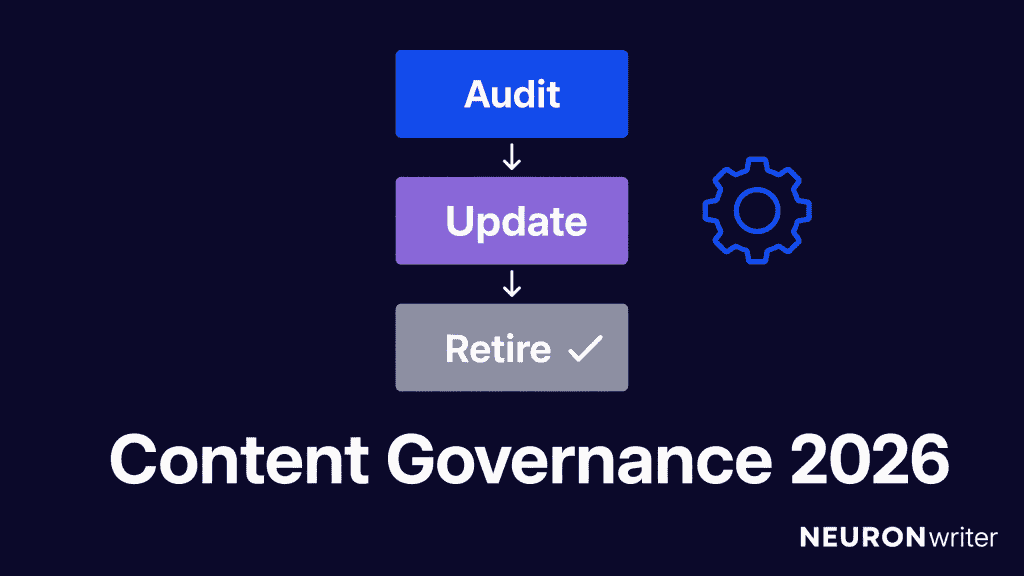
The Content Lifecycle: Audit, Update, Retire.
Governance is not just about creating guidelines; it is about managing the entire lifecycle of a page. Every URL on your site should be assigned to a specific stage in the content lifecycle management process.
The Quarterly Content Audit.
You cannot govern what you cannot measure. A quarterly content audit is the diagnostic tool that drives your governance strategy. You need to pull data from Google Search Console, your analytics platform, and your CRM to evaluate performance.
Look for pages that have experienced a drop in impressions, pages with high bounce rates, and pages that no longer align with your current product offerings.
The Update Cadence.
Not all content requires the same level of attention. Establish a tiered update schedule based on the page’s value:
- Tier 1 (Core Product Pages & Pillar Guides): Review monthly. Ensure pricing, features, and primary NLP entities are perfectly optimized.
- Tier 2 (High-Traffic Blog Posts): Review quarterly. Refresh statistics, add new internal links, and update the publish date.
- Tier 3 (News & Announcements): Do not update. Let them serve as historical archives.
The Art of Retiring Pages.
There is a persistent myth that deleting pages hurts your SEO. In reality, pruning dead weight is one of the fastest ways to improve site-wide authority. If a page has zero traffic, zero backlinks, and offers no business value, it should be retired.
When retiring a page, you have two options:
1.Consolidate: If the page has some value but is too thin to stand alone, merge its content into a larger, more comprehensive guide and implement a 301 redirect.
2.Delete: If the content is entirely obsolete (e.g., a promo for a 2021 webinar), delete the page and let it return a 410 (Gone) status code.
How to Effectively Implement Management Principles with NEURONwriter.
Guidelines written in PDFs quickly end up in a “read later” folder and, in practice, rarely impact the team’s daily work. If you want to effectively manage content on a large scale, guidelines must be part of the tools the team uses every day.
This is where NEURONwriter ceases to be just a content optimization tool and begins to serve as a platform supporting content management.
For large teams of copywriters or those developing programmatic SEO, maintaining semantic consistency becomes the biggest challenge. NEURONwriter helps organize this by centralizing key optimization guidelines. Even before writing begins, a content manager can define key Core Terms and Extended Terms that should be included in an article.
This way, content quality assessment is no longer based on subjective opinions like “this looks good.” The team receives a specific benchmark in the form of a Content Score. For example, you can establish a simple rule: an article doesn’t go to publication until it reaches a score of at least 75 points. This allows for maintaining a consistent level of quality regardless of who creates the content.
Good content management isn’t about limiting the pace of work. It’s about ensuring that published materials truly support business goals. In 2026, the advantage will not be held by the teams that publish the most pages, but by those that can best control the quality and consistency of their content.
FAQ
What is content governance?
Content governance is the strategic framework that dictates how content is planned, created, reviewed, published, and maintained. It defines roles, establishes quality standards, and creates workflows to ensure all content remains accurate, on-brand, and aligned with business goals over time.
Why is content lifecycle management important for SEO?
Content lifecycle management prevents your website from becoming bloated with outdated or irrelevant pages. By regularly auditing, updating, and retiring content, you consolidate link equity, optimize your crawl budget, and signal to search engines that your site is a consistently reliable source of information.
How often should I perform a content audit?
For most enterprise and mid-market websites, a comprehensive content audit should be performed quarterly. However, high-value pages (like core product pages or top-converting pillar guides) should be reviewed monthly to ensure accuracy and competitive semantic relevance.
What is the difference between updating and consolidating a page?
Updating involves refreshing the content on an existing URL adding new data, optimizing NLP entities, and improving formatting. Consolidating involves taking multiple thin or underperforming pages on similar topics, merging their best information into one comprehensive master guide, and setting up 301 redirects from the old URLs to the new one.
When should I delete or retire a page completely?
You should retire pages that receive no organic traffic, have no valuable backlinks, and serve no current business purpose (such as expired promotional offers or outdated company news). Removing these pages improves overall site quality and prevents brand drift.
How does AI impact the need for content governance?
Generative AI allows teams to produce content at unprecedented speeds, which dramatically increases the risk of factual errors, inconsistent brand voice, and contradictory messaging. A strong governance framework provides the necessary guardrails to maintain quality and semantic consistency when scaling AI content.
How can NEURONwriter help with content governance?
NEURONwriter helps enforce governance by providing objective, data-driven standards for content quality. Content managers can set required Content Scores and define mandatory NLP entities before writing begins, ensuring that all contributors produce semantically rich, algorithm-aligned content that builds topical authority.