Google Discover Optimization 2026: Getting Featured in AI-Curated Feeds
📍 Semantic Summary
- Idea: Google Discover is no longer just a secondary traffic source; it is a primary, AI-curated feed that pushes content to users before they even type a query. Optimizing for Discover requires a fundamentally different approach than traditional keyword-based SEO.
- Challenge: Following the February 2026 Discover core update and the integration of Gemini AI summaries (which now appear in 51% of Discover feeds ), the barrier to entry has skyrocketed. Google now aggressively filters out clickbait, thin rewrites, and content lacking strong E-E-A-T signals or local relevance.
- Summary: To achieve Google Discover optimization in 2026, publishers must focus on topical authority, high-resolution imagery (minimum 1200px), and deep semantic relevance. By using NEURONwriter to build dense, entity-rich content that satisfies the AI’s understanding of a topic, you can signal to Google’s algorithms that your content is worthy of proactive recommendation.
Read the full guide below, or explore related topics: The “15k Token Limit”: Why Content Density Matters · First-Party Data & Content Strategy
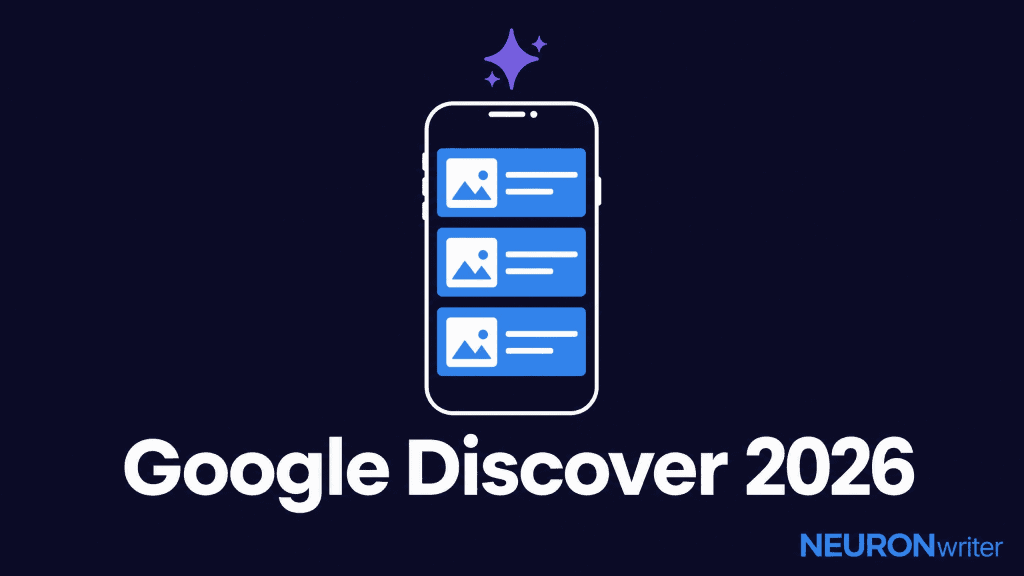
For years, SEO has been a game of “pull” marketing: a user types a query, and you try to pull them to your site. Google Discover flips this model entirely. It is a “push” mechanism an AI-curated feed that recommends articles, videos, and news based on a user’s past behavior, interests, and location, without them ever entering a search term .
The scale of Discover is easy to underestimate. Across the Raptive publisher network alone, the platform generates around one billion clicks per year . For many news and media sites, it is the single largest source of organic traffic larger than Google Search itself. Yet most SEO teams barely mention it in their strategy documents.
In 2026, Discover is evolving rapidly. With the introduction of personalized intelligence via Gemini, AI summaries now make up 51% of the Discover feed . Furthermore, the unprecedented February 2026 Discover core update radically changed what types of content get featured . If you want to tap into the massive, albeit ephemeral, traffic spikes that Discover provides, you must adapt to these new rules.
A Brief History: How Discover Became a Serious Channel.
Google Discover launched in 2018 as a rebranding of “Google Feed,” but it remained a niche channel for years primarily the domain of news publishers and lifestyle bloggers. That changed dramatically in 2024 and 2025, when Google began investing heavily in the platform, rolling out new features and, crucially, integrating its Gemini large language model into the feed’s recommendation engine .
The shift matters because it changes the nature of the algorithm. Traditional Discover relied on signals like topic following, browsing history, and engagement metrics (saves, shares, “not interested” feedback). The Gemini integration adds a layer of semantic understanding: the AI now evaluates not just what a user has read, but what they are likely to find valuable based on a deep model of their interests. This is the same technology that powers AI Overviews in Google Search, and it brings with it the same emphasis on entity-level understanding and topical depth .
“Google has invested more in the platform, rolled out more features, and on February 5th, announced its first-ever Discover-focused core algorithm update.” — Tom Critchlow, Raptive
The Impact of the February 2026 Discover Core Update.
On February 5, 2026, Google rolled out its first-ever algorithm update focused explicitly on the Discover feed . The stated goal was to show users more locally relevant content, reduce clickbait, and surface more quality content from trusted websites .
According to industry analysis by Clarity Global, the update introduced five critical shifts :
Shift 1 — Topic-Level Expertise Over Domain Authority. Perhaps the most significant conceptual change: Google now evaluates expertise topic by topic, not at the domain level. A niche site with deep, consistent coverage of a specific subject can outperform a massive media brand that only touches on the topic occasionally. For B2B marketers and specialist publishers, this is genuinely good news.
Shift 2 — Anti-Clickbait Enforcement. Sensational headlines, misleading thumbnails, and “curiosity gap” titles that withhold basic information are now actively penalized. The update is not anti-engaging headlines; it is anti-misleading ones. There is an important distinction.
Shift 3 — Local and Regional Relevance. The algorithm now strongly prefers content grounded in the user’s local market context, regulations, or events. A “one size fits all” article is less likely to perform equally well across different geographies.
Shift 4 — Depth and Originality. Thin rewrites of what everyone else has already said are increasingly unlikely to sustain Discover visibility. The update rewards in-depth, original analysis, timely coverage, and content that clearly adds something new — data, perspective, frameworks, or examples.
Shift 5 — Page Experience. Intrusive ads, autoplay videos, and layout shifts can actively hurt Discover visibility. This makes optimization not only an editorial challenge but also a design and user experience challenge.
Core Technical Requirements for Discover Eligibility.
Before you can optimize for the AI algorithms, you must meet Google’s strict technical prerequisites. These are non-negotiable.
| Requirement | Specification | Why It Matters |
| Image width | Minimum 1200px | Enables the large card format in the feed |
| Robots meta tag | max-image-preview:large | Tells Google it can display the full image |
| Page experience | Good Core Web Vitals (LCP, INP, CLS) | Poor UX reduces Discover eligibility |
| Indexability | Page must be indexed by Google | Discover only surfaces indexed content |
| Content freshness | Recent publication or significant update | Discover strongly favors timely content |
The image requirement deserves special attention. Google’s own documentation confirms that pages using large images are significantly more likely to receive Discover traffic . An interesting side effect: this requirement has pushed many publishers to invest in original custom photography and illustration which, as it turns out, also strengthens E-E-A-T signals by demonstrating first-hand experience.
How to Optimize Content for the AI-Curated Feed.
Traditional keyword research will not help you here, because there are no keywords. Instead, you must optimize for entities and user interests. This is a fundamentally different mindset.
| Traditional SEO | Google Discover Optimization |
| Target specific search queries | Target broad user interests and entities |
| Focus on search volume | Focus on trending topics and timely analysis |
| Evergreen “How-to” guides | Opinion pieces, original research, news analysis |
| Standard featured images | Highly emotive, 1200px+ custom visuals |
| Optimize for Googlebot | Optimize for Gemini’s semantic understanding |
Build Entity Connections.
Google’s AI builds a Knowledge Graph of a user’s interests. If a user frequently reads about “Artificial Intelligence,” the algorithm looks for content deeply associated with that entity. To get featured, your content must be semantically dense it should not just mention the topic; it should include all the related sub-entities, concepts, and terminology that prove comprehensive coverage.
An interesting observation from practitioners: content that performs well in AI Overviews tends to also perform well in Discover. This is not a coincidence. Both systems rely on the same underlying Gemini model to evaluate content quality and relevance. Optimizing for one channel increasingly means optimizing for both.
The Role of Timeliness.
Unlike traditional SEO, where evergreen content compounds over time, Discover rewards timeliness. A well-written analysis of a breaking industry development published within hours of the news can generate tens of thousands of visits in a single day. The average Discover traffic spike window is 24 to 48 hours , after which the feed refreshes and the placement fades.
This creates a strategic opportunity: publishers who combine strong topical authority (built over months of consistent publishing) with rapid response content (published within hours of relevant news) can achieve both the initial spike and sustained baseline visibility.
Using NEURONwriter to Dominate Discover.
This is where NEURONwriter bridges the gap between editorial instinct and algorithmic precision.
Since Discover relies on Gemini to understand what your article is about, you need to speak the AI’s language. NEURONwriter analyzes the top-performing content across the web and provides you with the exact NLP entities and semantic terms that define a topic. By incorporating these recommendations, you achieve two things simultaneously.
First, you build the “Topic-Level Expertise” that the February 2026 update specifically rewards . Second, you provide the dense, structured context that Gemini needs to confidently categorize and recommend your content to the right users.
Furthermore, NEURONwriter Content Score helps you ensure your text is comprehensive without resorting to the “fluff” or clickbait tactics that will get you deprioritized in the feed. The goal is not to write more it is to write with greater semantic precision.
Optimize for the machine’s understanding of the topic, pair it with a stunning 1200px image, and you will unlock the massive potential of the 2026 Discover feed.
FAQ
What is Google Discover?
Google Discover is a personalized, AI-curated feed available on mobile devices that pushes articles, news, and videos to users based on their interests, search history, and browsing behavior — without requiring a search query.
How did the February 2026 core update change Discover?
The February 2026 update focused on surfacing locally relevant content, rewarding deep topic-level expertise, and heavily penalizing clickbait headlines, misleading thumbnails, and thin, unoriginal content.
What are the image requirements for Google Discover?
To be eligible for the large card format in Discover, your featured image must be at least 1200 pixels wide. Your site must also use the max-image-preview:large robots meta tag to allow Google to display the full image.
Can I do keyword research for Google Discover?
No, because users do not type queries into Discover. Instead of optimizing for keywords, you must optimize for entities and user interests by creating semantically rich content around specific, trending, or highly engaging topics.
How long does traffic from Google Discover last?
Discover traffic is typically highly ephemeral. A successful placement usually results in a massive spike of traffic that lasts for 24 to 48 hours before dropping off as the feed refreshes with newer content .
Does NEURONwriter help with Google Discover optimization?
Yes. NEURONwriter helps you build semantic density and topic-level expertise by providing the exact NLP entities associated with a subject. This helps Google’s Gemini model confidently understand and categorize your content, making it more likely to be recommended in the feed.
Why did my site stop getting Discover traffic?
If your traffic dropped especially around February 2026 it is likely due to the core update. Common reasons include using clickbait headlines, lacking original insights (thin rewrites), poor page experience, or failing to establish deep, consistent topical authority in your niche.