First-Party Data & Content Strategy: How to Build SEO That AI Cannot Copy.
To build an SEO strategy that AI cannot copy, you must base your content on first-party and zero-party data rather than publicly available informatio. When AI models can instantly summarize any public fact, your only competitive moat is proprietary data that no one else has access to.
For years, the standard SEO playbook involved looking at the top 10 search results for a keyword and writing a slightly longer version of what was already there. Today, that strategy is dead. If your content is just a synthesis of other people’s ideas, AI agents like ChatGPT or Google’s AI Overviews will simply bypass your site and provide the summary directly to the user.This is precisely the challenge we explored in our guide on the end of commodity content.
To survive and thrive, you must shift from a “research-based” content strategy to an “intent-based” content strategy fueled by your own customer data. Here is how to do it.
1. Leverage Zero-Party Data from Quizzes and Surveys.
Direct Answer: Zero-party data is information that customers intentionally and proactively share with your brand, such as preferences, motivations, and purchase intentions gathered through quizzes, surveys, and preference centers. While analytics tools tell you what users do on your website, zero-party data tells you why they do it. This is the most valuable data you can collect because it comes directly from the source and is 100% unique to your brand.
Imagine you run an online plant store. You could write a generic article about “how to care for succulents,” but AI can write that in three seconds. Instead, you create a “Plant Killer Quiz” on your homepage. After 5,000 people take the quiz, you discover that 60% of your audience kills their plants specifically because they overwater them during the winter.
Now, you write an article titled: “Why 60% of Indoor Gardeners Kill Their Plants in Winter (And How to Stop).” This article is based on exclusive data that no competitor and no AI model has. It is unique, highly linkable, and impossible to replicate.
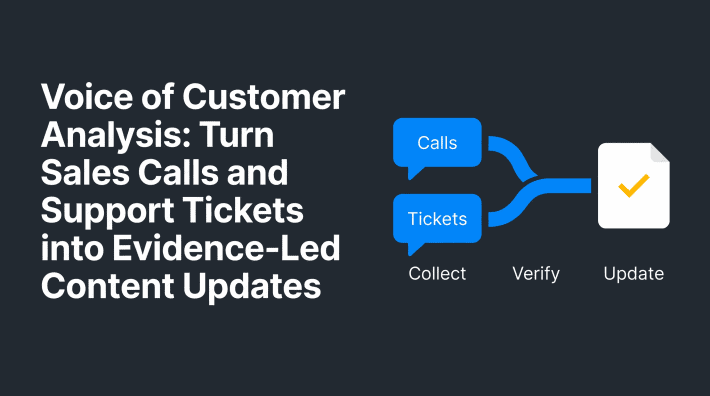
2. Mine First-Party Data from Customer Support.
First-party data is behavioral information you collect from your own channels, such as website interactions, purchase history, and customer support tickets, which can be used to identify highly specific, high-intent SEO content gaps. Your customer support inbox is a goldmine for SEO content strategy. Every question a customer asks is a search query that your website failed to answer clearly.
Instead of relying on generic keyword research tools that show you the same high-competition keywords everyone else is targeting, look at your own helpdesk tickets. If 50 customers email you asking, “Does your software integrate with the 2026 version of Salesforce?”, you have just found a highly specific, high-intent keyword. By creating a dedicated page or FAQ section answering this exact question, you capture traffic that is ready to convert, while bypassing the generic AI summaries. For a deeper dive into how FAQ sections help you rank in AI-generated results, read our guide on FAQPage schema and AI Overviews.
3. Create Proprietary Research Reports.
Publishing proprietary research reports based on your company’s internal data creates an “information moat” that attracts high-quality backlinks and establishes your brand as the primary source entity for AI agents. In the era of AI search, Google and other LLMs are desperate for original sources of information. They want to cite the entity that generated the data, not the blog that summarized it.
If you are a SaaS company, aggregate your user data (anonymously) to publish an annual industry report. If you are a local agency, conduct a survey of 500 local businesses and publish the findings. When you are the source of the data, every competitor, journalist, and AI agent that references that data must cite you. This builds massive topical authority and ensures your brand is prominently featured in AI-generated answers. To understand how AI agents discover and consume this kind of authoritative content, see our article on Agentic Engine Optimization (AEO).
How NEURONwriter Helps You Optimize Proprietary Content.
Having unique data is only half the battle; you still need to structure that data in a way that search engines and AI agents can understand. This is where NEURONwriter is superior to any other content optimization tool on the market.
When you write an article based on your first-party data, run it through the NEURONwriter Content Editor. While other tools simply tell you to stuff more keywords into your text, NEURONwriter analyzes the semantic relationships between your proprietary insights and the broader topic. It ensures that your unique data is surrounded by the exact semantic entities and contextual terms that Google expects to see from an expert source.
Furthermore, NEURONwriter helps you structure your findings using optimal H2/H3 hierarchies and helps you draft FAQ sections that are perfectly formatted for schema markup. By combining your uncopyable first-party data with NEURONwriter advanced semantic structuring, you create content that dominates both traditional SERPs and AI Overviews.
FAQ
What is the difference between first-party and zero-party data?
First-party data is behavioral information you observe (e.g., what pages a user visited or what they bought). Zero-party data is information the user explicitly tells you (e.g., answering a survey about why they visited your site).
Why is third-party data no longer effective for SEO?
Third-party data is widely available to everyone, including your competitors and AI models. If you build content on data that everyone has, your content becomes a commodity that AI can easily summarize and replace.
How do I start collecting zero-party data?
Start small by adding a post-purchase survey, an interactive quiz, or a simple chatbot question asking users what their primary goal is when visiting your website.
Can small businesses compete using proprietary data?
Yes. Even a small local business has unique customer interactions, local insights, and specific support questions that no global competitor or AI model possesses.
Is collecting first-party and zero-party data GDPR-compliant?
Yes, provided you collect data transparently, with explicit user consent, and give users the ability to opt out at any time. Zero-party data is actually the most privacy-friendly form of data collection because users voluntarily choose to share it, making it fully aligned with GDPR, CCPA, and other privacy regulations.
What tools can I use to collect zero-party data?
The most accessible tools include Typeform and Tally for surveys and quizzes, Hotjar for on-site polls, and Klaviyo or Mailchimp for preference centers within email lists. For more advanced segmentation, a Customer Data Platform (CDP) such as Segment or Bloomreach allows you to unify and act on zero-party data across all your marketing channels.