
Localizing Semantic Content: Why Direct Translation Ruins NLP Scores.
📍 Semantic Summary
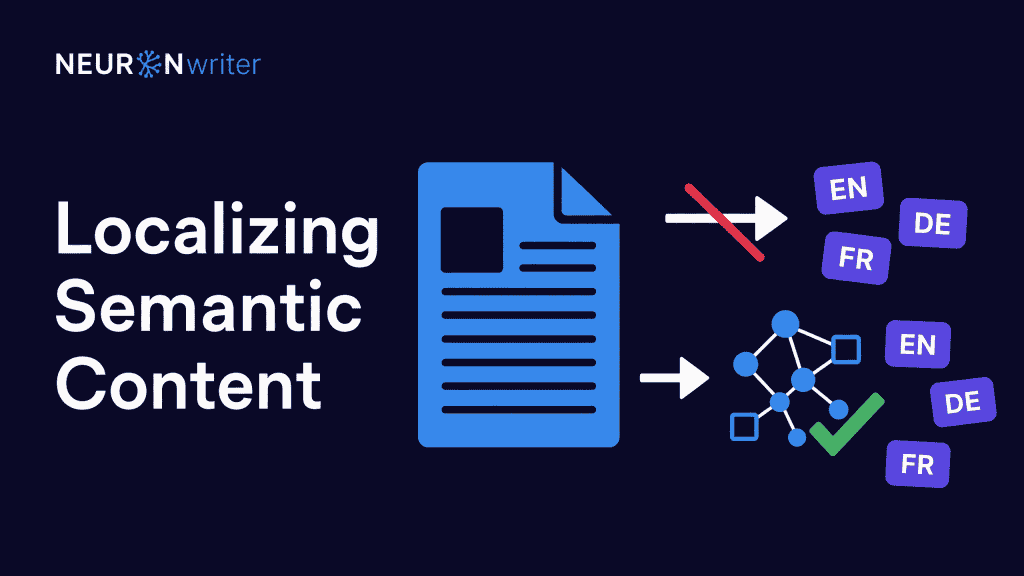
- Idea: Many global brands attempt to scale their multilingual SEO by writing an optimized article in English and running it through a translation management system (TMS) or an AI translator.
- Challenge: While modern machine translation produces grammatically correct sentences, it completely destroys the semantic density of the page. NLP entities and co-occurrence patterns are language-specific. A direct translation often results in a page that reads well to humans but looks semantically hollow to AI search engines.
- Summary: To rank across borders in 2026, you must shift from translation to content localization. This requires analyzing the SERP natively in the target language and optimizing for the specific Basic and Extended Terms expected by local algorithms. Using tools like NEURONwriter, you can rebuild the Content Score natively, ensuring your global content maintains its topical authority.
Explore related topics: International SEO in the AI Era · NEURONwriter vs. SEO.ai
Imagine you have just spent two weeks crafting the ultimate, comprehensive guide to “B2B SaaS Pricing Models.” Your NEURONwriter Content Score is a pristine 85. The page is dense with relevant NLP entities like customer acquisition cost, churn rate, and value-based pricing. It ranks number one in the US.
You want to capture the German market, so you run the text through DeepL or a high-end enterprise translation management system (TMS). The German text comes back grammatically flawless. You publish it. And… crickets. The page never breaks the top 50 in Google.de.
What went wrong? The grammar was perfect, but the semantic relevance was lost in translation.
In 2026, multilingual SEO is no longer a linguistics problem. It is a data science problem. If you are relying on direct translation, you are actively destroying your NLP scores. Here is why, and how to fix it.
The Semantic Disconnect: Why Translation Fails AI Search.
To understand why translated content fails, we have to look at how search engines evaluate relevance.
Algorithms do not read language; they map mathematical relationships between entities. When Google evaluates an English page about “SaaS pricing,” it expects to see a specific cluster of co-occurring words based on its English Knowledge Graph.
When you translate that page directly into German, a linguistic anomaly occurs. The literal translation of those English concepts does not necessarily match the natural vocabulary that German experts use when discussing the topic online.
“A mere translation can often result in misinterpretations and a failure to connect with the target audience… The greatest challenge in multilingual SEO lies in accurately adapting content to suit the nuances of different cultures and languages.”
For example, a direct translation might convert “churn rate” to Abwanderungsquote. But what if the top-ranking German articles actually use the English loanword Churn-Rate or the phrase Kundenverlust? If your translated text uses the mathematically “correct” translation rather than the semantically “expected” term, your NLP score plummets. To the algorithm, your page looks like it was written by an outsider, lacking true E-E-A-T.
The Localization Gap: Entities Don’t Always Translate.
The problem goes deeper than vocabulary. Localization requires adapting content to the cultural and structural realities of the target market.
When you translate an English article about “Personal Finance,” it will likely contain references to 401(k)s, the IRS, and Roth IRAs. If you translate these terms directly into Spanish for the market in Spain, the content becomes semantically absurd. A Spanish search engine evaluating a personal finance page expects to see local entities like Hacienda (the tax authority) or Planes de Pensiones .
If these local entities are missing, the AI search engine categorizes the page as a shallow translation, effectively filtering it out of top results.
The Native Optimization Workflow
To succeed in global markets, you must decouple your SEO strategy from your translation process. You cannot optimize an English text and expect the optimization to survive translation. You must optimize natively.
Here is the modern workflow for localizing semantic content:
| Step | Traditional Translation (Failing) | Native Semantic Localization (Winning) |
| 1. Research | Translate the English keyword into French. | Run a fresh keyword and intent analysis natively in the French market. |
| 2. Drafting | Translate the English text sentence by sentence. | Transcreate the content, adapting examples and cultural references to France. |
| 3. Optimization | Assume the English SEO value carries over. | Run the French draft through NEURONwriter against the top 30 French competitors. |
| 4. Entity Injection | Ignore missing local terminology. | Inject the specific Basic and Extended Terms expected by the French algorithm. |
Rebuilding the Content Score with NEURONwriter.
This is where enterprise translation workflows usually break down: translators are not SEOs, and SEOs do not speak every language.
NEURONwriter bridges this gap by providing a mathematical framework for localization. Instead of guessing if a translation is semantically accurate, you can measure it.
When you bring a translated draft into the NEURONwriter Content Editor, you select your target country and language (e.g., Google.de / German). NEURONwriter analyzes the live German SERP and generates a native list of NLP terms.
You will immediately see the “Semantic Disconnect” in real-time. Your beautifully translated draft might only score a 35/100 because it is missing the specific entities German competitors are using.
By having your local editors optimize the text to hit a green Content Score using NEURONwriter recommendations, you transform a generic translation into a highly authoritative, native asset that AI search engines trust and rank.
FAQ.
What is the difference between translation and localization in SEO?
Translation is the process of converting text from one language to another, focusing on grammatical and linguistic accuracy. Localization in SEO involves adapting the content to the target market’s culture, search intent, and specific search engine expectations, including using local terminology, regional entities, and culturally relevant examples.
Why does machine translation hurt my SEO rankings?
Machine translation tools (like Google Translate or standard LLMs) focus on literal linguistic conversion. They do not analyze the target market’s SERP. As a result, they often use vocabulary that is technically correct but rarely used by local searchers, resulting in low semantic density and poor NLP scores.
What are NLP entities in multilingual SEO?
NLP entities are specific people, places, concepts, or things that search engines expect to find in comprehensive content about a specific topic. Because different cultures discuss topics differently, the required NLP entities for a topic in English will be entirely different from the required entities for the same topic in Japanese.
Can I just translate my English keywords?
No. Translating keywords directly is a common mistake. Search behavior varies widely by region. A term that has high search volume in English might be searched using a completely different conceptual phrase in another language. You must conduct native keyword research for every market.
How do I know if my translated content is SEO-friendly?
You cannot judge SEO-friendliness by reading the translation. You must measure it against the local competition. By importing your translated text into a tool like NEURONwriter and setting the target language and region, you can see exactly which Basic and Extended Terms are missing compared to the top-ranking local pages.
Does hreflang fix poor translation?
No. Hreflang tags are technical signals that tell Google which language version of a page to serve to a specific user. They do not improve the quality or relevance of the content itself. If your translated page has a low Content Score, hreflang tags will not help it rank higher.
How does NEURONwriter help with content localization?
NEURONwriter analyzes the top 30 competitors in your specific target language and region. It extracts the exact NLP terms those local competitors are using. This allows your localization team to optimize translated content natively, ensuring it meets the mathematical semantic relevance required by local search algorithms.