The Death of the “10 Blue Links”: Preparing for the 2027 Search Interface.
“Listen to this article”
📍 Semantic Summary
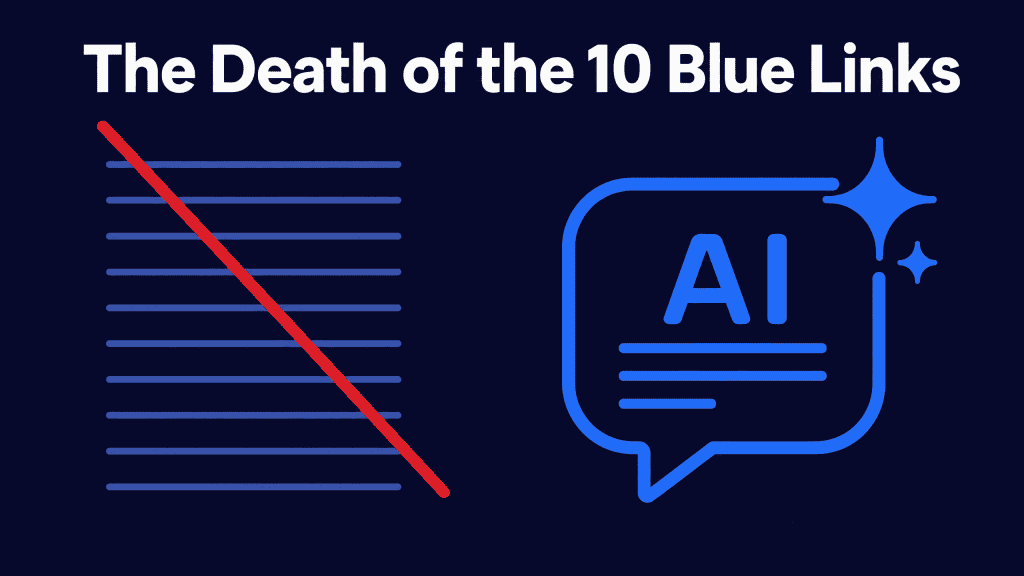
Idea: For 25 years, Google Search was defined by a simple list of ten blue links. In 2026, that era officially ended. Google has transformed its search engine into an AI-first, interactive “answer engine” where links are no longer the primary focus.
Challenge: As AI Overviews, interactive widgets, and autonomous “information agents” take over the search results page (SERP), organic click-through rates are plummeting. With nearly 65% of searches now ending without a click to a website, traditional SEO strategies that rely on raw traffic volume are rapidly becoming obsolete.
Summary: To survive the transition to the 2027 search interface, content creators must adapt. Instead of optimizing for clicks, you must optimize for inclusion in AI-generated answers. This means shifting focus from keyword stuffing to deep semantic relevance, building strong brand entities, and creating highly structured, extractable content. By using NEURONwriter, you can ensure your content is semantically dense enough that Google’s AI models confidently select it as the source of truth, even when the blue links disappear.
Related reads: – Agentic Engine Optimization (AEO): How to Make Your Content Readable by AI Agents – Zero-Click Newsletter Strategy: Delivering Value Directly in the Inbox
If you type a question into Google today, you might not see a single blue link before you have to scroll.
At the Google I/O conference in May 2026, Google made it official: the familiar list of websites that defined the internet for a quarter of a century has been replaced. In its place is an “intelligent search box” that drops users into interactive, AI-powered experiences, generates custom visual widgets on the fly, and even dispatches autonomous agents to track information for you.
The “ten blue links” are dead.
For everyday users, this means getting answers faster. For SEO professionals, content marketers, and business owners, it feels like an existential crisis. If Google is giving away the answers directly on the search page, how do we get traffic?
The reality is that search is not dying; it is evolving. To prepare for the 2027 search interface, we need to understand exactly what is replacing the blue links and how to adapt our content strategies to thrive in an AI-first ecosystem.
What Replaced the Blue Links?
Google did not just add an AI summary to the top of the page; they fundamentally restructured how information is retrieved and displayed.
AI Overviews and Conversational Mode When you search for a complex topic, Google’s Gemini models now synthesize an answer from multiple sources. You can ask follow-up questions in a conversational interface without ever leaving Google. As of mid-2026, AI Overviews are used by over 2.5 billion monthly users, while the conversational “AI Mode” tops 1 billion monthly users.
Generative UI and Interactive Widgets Google is now building custom user interfaces on the fly. If you search for information about black holes, Google might generate an interactive 3D visual right in the search results. The search engine is acting more like an app and less like a directory.
Information Agents Perhaps the biggest shift is the introduction of “information agents.” Users can now instruct Google to monitor the web for specific data like market movements or product releases and the agent will work 24/7 in the background, eventually providing a synthesized update.
“Search can build custom experiences just for your individual questions, from dynamic layouts, interactive visuals to persistent and stateful project spaces that you can return to again and again.” — Liz Reid, Head of Google Search
The Rise of the Zero-Click Search.
The immediate consequence of these changes is a massive drop in traditional website traffic.
Data from 2026 reveals that 64.82% of Google searches now end without a click to an external website. Furthermore, when AI Overviews appear on a search results page, organic click-through rates (CTR) drop by an average of 18%.
For informational queries questions like “how to boil an egg” or “what is semantic SEO”—the click is effectively gone. The AI provides the answer, and the user moves on.
Interesting Fact: While AI Overviews reduce total clicks, the clicks that do survive are incredibly valuable. Users who click through an AI Overview have already read a summary and are seeking deeper, more complex information. Data shows that these high-intent visitors convert at a 23% higher rate than traditional search traffic.
Preparing for 2027: How to Adapt Your Strategy.
The old playbook of writing a 2,000-word article stuffed with keywords just to rank for a simple question is over. To succeed in 2027, you must optimize for AI extraction.
Shift from Keywords to Entities.
AI models do not read keywords; they understand concepts and entities. Your content must clearly define the relationships between topics. This is where NEURONwriter becomes indispensable. By analyzing the top-ranking pages, NEURONwriter tells you exactly which Natural Language Processing (NLP) terms and entities you need to include so that Google’s AI recognizes your page as the definitive authority on a subject.
Write for the “Synthesizer”
When Google’s AI builds an Overview, it looks for clear, concise, and factual statements to extract. * Use the “Inverted Pyramid” style: give the direct answer in the first sentence, then expand on the details. * Use robust HTML5 structuring (clear H2s, H3s, and bulleted lists) so the AI can easily parse your content. * Provide unique data, original quotes, or strong opinions. AI models are trained to synthesize consensus, but they cite sources that provide unique “Information Gain.”
Focus on Brand Visibility over Traffic.
If 65% of users are not clicking, your goal is to make sure your brand name is the one they see in the AI Overview. Being cited as the source in an AI-generated answer builds immense brand trust. In 2027, brand visibility is the new SEO moat.
The Role of NEURONwriter in an AI-First World.
As the search interface shifts from a list of links to a synthesized answer engine, the underlying requirement for success remains the same: relevance.
Google’s AI will only cite your content if it is the most semantically relevant and topically dense source available. NEURONwriter is built specifically for this era. By guiding you to cover topics with incredible depth and semantic precision, NEURONwriter ensures your content provides the exact signals that AI models look for when constructing their answers.
The blue links may be dead, but the need for high-quality, perfectly optimized content has never been greater.
FAQ
What happened to the 10 blue links on Google?
At Google I/O 2026, Google officially announced a shift away from traditional link lists toward an AI-powered “intelligent search box.” The links still exist, but they are often pushed below AI Overviews, interactive widgets, and conversational interfaces.
What is a zero-click search?
A zero-click search occurs when a user types a query into a search engine and gets the answer directly on the results page (via an AI Overview or Featured Snippet), meaning they never click through to a website. In 2026, nearly 65% of searches are zero-click.
Does this mean SEO is dead?
No. SEO is evolving into AEO (Answer Engine Optimization). While raw traffic for simple questions is dropping, optimizing your content to be cited by AI models is now the primary way to build brand authority and capture high-intent visitors.
What are Google’s “Information Agents”?
Introduced in 2026, these are AI agents that users can deploy to monitor the web for specific information 24/7. Instead of users searching manually, the agent tracks data and provides a synthesized summary when conditions are met.
How do I get my content featured in AI Overviews?
You must write highly structured, factual, and semantically dense content. Using tools like NEURONwriter helps ensure your text includes the specific NLP entities and concepts that Google’s AI models associate with authoritative answers.
Why do clicks from AI Overviews convert better?
Even though AI Overviews reduce total clicks, the users who do click through have already read the summary. They are looking for deep dives, products, or specific services, making them highly qualified leads that convert 23% better than standard traffic.
How does NEURONwriter help in this new era?
NEURONwriter focuses on semantic SEO rather than traditional keyword stuffing. It analyzes what top-ranking content has in common conceptually, allowing you to build the deep, entity-rich content that AI synthesizers prefer to cite.