How to Write Content That AI Actually Uses.
📍 Semantic Summary
Idea: AI-powered search tools like Google’s AI Overviews and ChatGPT do not browse the web the way a human does. They scan content looking for clear, self-contained answers they can pull out and use.
Challenge: Most blog content is still written to keep readers on the page with long introductions, slow build-ups, and answers buried deep in the text. That approach works against you when AI is doing the reading.
Summary: Writing for AI in 2026 means getting to the point fast. Put the answer right after the heading. Keep paragraphs short. Use real data with named sources. This article shows you exactly how to do that and how NEURONwriter makes the process easier.
Related reads: – AEO Guide: How to Make Your Content Readable by AI Agents – The Death of the “10 Blue Links”: Preparing for the 2027 Search Interface
There is a quiet shift happening in how people find information online. More and more, they are not clicking through a list of links they are reading a single AI-generated answer at the top of the page, and moving on.
Google’s AI Overviews now appear on nearly half of all searches. ChatGPT processes 2.5 billion queries every day. Perplexity is growing fast. And in most of these cases, the AI picks one or two sources, pulls a few sentences from them, and presents those sentences as the answer.
If your content is not written in a way that makes it easy to pull those sentences out, it will not be used. It is that simple.
Why AI Does Not Read the Way Humans Do.
When you read an article, you follow the story. You enjoy the introduction, you build up to the main point, and you appreciate a good conclusion.
AI does not do any of that.
An AI model scans your text looking for a specific thing: a clear, self-contained answer to the question a user just asked. It needs to find that answer quickly, and it needs to be confident the answer is correct. If it cannot find what it is looking for in the first few sentences of a section, it moves on to the next source.
This is why the way you structure your content matters so much right now.
The Simple Rule: Answer First, Explain Second.
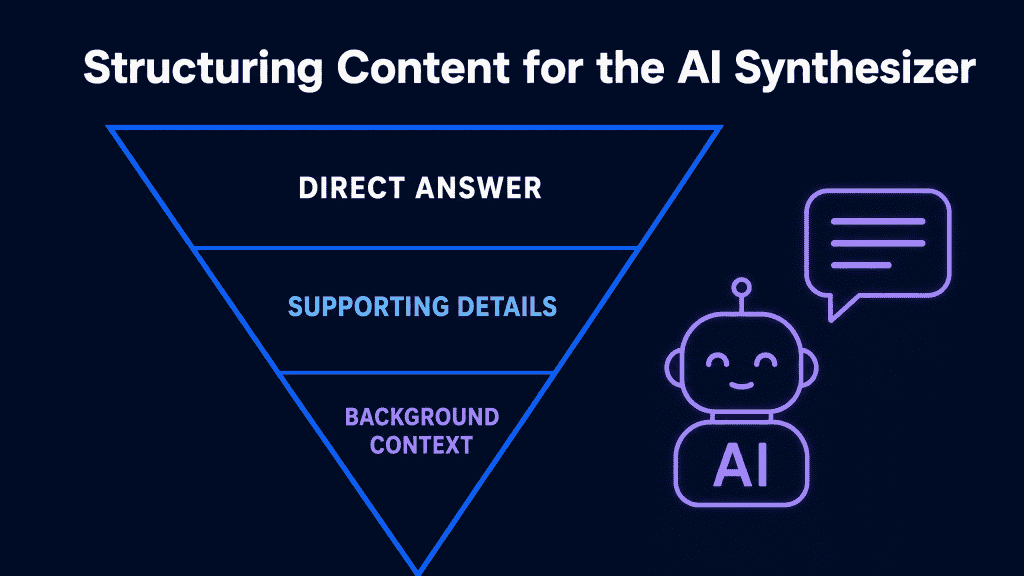
The most effective change you can make to your writing is also the simplest one: put the answer at the top of every section, not at the bottom.
This is sometimes called the “inverted pyramid” a structure that journalists have used for over a hundred years. The idea is that the most important information comes first. Everything else the context, the examples, the background comes after.
Here is what that looks like in practice. Instead of writing:
“SEO has changed a lot over the years. In the early days, it was all about keywords. Then Google started looking at links. Now, with AI becoming more powerful, things are shifting again. So what does this mean for content creators? Well, it means that…”
You write:
“Content creators need to structure their articles so AI can extract clear answers from them. This means leading every section with a direct response to the question in the heading, followed by supporting details.”
Same information. But the second version gives AI exactly what it needs in the first two sentences.
What Makes Content Easy for AI to Use.
There are a few practical things you can do to make your content more likely to be picked up by AI tools. None of them require technical knowledge just a shift in how you approach writing.
Use headings that sound like real questions. Instead of “Content Structure Tips,” write “How should I structure my content for AI search?” AI models are trained on questions and answers. A heading that mirrors how a person would actually ask a question makes it much easier for the AI to match your answer to the right query.
Keep paragraphs short. Aim for two to four sentences per paragraph, with one clear idea in each. Long, dense paragraphs are harder for AI to parse. Short ones are easy to extract and use.
Be specific with your facts. Vague statements like “AI search is growing fast” are easy to ignore. Specific ones like “AI Overviews now appear on 48% of all Google searches” are much more likely to be cited, because they give the AI something concrete to work with.
Include a FAQ section. Questions and answers are one of the most citation-friendly formats available. AI models love them because each question-answer pair is already a self-contained unit of meaning.
How Traditional Blog Writing Compares to AI-Optimized Writing.
| Traditional Blog Writing | Writing for AI Search | |
| Opening | Hook or personal story | Direct answer or summary |
| Paragraph length | Variable, often long | Short, one idea per paragraph |
| Headings | Creative or teasing | Clear questions |
| Answer placement | Near the end | Right after the heading |
| Data and sources | General claims | Specific stats with named sources |
| Main goal | Keep the reader engaged | Give AI a clear, extractable answer |
Neither approach is wrong but if you want to appear in AI Overviews, the right column is what matters.
How NEURONwriter Helps You Get This Right.
Knowing the structure is one thing. Knowing what to actually write about is another.
When AI tools decide whether to cite your content, they are not just looking at how well it is formatted. They are also checking whether your content covers the right topics in enough depth. If your article answers the question but misses several related concepts the AI expects to see, it may still be passed over.
This is where NEURONwriter comes in. It analyzes the top-performing content for your target topic and shows you exactly which terms, concepts, and questions you need to cover. You can think of it as a checklist that tells you: “If you want AI to trust your content on this topic, make sure you include these things.”
Combined with the writing approach described in this article — clear headings, short paragraphs, answers first — NEURONwriter gives you both the structure and the substance that AI models are looking for.
FAQ.
What does it mean to write content for AI extraction?
Writing for AI extraction means structuring your content so that AI tools can easily find and pull out specific answers. This involves placing the key answer right after the heading, keeping paragraphs short, and using clear, factual language.
Why is the inverted pyramid useful for AI search?
The inverted pyramid puts the most important information first. AI models scan from the top of a section downward, so if your answer is in the first two sentences, the AI finds it quickly and is more likely to use it.
How long should paragraphs be in an AI-optimized article?
Keep paragraphs to two to four sentences, each focused on a single idea. Short, focused paragraphs are much easier for AI to extract than long, dense blocks of text.
Do headings really matter for AI visibility?
Yes. Headings act as signals that tell AI what information follows. Formatting headings as real questions the way a user would actually phrase them makes it much easier for AI to match your content to the right search query.
How important is it to include specific data and statistics?
Very important. Specific, attributed statistics (for example, “48% of Google searches now trigger AI Overviews, according to Averi AI”) are far more likely to be cited than vague general claims. They give the AI something concrete and verifiable to work with.
What is a FAQ section and why should I include one?
A FAQ section is a list of questions and direct answers at the end of an article. It is one of the most citation-friendly formats for AI, because each question-answer pair is already a self-contained unit of information that AI can extract and use directly.
How does NEURONwriter help with AI search visibility?
NEURONwriter analyzes top-performing content for your topic and shows you which terms and concepts you need to cover. This ensures your content has the semantic depth that AI models expect, making it more likely to be recognized as authoritative and cited in AI answers.