Entity Salience: How Google Determines What Your Page is Really About.
📍 Semantic Summary
Idea: Search engines no longer rely on counting how many times a word appears on a page to understand its topic. Instead, they use Natural Language Processing (NLP) to identify “entities” — specific people, places, concepts, or things — and measure their “salience,” which is how central those entities are to the overall meaning of the text.
Challenge: Many content creators are still stuck in the past, optimizing for keyword density. They repeat the same exact phrase over and over, hoping to signal relevance. In 2026, this approach actually hurts your visibility. Google’s algorithms easily see past repetitive words and instead look for deep, contextual relationships between concepts.
Summary: Entity salience is a score from 0 to 1 that indicates how important a topic is to your content. To achieve a high salience score, you need to place key concepts in prominent positions (like headings) and surround them with related ideas. This article explains how entity salience works in plain English and shows how NEURONwriter helps you build the kind of semantic depth that modern search engines reward.
Related reads: – Entity SEO: The Missing Link Between Content and AI Rankings – How to Write Content That AI Actually Uses
If you have been creating content for the web for a while, you probably remember the old rules of SEO. You would pick a keyword, put it in the title, drop it in the first paragraph, and make sure it appeared a few more times throughout the text. If you wanted to rank for “best running shoes,” you made sure you wrote “best running shoes” enough times for Google to notice.
That playbook is now actively working against you.
Today, Google and other AI-powered search engines do not read words; they understand concepts. They do this through a process called Named Entity Recognition (NER), which identifies specific things in your text, and a metric called entity salience, which measures how important those things are to your article.
Understanding entity salience is the key to moving past outdated keyword tricks and creating content that actually ranks in 2026.
What Exactly is an Entity?
Before we talk about salience, we need to understand what an entity is.
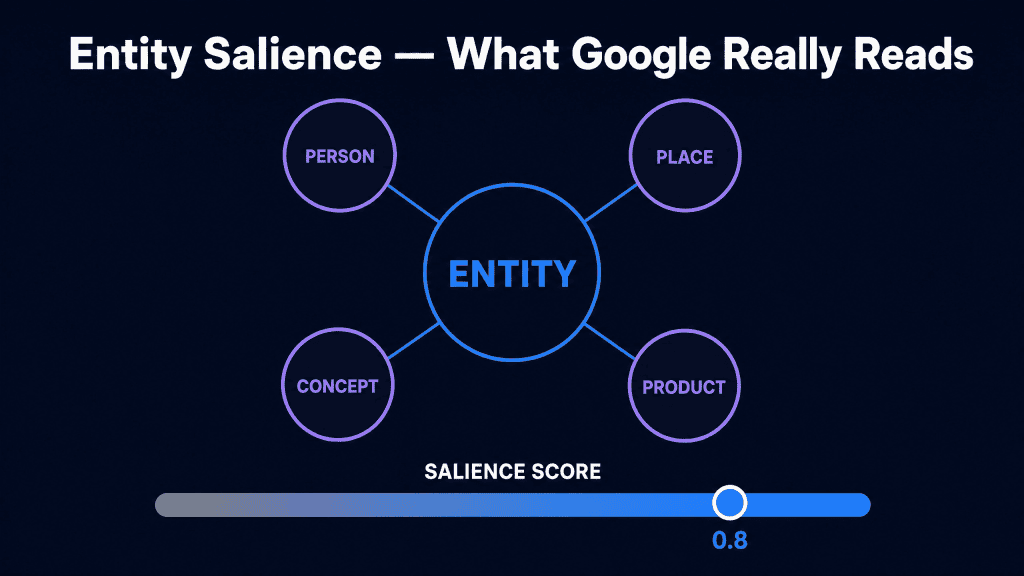
An entity is a distinct, recognizable thing. It can be a person (Elon Musk), an organization (Apple), a place (Paris), a product (iPhone), or even an abstract concept (Artificial Intelligence).
When Google crawls your article, its systems scan the text and identify all the entities you mentioned. But identifying them is only the first step. Google then connects these entities to its Knowledge Graph a massive database containing billions of facts and the relationships between them.
This is how Google tells the difference between “Apple” the technology company and “Apple” the fruit. It looks at the other entities around it. If your article also mentions “Steve Jobs,” “iPhone,” and “Silicon Valley,” Google knows exactly which Apple you mean.
What is Entity Salience?
Entity salience is a score that Google gives to every entity it finds on your page. The score ranges from 0 to 1, and it represents how central that entity is to the overall meaning of your content.
- A score closer to 1.0 means the entity is the primary focus of the article.
- A score closer to 0.0 means the entity was just mentioned in passing.
Google’s Natural Language API generally considers a salience score of 0.5 or higher as an indicator that the entity is a primary topic.
“Entity salience represents how search engines actually evaluate content relevance in 2026. Unlike keyword density (which measures word frequency), entity salience measures how central and important specific entities are to your content’s meaning.” — SearchAtlas.
It is not about counting mentions. You cannot trick the system by writing “cloud security” fifty times. In fact, one comprehensive paragraph that deeply explores an entity will often generate a higher salience score than ten superficial mentions.
How to Increase Entity Salience.
So, how do you signal to Google that a specific concept is the main focus of your page? The algorithms look at several specific signals:
- Where you put the entity (Structural Prominence) Position matters. If an entity appears in your main title, your headings, and your opening paragraph, it receives a much higher salience score than if it is buried in the middle of a long block of text.
- What you put next to it (Contextual Reinforcement) This is the most important part of modern SEO. When you mention your main entity alongside related entities, you strengthen its score. For example, if your main entity is “electric vehicles,” discussing it alongside “battery life,” “charging stations,” and “range anxiety” creates a semantic cluster that proves you are covering the topic in depth.
- How you use it in a sentence (Syntactic Roles) Google’s NLP even looks at grammar. Entities that act as the subject of a sentence are weighted more heavily than entities that act as the object.
Keyword Density vs. Entity Salience
The shift from keywords to entities changes how we plan and write content. Here is a simple breakdown of the difference:
| Feature | Keyword Density | Entity Salience |
| What it measures | How often a specific phrase appears | How important a concept is to the text |
| How it works | Word counting | Natural Language Processing (NLP) |
| How to optimize | Repeat the exact phrase | Discuss related topics and concepts |
| Risk of penalty | High (keyword stuffing) | Low (encourages natural writing) |
| Focus | Pleasing an algorithm | Providing comprehensive information |
How NEURONwriter Helps You Build Salience
The hardest part of optimizing for entity salience is knowing exactly which related concepts you need to include to build that strong contextual reinforcement. You cannot just guess what Google’s Knowledge Graph expects to see.
This is where NEURONwriter gives you a massive advantage.
When you enter your target topic, NEURONwriter analyzes the top-ranking content and shows you exactly which entities and NLP terms are driving their high salience scores. It provides a clear, prioritized list of the concepts you need to weave into your article.
By using NEURONwriter, you ensure that you are not just repeating a keyword, but actually building the deep, entity-rich semantic clusters that prove to Google your page is the most relevant, comprehensive answer on the internet.
FAQ
What is the difference between a keyword and an entity?
A keyword is simply a string of words or characters. An entity is a specific, recognizable concept, person, place, or thing that has a defined meaning and relationships to other things in a search engine’s Knowledge Graph.
What does entity salience mean in simple terms?
Entity salience is a measure of how important a specific topic or concept is to the overall meaning of your article. It tells search engines what your page is truly about, rather than just what words you used.
How does Google calculate a salience score?
Google uses Natural Language Processing (NLP) to assign a score between 0 and 1. It looks at where the entity is placed (like in headings), how it connects grammatically to other words, and what other related entities are mentioned nearby.
Does repeating a word increase its entity salience?
No. Repeating a word over and over is called keyword stuffing, and it does not increase salience. In fact, one detailed paragraph explaining a concept builds higher salience than mentioning the word superficially ten times.
What is contextual reinforcement?
Contextual reinforcement happens when you mention your main topic alongside other closely related topics. For example, mentioning “coffee” alongside “espresso machine,” “beans,” and “roasting” reinforces to Google that the page is deeply focused on coffee.
How do I check the entity salience of my content?
You can use Google’s own Natural Language API demo to test text snippets, or you can use advanced SEO tools that integrate NLP analysis to show you which entities are most prominent in your draft.
How does NEURONwriter improve my content’s salience?
NEURONwriter analyzes top-ranking pages to show you exactly which related entities and terms you need to include in your article. By covering these recommended concepts, you naturally build high entity salience without having to guess what Google is looking for.