Using NEURONwriter to Map and Dominate Entity Clusters.
📍 Semantic Summary
Idea: A topic cluster is an information architecture strategy that organizes a website around a central “pillar” page and multiple supporting “cluster” articles. In 2026, building a successful cluster is no longer about grouping similar keywords together. It is about mapping the relationships between distinct entities (concepts, people, products) to prove deep, comprehensive knowledge to search engines and AI models.
Challenge: Many content teams still rely on traditional keyword research tools to plan their clusters. This leads to creating dozens of overlapping pages that target slight variations of the same phrase (like “best coffee beans” and “top coffee beans”). This approach causes keyword cannibalization and fails to build the broad semantic network that modern algorithms, like Google’s AI Overviews, require to establish topical authority.
Summary: To dominate a topic in 2026, you must build an entity cluster. This involves identifying a core entity, mapping its related attributes, and connecting them through internal links. This article provides a step-by-step guide on how to shift from keyword silos to entity clusters, and explains why NEURONwriter is the superior tool for planning and executing this semantic architecture compared to traditional SEO software.
Related reads: – Entity Salience: How Google Determines What Your Page is Really About – How to Write Content That AI Actually Uses
For years, the standard advice for building authority in SEO was to create a “topic cluster.” The idea was simple: write one massive guide about a broad subject, and then write twenty smaller articles about specific keywords related to that subject.
But search has evolved. Today, search engines and AI answer engines do not organize the world’s information by keywords; they organize it by entities and the relationships between them. If your content strategy is still based on grouping similar phrases together, you are building a house on an outdated foundation.
To win in 2026, you need to stop building keyword clusters and start building entity clusters. This guide will explain exactly what that means and how to use NEURONwriter to map and dominate your niche.
The Shift: From Keywords to Entities.
A traditional topic cluster focuses on search volume and string-matching. An entity cluster focuses on concepts and their logical relationships.
Imagine you run a website about photography. In the old keyword model, you might look at a keyword tool and build a cluster around the phrase “portrait photography tips.” You would write articles targeting variations like “best portrait photography tips,” “portrait photography tips for beginners,” and “outdoor portrait photography tips.” You end up with a lot of repetitive content that fights with itself for rankings.
In the entity model, you start with the core entity: Portrait Photography. Then, you map out the related entities and attributes that define it. Your cluster articles become distinct explorations of those related concepts: Lighting Techniques, Lens Selection (e.g., 85mm vs 50mm), Posing Fundamentals, and Studio Backdrops.
This approach creates a web of deep, non-overlapping knowledge.
| Feature | Traditional Topic Cluster | Modern Entity Cluster |
| Foundation | Keyword search volume | Entity relationships |
| Goal | Rank for specific phrases | Build comprehensive topical authority |
| Risk | High (Keyword cannibalization) | Low (Distinct, complementary pages) |
| Tool Required | Standard keyword research tool | Semantic SEO tool (NEURONwriter) |
| AI Readiness | Poor (Seen as repetitive) | Excellent (Feeds the Knowledge Graph) |
How to Build an Entity Cluster
Building an entity cluster requires a shift in how you plan your content architecture. It is a deliberate process of scoping, mapping, and linking.
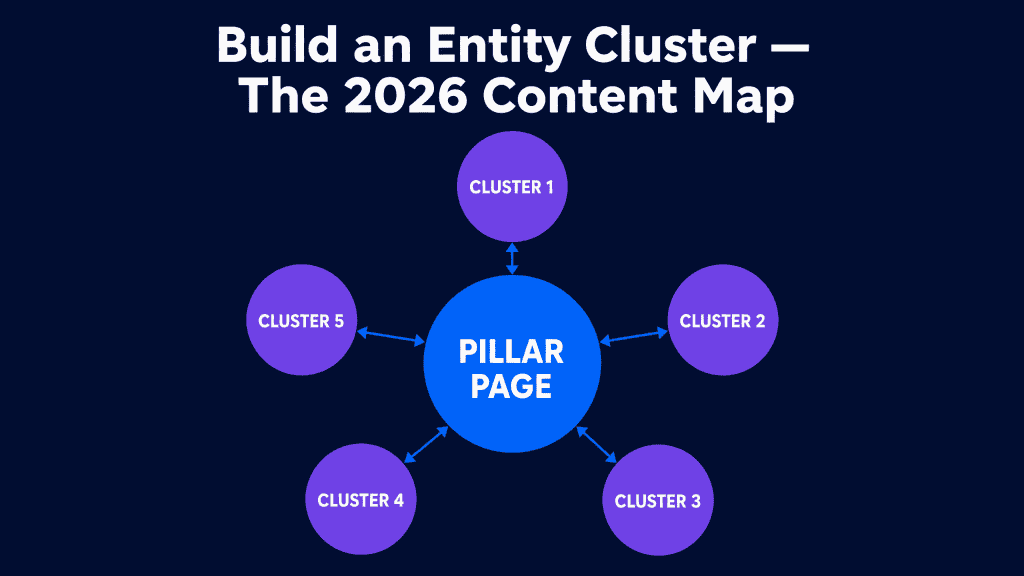
Step 1: Identify Your Core Entity (The Pillar)
Your core entity should be a broad, high-level concept that your business wants to be known for. It needs to be substantial enough to support multiple deep-dive articles.
“Scope the pillar before you write a word. Not every topic deserves a pillar. Score candidates on search volume, subtopic depth, business relevance, competitive gap, and AI-citation potential. A pillar typically needs 8+ supportable subtopics and a real business reason to exist.” — Digital Applied
If you sell project management software, your core entity might be “Agile Methodology.”
Step 2: Map the Related Entities (The Cluster)
This is where you move away from keyword tools. Instead of looking for phrases containing the word “agile,” you need to identify the concepts that are intrinsically linked to it. For Agile, related entities include “Scrum,” “Kanban,” “Sprint Planning,” “Story Points,” and “Product Owner.”
Each of these related entities becomes a dedicated cluster article. They are distinct concepts, but they all support and define the core entity.
Step 3: Bind Them with Internal Links
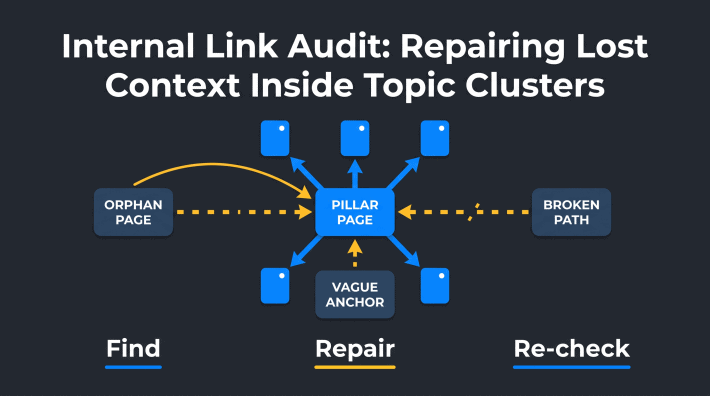
An entity cluster is only a cluster if search engines can see the connections. The internal links are the connective tissue that routes authority and signals relative importance.
Every cluster article (e.g., “How to Run a Sprint Planning Meeting”) must link back to the main pillar page (“The Ultimate Guide to Agile Methodology”). Crucially, the pillar page must also link out to every cluster article. This two-way linking structure allows Google and AI systems to read the whole cluster as one authoritative entity.
Why NEURONwriter is the Ultimate Mapping Tool.
Planning an entity cluster manually is incredibly difficult. You are forced to guess which related concepts search engines associate with your core topic. Traditional SEO tools are not much help, as they are built to analyze keyword volume, not semantic relationships.
This is why NEURONwriter is the superior choice for modern content teams. NEURONwriter is built from the ground up for semantic SEO.
When you input your core entity into NEURONwriter, it does not just spit back a list of similar keywords. It analyzes the top-ranking content across the web and extracts the actual NLP terms and related entities that Google currently associates with your topic.
It provides you with a ready-made semantic map.
Instead of guessing what your cluster articles should be, NEURONwriter shows you exactly which concepts you need to cover to achieve topical authority. As you write your pillar page and cluster articles, the Content Editor ensures you are naturally weaving in these critical entity relationships, preventing you from straying off-topic a crucial factor since recent data leaks confirmed Google actively measures how tightly a site focuses on its core subject.
By using NEURONwriter to plan and execute your entity clusters, you ensure your architecture is built on the exact semantic relationships that modern search algorithms and AI models reward.
FAQ
What is a topic cluster?
A topic cluster is a way of organizing your website’s content. It consists of a central “pillar” page that covers a broad subject, and multiple “cluster” articles that cover specific subtopics in detail. All the pages are connected through internal links.
How is an entity cluster different from a keyword cluster?
A keyword cluster groups articles based on similar search phrases (e.g., “best shoes,” “top shoes,” “good shoes”). An entity cluster groups articles based on related concepts and real-world relationships (e.g., “running shoes,” “pronation,” “marathon training”).
Why are internal links important for clusters?
Internal links are how search engines understand that your pages are connected. They route authority from one page to another and signal to algorithms that your content forms a comprehensive, authoritative body of work rather than just isolated posts.
What is keyword cannibalization?
Keyword cannibalization happens when multiple pages on your website compete to rank for the exact same search query. This often occurs in traditional keyword clusters and confuses search engines, resulting in lower rankings for all the competing pages.
How do I choose a core entity for a pillar page?
Choose a broad concept that is highly relevant to your business and has enough depth to support at least 8 to 10 distinct subtopics. It should be a topic you want your brand to be recognized as an authority on.
Can a small website build topical authority?
Yes. Topical authority is not the same as domain authority, which favors massive sites with millions of backlinks. A small website can build strong topical authority by creating deep, tightly interconnected entity clusters on a very specific subject.
How does NEURONwriter help build entity clusters?
NEURONwriter analyzes search results to identify the exact entities and NLP terms associated with your topic. This takes the guesswork out of planning, allowing you to build cluster articles based on the semantic relationships that search engines already recognize and reward.