The Anatomy of a Perplexity Citation: How to Structure Content for Answer Engines
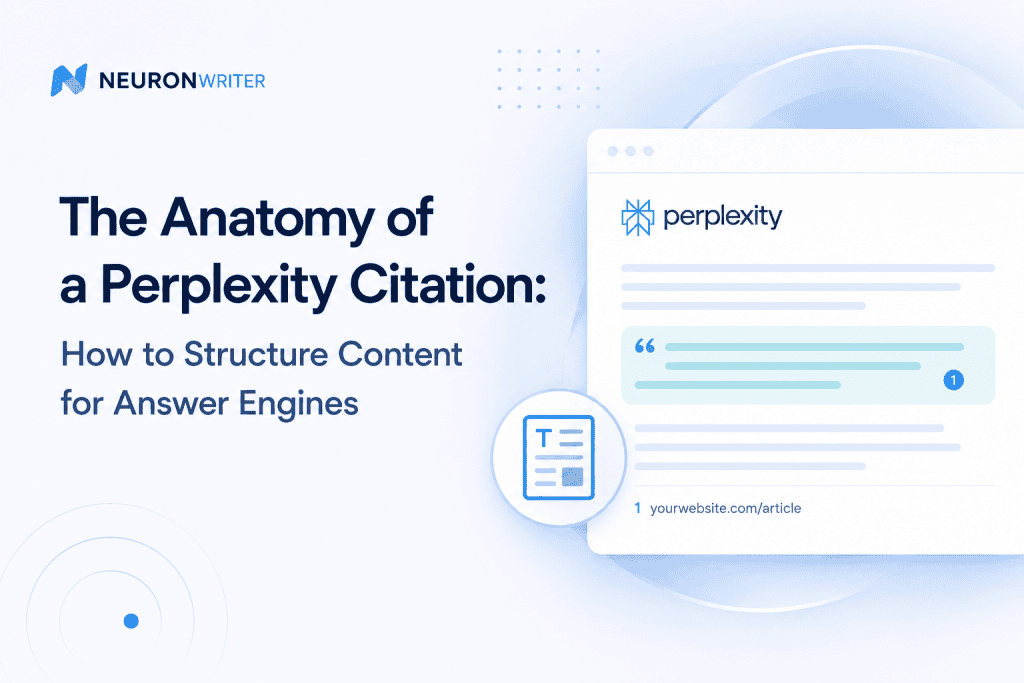
A Perplexity citation is built from a passage, not a page. When Perplexity, ChatGPT, or Google’s AI Overviews answer a question, they extract a specific paragraph or sentence and attribute it to a source they don’t cite an entire article. If you want your content cited, the goal isn’t just to rank; it’s to write passages that are self-contained, factual, and easy to lift out of context. This is the core discipline behind answer engine optimization (AEO), and it changes how you should structure everything you publish.
What Is Answer Engine Optimization (AEO)?
Answer engine optimization (AEO) is the practice of structuring and writing content so that AI-driven answer engines Perplexity, ChatGPT, Google AI Overviews, and voice assistants can accurately extract, summarize, and cite it in a generated response.
AEO is the practice of treating a large language model’s answer, not a search engine results page, as the surface you’re optimizing for. Where traditional search engine optimization targets a ranking position, AEO targets something narrower and arguably harder: being the exact source an AI system quotes or paraphrases when it performs question answering for a user.
You’ll also see the term generative engine optimization (GEO) used almost interchangeably with AEO, and the two overlap heavily in practice. Marketers in the U.S. tend to favor “AEO,” while European and product-led sources lean toward “GEO. A third, older bucket voice search optimization targets similar behavior for voice assistants like Google Home and Alexa, and the same structuring principles largely carry over: short, direct, natural-language answers win across all three.
Functionally, AEO, GEO, and voice search optimization describe the same underlying shift: writing for extraction by AI systems rather than for a blue link.
| Approach | Optimizes For | Success Metric |
| Traditional SEO | Ranking position, organic search results | Clicks, rank position |
| AEO / GEO | Being quoted inside an AI-generated answer | Citation frequency, brand visibility in AI answers |
| Voice search optimization | Being read aloud as the single answer | Voice assistant answer share |
AEO vs. Traditional SEO — What Actually Changes
Traditional SEO is built around ranking a page and earning a click. AEO is built around being the passage an answer engine chooses to quote often without the user ever visiting your site. That’s a fundamentally different success metric: visibility inside an AI response, not just position on a search result.
Three practical differences follow from that:
- Ranking still matters, but it’s a precondition, not the goal. Perplexity and Google AI Overviews mostly draw from pages that already rank reasonably well organically — but ranking alone doesn’t guarantee the citation.
- The unit of competition is the passage, not the page. Two competing pages can both rank; the one written for extraction is the one that gets quoted.
- Clicks become a secondary signal. A citation with no click still builds brand visibility and trust — a genuinely new kind of “traffic” that traditional SEO reporting doesn’t capture well.
None of this makes traditional search irrelevant. Unlike traditional search, where a click is the only outcome that counts, AEO treats ai-generated answers as a parallel channel one where optimized content and organic search visibility reinforce each other rather than compete. A page that already ranks well is far more likely to be pulled into an AI-generated answer than one starting from zero.
The Anatomy of a Perplexity Citation
Understanding what Perplexity actually does when it cites a source is the fastest way to reverse-engineer how to write for it. Four mechanics matter most.
Passage-Level Extraction
Perplexity doesn’t summarize your whole article it identifies the single passage, usually two to four sentences, that most directly answers the query, and cites that passage’s source. This means every section of your article is competing independently to be the extracted answer, not just the page as a whole.
Citable passage: “Answer engine optimization structures content so AI systems like Perplexity can extract and cite it directly — the core requirement is a self-contained, factual answer near the top of a section.”
Buried version: A three-paragraph narrative build-up that only states the definition in the final sentence, wrapped in caveats and throat-clearing. Perplexity’s extraction model has nothing clean to pull from that passage, so it moves on to a competitor’s page instead.
Query Fan-Out
A single user question rarely maps to a single search query behind the scenes. Perplexity (like Google’s AI Mode) breaks one question into multiple parallel sub-queries covering definitions, comparisons, examples, and edge cases then assembles an answer from whichever sources best address each sub-query.
Practically, this means one article needs to answer several closely related micro-questions, not just its main keyword. That’s exactly why a dedicated FAQ section, with headers phrased as real questions, is not optional it’s how you show up across more of the fan-out.
Source Signals: Freshness, Authorship, and Entity Clarity
When multiple pages contain a similarly good passage, answer engines lean on trust signals to break the tie: a visible publish or updated date, a named author with relevant expertise, clear first-party data or examples, and unambiguous entities (naming “Perplexity AI,” “ChatGPT,” or “Google AI Overviews” explicitly rather than vague references like “AI tools”).
Structured Data as a Citation Aid
Schema markup particularly Article, FAQPage, and HowTo doesn’t directly cause a citation, but it helps answer engines parse your page’s structure faster and more accurately, which lowers the friction for extraction. Think of it as removing ambiguity, not as a ranking trick. FAQ schema in particular gives an answer engine a pre-packaged question-and-answer pair it can lift almost verbatim.
How This Differs From a Google Featured Snippet
Featured snippets and Perplexity citations look similar on the surface both surface a short passage above the usual search results page but they’re generated differently. A featured snippet is algorithmically selected from a single top-ranking page using natural language pattern-matching against the query.
A Perplexity citation is synthesized by a large language model that reads across multiple sources, decides which passage best supports its answer, and may quote several sources in a single response.
That means Perplexity, unlike classic snippet selection, can and does distribute citations across more than one source per answer — which is good news for sites that aren’t ranked #1, since a well-structured passage from a lower-ranking page can still earn a cited answer.
How to Structure Content for Answer Engines: Best Practices and a Practical Framework
With the mechanics above in mind, here’s how to actually structure a piece of content so it competes for citations.
- Lead every major section with a direct answer. The first one to two sentences after each H2 should state the point plainly, before you elaborate, qualify, or give examples. This is the single highest-leverage change most content teams can make.
- Write headers as real questions people ask. “What Is Answer Engine Optimization?” extracts more cleanly than “Understanding the Landscape.” Match your H2/H3 phrasing to natural search-style questions.
- Use bullets and tables for facts, not just narrative prose. Structured lists are easier for extraction models to lift cleanly and easier for readers to scan.
- Add specific, checkable details. Named examples, real numbers, and named experts read as more citable than generic claims — this is the E-E-A-T signal answer engines are increasingly trained to weight.
- Keep a visible freshness signal. A “last updated” date, paired with content that’s actually been revisited, measurably helps in categories where AI systems favor recency.
- Add the appropriate schema markup. FAQPage for FAQ sections, HowTo for step-based content, Article as a baseline for everything else.
- Don’t neglect the technical basics. None of the above matters if your page isn’t crawlable. Check robots.txt, confirm the page is in your XML sitemap, and make sure AI crawlers (like PerplexityBot and GPTBot) aren’t blocked if you want to be cited. There’s no special “AI file” required beyond getting these fundamentals right.
Common Mistakes That Keep Content From Being Cited
| Mistake | Why It Blocks Citation |
| Answer buried at the end of a long intro | Extraction models favor upfront, self-contained passages |
| No visible publish/update date | Freshness is a tiebreaker signal when multiple sources qualify |
| Vague references (“AI tools,” “search engines”) | Answer engines weight explicit, named entities more heavily |
| Keyword-stuffed, not people-first copy | Reads as low-trust and is deprioritized versus specific, concrete writing |
| No FAQ section or question-style headers | Misses most of the query fan-out entirely |
Measuring AEO Success and Visibility
Because a citation often generates zero clicks, standard analytics undercounts AEO performance. Track it instead through: manual or tool-based checks of whether your brand or page is cited in Perplexity, ChatGPT, and Google AI Overviews responses for your target queries; branded search lift (people searching your brand name after seeing it in an AI answer); and referral traffic specifically from answer engines, which most analytics platforms now segment separately from organic search.
Off-Page Signals That Support Citations
Citations aren’t won by a single article in isolation. Distribution beyond your own domain appearing in “best of” roundups, being discussed on Reddit or industry forums, and getting referenced in other publications increases the pool of independent signals that answer engines use to judge trust and relevance from trusted sources across the web. Treat AEO as a content-plus-distribution strategy, not a content-only one.
Integrating AEO Into Your Existing Content Workflow
AEO doesn’t require a separate content team or a parallel publishing calendar it’s a set of structural checks layered onto the workflow you already run. Large language models power all of the major answer engines (Perplexity, ChatGPT, and Google’s AI Overviews included), and they’re trained to reward the same underlying qualities: clarity, structure, and verifiable specifics. That consistency is good news, because it means you don’t need to write differently for each ai-powered platform you need to write well once, in a format all of them can parse.
A practical rollout looks like this: audit your highest-traffic existing pages for AEO gaps first (missing direct answers, no FAQ, no schema), fix those before writing anything new, then build the seven-point framework above into your content brief template so every future article ships AEO-ready.
Track ai visibility for a handful of priority pages using manual checks in Perplexity and ChatGPT alongside any AI-search tracking tool you adopt, and revisit that shortlist monthly. Over a few publishing cycles, this turns “getting cited by AI systems” from a one-off audit into a standing part of how your team writes.
The upside compounds: as more of your library becomes ai-search-ready, your brand starts showing up across a wider range of ai engines and platforms for adjacent queries not just the one keyword each article was written for, since answer engines route related sub-queries to whichever of your pages answers them best.
That’s the future of search this framework is built for: fewer clicks, more citations, and a brand presence that shows up inside the answer itself.
A Quick Note on Discoverability
Underneath all of this sits a simple discoverability problem: an answer engine can only cite pages it can find, parse, and trust. Third-party validation reviews on independent review sites, mentions across Reddit threads, and citations in other publications feeds the same trust model that ai search systems use when ranking passages against each other. None of this replaces the on-page work above; it just widens the pool of signals that help you get cited consistently, rather than as a one-off.
FAQ
What is Answer Engine Optimization (AEO)?
Answer engine optimization is the practice of structuring content so AI answer engines like Perplexity, ChatGPT, and Google AI Overviews can extract and accurately cite it in a generated response, rather than simply ranking it on a search results page.
How is AEO different from SEO?
Traditional SEO optimizes for ranking and clicks on a search results page. AEO optimizes for being the specific passage an AI system quotes or paraphrases visibility inside an answer, which can happen even without a click.
Is ChatGPT considered an answer engine?
Yes. ChatGPT, along with Perplexity and Google AI Overviews, is generally classified as an answer engine because it synthesizes a direct response from multiple sources rather than returning a list of links.
What’s the best tool for tracking AEO performance?
There’s no single standard yet; most teams combine manual spot-checks of AI answers for target queries with newer platforms (such as Profound or similar AI-visibility trackers) and branded search-lift data from their existing analytics stack.
Will AEO replace traditional SEO?
Unlikely in the near term. AEO builds on a solid SEO foundation crawlability, indexation, and organic relevance still matter but adds an extraction layer on top. Most practitioners treat AEO as an extension of SEO rather than a replacement for it.
How long does it take to see AEO results?
Because answer engines re-crawl and re-generate responses frequently, well-structured content can start appearing in citations within weeks, faster than typical organic ranking timelines though consistent visibility usually takes a few months of sustained, structured publishing.
What are the key best practices for AEO?
Lead each section with a direct answer, write headers as real questions, use structured facts (lists, tables), add named examples and visible freshness dates, apply relevant schema markup, and keep the technical basics (crawlability, sitemap, robots.txt) in order.
Why does Perplexity cite some pages and not others that rank similarly well?
When multiple ranking pages cover a topic comparably, Perplexity’s extraction model favors the one with the cleanest, most self-contained passage supported by freshness, named sources, and clear entity references as the tiebreaker.
Do I need to pick between AEO and traditional SEO?
No. Search engine optimization and AEO share the same foundation crawlability, indexation, and topical relevance so a solid SEO program is what makes a page eligible to be cited in the first place. Treat AEO as an additional structuring layer on top of your existing organic search work, not a separate strategy competing for budget.
Does AEO apply to voice assistants too?
Yes. Voice assistants answer queries the same way answer engines do: they pick a single passage and read it aloud, with no visual results page for the user to scan. The same rules a direct answer up front, natural language phrasing, and clear entity names apply directly to voice search optimization as well.