How to Check If ChatGPT or Perplexity Is Citing Your Site: A Step-by-Step Checklist
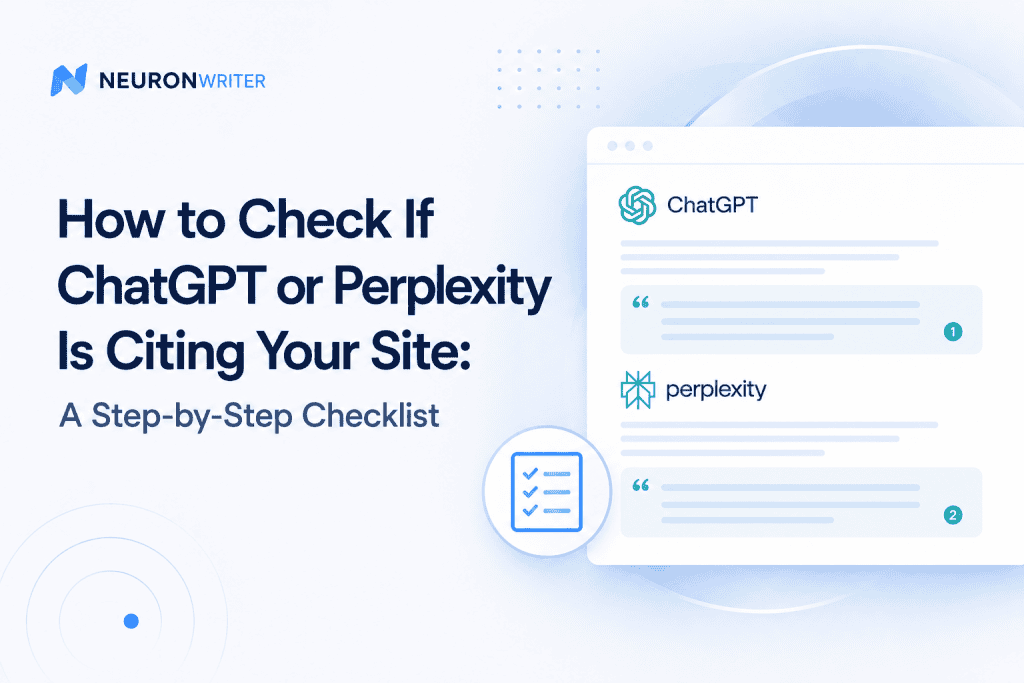
The fastest way to check if ChatGPT is citing your site is to ask it a buyer-style question about your category not a question about your brand name and see whose domain shows up in the answer or source list. Do the same in Perplexity, Google AI Overviews, and Gemini, since each engine surfaces citations differently. Below is a five-step checklist that takes about 20 minutes to run manually, plus a faster automated route for tracking your AI visibility on an ongoing basis.
Why AI citations matter now
A growing share of searches never produce a click. Instead of typing a query into traditional search engines and choosing a blue link, people ask ChatGPT, Perplexity, Gemini, or Google’s AI Overviews a question and act on the AI-generated answer directly.
When a generative AI system writes that answer, it pulls from a handful of sources and sometimes names or links them. If your site is one of those sources, your brand reaches a buyer at the exact moment they’re deciding even if they never visit your page.
If it isn’t, a competitor gets that moment instead, and the miss won’t show up anywhere in Google Analytics or any other normal analytics tool, because there was no click to measure no ai traffic, no referral, nothing to attribute.
This is the discipline usually called generative engine optimization (GEO) or answer engine optimization (AEO): making sure your content is the kind of source these AI systems actually pull from and cite.
Whether you call it a ChatGPT citation check, checking if ChatGPT cites your brand, or just tracking your chat gpt visibility over time, the underlying process is the same across AI platforms: send the same buyer-relevant question to several AI models, and see whose content each one leans on for its ai-generated answers.
The 5-step checklist
Run these in order. Steps 1–4 are manual and free. Step 5 is where you move from a one-time snapshot to ongoing tracking.
Step 1: Ask buyer-intent prompts, not brand-name prompts
Open ChatGPT and ask the kind of question your buyer would actually type a description of the problem you solve, not your company name.
If you ask “Does [Your Brand] have good customer support?” you’re testing recall, not citation. Ask “What’s the best [your category] for [use case]?” instead, and see whether your domain appears in the answer, in a source link, or gets paraphrased without attribution (a mention without a citation still tells you something, but it’s not the same thing).
Run 4–6 variations of the buyer question, since ai responses change between sessions and even between near-identical prompts. A brand mention buried in the middle of an answer, with no link or clear attribution, is worth noting separately from an actual citation the two get lumped together a lot, but they mean different things for how much traffic or trust you’re actually getting.
Step 2: Test with browsing mode on and off
ChatGPT, OpenAI’s ai-powered assistant, answers differently depending on whether it’s pulling from its trained knowledge or actively browsing the live web a distinction that matters for every ai-powered search tool, not just this one.
Ask the same question with web search/browsing enabled and disabled. If you only show up in browsing mode, that tells you your visibility depends entirely on live crawlability and freshness not on being “known” by the model which changes what you should fix first.
Step 3: Check Perplexity separately
Perplexity is more consistently transparent about citations than ChatGPT it shows numbered source links inline with most answers by default.
Run the same buyer-intent prompts here and look at the actual source list, not just whether your brand name appears in the prose. Perplexity and ChatGPT frequently cite different domains for the same question, so checking only one engine gives you an incomplete picture of your ai search visibility.
Because different ai search engines and ai engines generally pull from different indexes, a site with strong visibility in ai from one engine can be entirely invisible in another’s ai search results which is exactly why you need to track ai citations per engine, not just check whether you’re cited in ai somewhere in general.
Step 4: Check Google AI Overviews, AI Mode, and Gemini
Google’s AI Overviews and AI Mode pull from a different pipeline than ChatGPT or Perplexity closer to Google’s existing search index and ranking signals.
Gemini, run directly through the Gemini app, sits somewhere in between and is worth checking separately since it doesn’t always surface the same sources as AI Overviews. Search your buyer-intent queries on Google itself and check whether an AI Overview appears, and if so, whether your site is among the linked sources.
Sites that already rank well in traditional search results have a real advantage here, since AI Overviews draw heavily from top organic results this is one of the clearest signals that traditional SEO and GEO aren’t separate disciplines so much as overlapping ones.
Step 5: Set up ongoing citation tracking
Manual checks give you a snapshot, and ai-generated answers are not static the same prompt can return different sources from one day to the next as models update and re-crawl the web. A dedicated tool for tracking ai citations (NEURONwriter AI-Tracking is built for exactly this) runs your buyer-intent prompts across ChatGPT, Perplexity, and Google’s AI surfaces on a schedule, logs which domains get cited by ai tools each time, and flags when a competitor starts appearing where you used to.
That gives you visibility across every engine you care about and turns a one-off check into an actual trend line you can act on, instead of trying to measure your ai visibility by hand every week.
| Method | Cost | Coverage | Best for |
| Manual prompts (Steps 1–4) | Free | One engine, one moment in time | A quick gut-check or a one-time audit |
| Automated tracking (Step 5) | Paid tool | Multiple engines, tracked over time | Ongoing GEO/AEO strategy and reporting |
Why ChatGPT might not be citing your site
If your buyer-intent prompts come back empty, a few things are usually at play:
- Weak authority signals. AI systems favor sources that already carry independent trust signals backlinks, mentions on other credible sites, and consistent entity information about your brand across the web.
- Thin or vague content. Pages that never state a direct, extractable answer make it harder for a model to lift a clean passage to cite. Buried answers get skipped over in favor of a competitor’s page that states the point in the first sentence.
- Missing or incomplete structured data. Schema markup (Article, FAQPage, HowTo, depending on content type) helps AI systems parse what a page is actually about and extract it accurately.
- Blocked AI crawlers. If your robots.txt disallows AI crawlers like GPTBot, PerplexityBot, or Google-Extended or if you deliberately block ai crawlers you don’t trust you’ve opted out of citation entirely for that engine, regardless of how good the content is.
- No recent content signals. Stale, un-updated pages are less likely to be surfaced for fast-moving topics, since freshness is one of the few explicit ranking-style signals these systems still rely on.
How to improve your odds of getting cited
Once you know where the gap is, the fixes for how you create content and optimize your content are fairly consistent across engines, and they improve your chances everywhere at once rather than requiring a separate playbook per AI platform:
- Lead with the direct answer. Open the page and ideally each major section with a 1–2 sentence answer before elaborating. This is the single highest-leverage change, because AI systems extract passages, not whole pages.
- Structure for extraction. Short paragraphs, clear H2/H3 headers, and tables or lists make it easier for a model to lift a clean, self-contained chunk.
- Add real specifics. Named examples, data points, and concrete steps read as more citable than general advice, because they’re harder for a model to reconstruct from anywhere else.
- Add or fix schema markup so the page’s structure is machine-readable, not just human-readable.
- Build off-page mentions. Citations, “best of” roundups, and forum or community answers that reference your brand all feed the authority signals these systems weigh a citation strategy isn’t just an on-page exercise.
- Keep the page current. Note a visible last-updated date and revisit the content on a schedule, especially for anything tied to a fast-changing topic.
None of this guarantees your chances of being cited on any single check ai search optimization is closer to improving your odds across hundreds of queries than winning any one prompt but sites that do this consistently see their content gets cited noticeably more often across Google and AI answers alike.
How often should you check?
A single check tells you where you stand today, not where you’re trending. Because AI answers shift as models update and re-crawl the web, a monthly manual spot-check plus continuous automated tracking is a reasonable baseline for most sites weekly if you’re actively working on GEO/AEO and want to see whether specific changes are moving the needle.
FAQ
How can I check if ChatGPT is citing my website?
Ask ChatGPT a buyer-intent question about your category (not your brand name) with browsing mode on, and check whether your domain appears in the answer or its source links this is the core “check if ChatGPT cites” method the rest of this guide builds on. Repeat with several prompt variations, since results aren’t identical every time and each variation tests slightly different answers to specific questions a real buyer might ask.
Can I ask ChatGPT to cite its sources?
Yes you can ask it directly to list its sources, and with browsing/search enabled it will often show links. Without browsing enabled, it may describe sources from training data that aren’t verifiable citations, so treat those answers more cautiously.
How do I check if Perplexity cites me?
Run the same buyer-intent prompts in Perplexity and look at the numbered source list it displays by default alongside most answers Perplexity is generally more consistent about showing citations inline than ChatGPT.
Why doesn’t ChatGPT always cite sources or my website?
Answers pulled from trained knowledge rather than live browsing often skip citations entirely. Even in browsing mode, a site can be skipped due to weak authority signals, unclear structure, blocked crawlers, or thin content that doesn’t state a clear, extractable answer.
What makes content more likely to be cited by ChatGPT and other AI tools?
Content that opens with a direct answer, is broken into clearly labeled sections, includes concrete specifics or data, and carries independent authority signals (backlinks, mentions elsewhere) is consistently more citable than vague, unstructured pages.
Does ChatGPT make up citations or hallucinate sources?
It can, particularly when answering from trained knowledge rather than live browsing. Fabricated citations are a known failure mode, which is another reason to verify actual citation behavior yourself rather than relying on what the model claims about its own sourcing.
What tools can help me track if ChatGPT cites my site?
Dedicated AI-visibility trackers, including NEURONwriter AI-Tracking, run a set of prompts across ChatGPT, Perplexity, and Google’s AI surfaces on a schedule and log which domains get cited over time, rather than requiring you to check by hand each time.
Does ranking well in Google SEO help with AI citations too?
It helps, especially for Google’s AI Overviews, which draw heavily on top organic search results. It isn’t a guarantee across engines, though ChatGPT and Perplexity weigh their own crawling and authority signals, so a page can rank well in Google and still be skipped elsewhere.
What if my site isn’t showing up in AI search yet?
Start with the diagnostic steps above confirm you’re not blocking AI crawlers, then check whether your content leads with a direct answer and carries structured data. Improvements typically take a few weeks to show up, since they depend partly on re-crawling.
Is checking AI citations free?
The manual method (Steps 1–4) is free it just costs your time. Citing ChatGPT checks, cited in ChatGPT spot-checks, and general ai mentions monitoring can all be done by hand at no cost.
Automated tools that track ChatGPT citations at scale, across many prompts and engines, are typically paid, since they’re doing the repetitive querying and logging for you.
How do I optimize my website for AI answers from AI assistants?
Building a proper website for AI means treating structure as seriously as wording: direct answers up top, clean headers, schema markup, and genuine specifics the same content for better visibility recommendations covered above, applied consistently across your highest-priority pages rather than as a one-off exercise.