
GEO vs. AEO vs. SEO: Are They Really Different Disciplines?
Semantic Summary
Idea: GEO, AEO, and SEO aren’t three competing disciplines they’re three layers of the same underlying work, each aimed at a different search surface: traditional results pages, direct-answer snippets, and generative AI answers.
Challenge: Teams often treat each acronym as its own initiative with a separate budget line, or drop SEO fundamentals entirely to chase AI citations. Both mistakes backfire, since AI Overviews and generative engines draw heavily on pages that already rank well organically in the first place.
Summary: A single well-structured page one that ranks, opens each section with a direct answer, and carries a consistent, unambiguous entity identity satisfies SEO, AEO, and GEO at once. The entity-clarity work is what completes the GEO layer, and it’s worth treating as a required step rather than an optional add-on.
Related reads: How to Check If ChatGPT or Perplexity Is Citing Your Site · The Atomic Answer Framework · Entity SEO in 2026
Why the acronyms keep multiplying
Search continues to evolve faster than the terminology settles: SEO vs GEO vs AEO, AEO vs GEO vs SEO, GEO vs AEO different writers order the same three letters differently, and some throw in a fourth (AIO, GSO) for the same underlying idea.
What matters isn’t memorizing which acronym came first, it’s recognizing that all of them describe adjustments to how content performs as search engines like Google, large language models, and AI-powered search tools each parse and rank the same underlying page slightly differently.
A digital marketing agency combining SEO fundamentals with AEO-style structuring and GEO-style entity clarity covers essentially every version of this acronym list at once, which is a more useful frame than treating each new term as a separate discipline requiring its own budget line.
Strong SEO alone still helps you create content that ranks in search, but it no longer guarantees content so AI systems choose to cite it that’s the part GEO helps AI-facing visibility with, and AEO ensures your content is at least structured well enough to compete for the attempt.
What each one actually is
SEO (Search Engine Optimization)
SEO is the practice of optimizing a page to rank higher in traditional search engine results pages, using signals search engines have relied on for two decades: keywords, backlinks, site structure, and page experience.
It’s the foundation everything else in this article builds on a page with no SEO fundamentals rarely has a chance at AEO or GEO success either, since Google’s own documentation on AI features in Search confirms AI Overviews and answer engines both draw heavily on pages that already rank well organically.
AEO (Answer Engine Optimization)
AEO is the practice of structuring content so it can be extracted as a direct, standalone answer the kind that wins a featured snippet, a voice-assistant response, or a short quoted answer inside an AI Overview.
Where SEO optimizes for ranking a whole page, AEO optimizes for a single passage: usually a short, self-contained paragraph or list that answers one specific question completely on its own.
GEO (Generative Engine Optimization)
GEO is the practice of making content more likely to be cited, quoted, or synthesized by generative AI systems ChatGPT, Perplexity, Gemini, and Google’s AI Overviews when they construct an answer from multiple sources rather than linking to just one.
GEO overlaps heavily with AEO (both care about extractable, well-structured answers) but extends further into entity clarity, off-page corroboration, and being one of several sources a model blends into a synthesized response rather than the single source it quotes verbatim.
Some teams call this “AI visibility” instead of generative engine optimization same underlying goal, different label, and either way it depends on more than just the AI tools you use to check it; the content and entity work underneath has to be there first.
| SEO | AEO | GEO | |
| Primary surface | Traditional search engine results page | Featured snippets, voice answers, short AI-quoted answers | ChatGPT, Perplexity, Gemini, AI Overviews (synthesized answers) |
| Unit optimized | The whole page | A single passage or list | A passage, plus the brand/entity behind it |
| Success metric | Ranking position, organic traffic | Snippet/answer win rate | Citation rate, share of AI-answer voice |
| Core techniques | Keywords, backlinks, technical SEO, page experience | Direct-answer paragraphs, schema, question-based headers | Everything AEO does, plus entity consistency and off-page corroboration |
How they overlap in practice
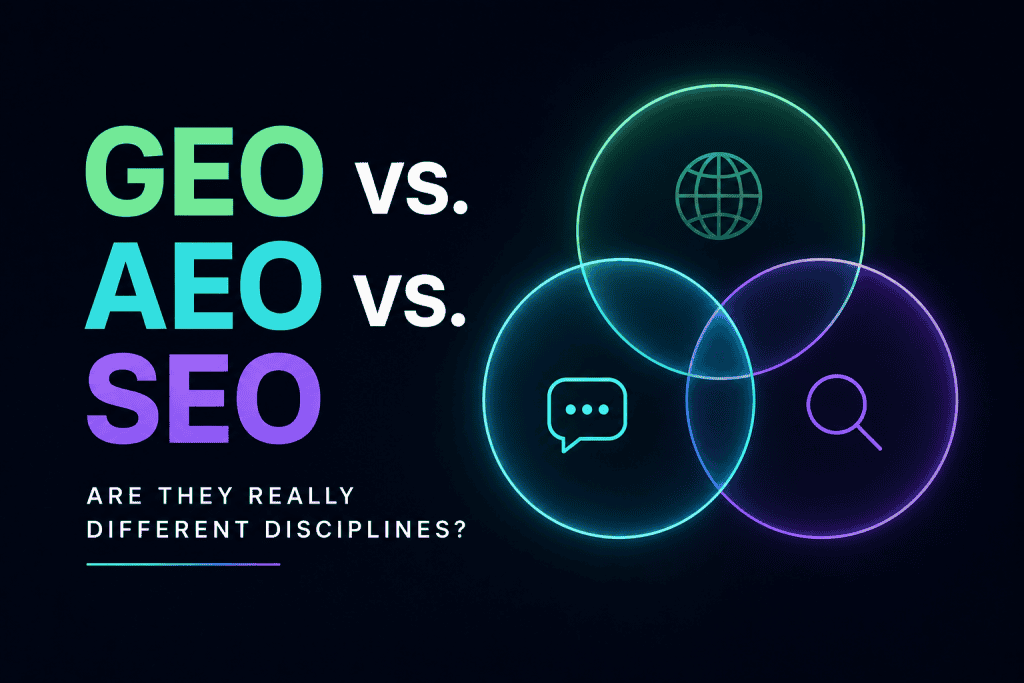
In practice, these three rarely require separate content they require the same content built with a bit more discipline at each layer. A page that already ranks well (SEO), opens each section with a direct answer (AEO), and gives search engines and AI platforms a consistent, unambiguous picture of who’s behind the content (GEO) is doing all three at once, not choosing between them.
This last part making sure a model can identify your brand as a single, well-defined source rather than a vague or inconsistent one is its own discipline worth treating seriously; our guide on entity SEO covers exactly how to build that unambiguous identity, which is a large part of what separates AEO from full GEO.
Do you need all three?
Realistically, yes but not with equal urgency for every business. If organic traffic is still your primary channel, SEO fundamentals come first; nothing in AEO or GEO compensates for a page that doesn’t rank at all. If your audience regularly uses voice search or expects instant answers (support content, definitions, how-tos), AEO’s direct-answer structuring pays off quickly.
If your buyers are increasingly asking ChatGPT or Perplexity category questions before ever visiting a website common in B2B software, research-heavy purchases, and anything with a long consideration cycle GEO deserves dedicated attention, because a citation there can influence a decision your analytics will never show you.
Common mistakes when transitioning from SEO to AEO/GEO
- Treating GEO as a replacement for SEO. Dropping SEO fundamentals to chase AI citations removes the base that AI Overviews and generative engines are drawing from in the first place.
- Optimizing only the H1, not every section. AEO and GEO reward direct answers at the section level a single strong opening paragraph followed by five unstructured ones underperforms a page where every section leads with its own answer.
- Ignoring entity consistency. Strong on-page structure without a clear, consistent brand identity across sources leaves GEO half-finished see the entity SEO guide linked above for the specific fix.
- Assuming one schema type covers everything. FAQPage, HowTo, and Article schema serve different content types; using the wrong one (or none) weakens the machine-readable signal search engine crawlers and AI tools like ChatGPT both rely on.
- Focusing only on AEO and skipping GEO’s entity work. Direct-answer paragraphs alone don’t build the consistent brand identity across the web that generative engines need to attribute an answer to you specifically.
How to measure success across all three
SEO has mature measurement (rankings, organic traffic, click-through rate) that most teams already track this is the search visibility layer most digital marketing agencies already report on. AEO’s clearest signal is whether you’re winning featured snippets and short AI-quoted answers for your target queries, including Google AI Overviews specifically.
GEO is the hardest to measure because there’s often no click to attribute the only reliable way to know if generative engines are actually citing you is to ask them directly and track it over time, since ai search optimization results rarely show up as a referral in standard analytics; our step-by-step checklist for checking if ChatGPT or Perplexity is citing your site walks through exactly that process, engine by engine.
FAQ
What is the difference between SEO, AEO, and GEO?
SEO optimizes a whole page to rank on traditional search engines; AEO optimizes individual passages to win direct answers and featured snippets; GEO optimizes both content and brand identity to be cited by generative AI systems synthesizing an answer from multiple sources.
What are the 4 types of SEO?
The four commonly cited types are technical SEO (crawlability, site speed, indexing), on-page SEO (content, keywords, headers), off-page SEO (backlinks, mentions, authority), and local SEO (location-based visibility) GEO and AEO are newer, adjacent disciplines rather than a fifth type within this traditional breakdown.
Is AEO replacing SEO, or is SEO still important in 2026?
SEO is still important AEO and GEO both depend on pages that are already well-optimized and crawlable in the first place, since AI Overviews and generative engines draw heavily on content that already ranks organically. AEO is additive, not a replacement.
Is AI SEO called GEO?
“AI SEO” is an informal umbrella term people often use to mean GEO specifically, though it sometimes gets used loosely to cover AEO and GEO together. GEO is the more precise term for optimizing specifically toward generative AI citation.
How do SEO, AEO, and GEO work together in a unified strategy?
They work together when the same content is built to rank (SEO fundamentals), structured to answer directly at the section level (AEO), and backed by a consistent, unambiguous brand identity (GEO) rather than treated as three separate content tracks requiring separate pages.
When should a business focus on SEO, AEO, or GEO first?
Start with SEO if organic traffic is still your primary channel and rankings are weak. Prioritize AEO if your audience expects instant answers (support, how-to, definitional content). Prioritize GEO if buyers in your category increasingly research using ChatGPT or Perplexity before visiting a site directly.
What are common mistakes to avoid when transitioning from SEO to AEO/GEO?
Dropping SEO fundamentals to chase AI citations, only optimizing the opening paragraph instead of every section, ignoring entity consistency across sources, and using the wrong (or no) schema markup for the content type.
How do you measure the performance of AEO and GEO?
AEO performance shows up in featured-snippet and short-answer win rates for target queries. GEO performance has to be measured by directly querying AI engines with buyer-intent prompts and tracking which domains get cited over time, since there’s usually no click to attribute in analytics.
Are answer engines and generative engines the same thing?
Not exactly answer engines are the broader category of systems returning direct answers (including traditional search features like featured snippets), while generative engines specifically produce an AI-generated answer by synthesizing across sources. AEO targets both; GEO focuses specifically on the generative, AI-answer case within the wider AI search landscape.
Does traditional SEO still matter if I invest in AEO and GEO?
Yes traditional SEO remains the foundation. AI models and answer engines both draw heavily on content that already performs well in classic search results, so skipping SEO fundamentals to chase AEO or GEO tends to undermine both.
AEO vs GEO vs SEO: what’s the difference in one sentence?
SEO focuses on ranking a page, AEO focuses on winning a direct answer from that page, and GEO focuses on making that same content and the brand behind it a source generative AI systems choose to cite.
Can one piece of content rank for SEO, AEO, and GEO together?
Yes, and that’s the goal rather than the exception a single well-structured page that ranks organically, opens each section with a direct answer, and maintains consistent entity signals across the web is doing SEO, AEO, and GEO at once, not competing versions of the same content. Focusing only on AEO while making your content structurally sound but entity-vague is the most common way teams fall short of the GEO half of that goal, so treat entity work as a required step, not an optional add-on.