AI Prompt Research: Build a Search Query Taxonomy for Better AI Visibility
Semantic Summary
Idea: AI prompt research is the disciplined process of collecting, classifying, and reviewing the questions people ask AI search tools. A prompt taxonomy gives each AI prompt a useful operational label: the decision behind it, the answer shape it needs, its market context, its business risk, and its next handling route.
Challenge: Teams often treat a growing prompt list as if it were keyword research, or they use one big prompt to make broad claims about their market. That produces noisy model output, weak priorities, and too many unnecessary content ideas. It also hides which questions are genuinely important for brand, product, or customer teams.
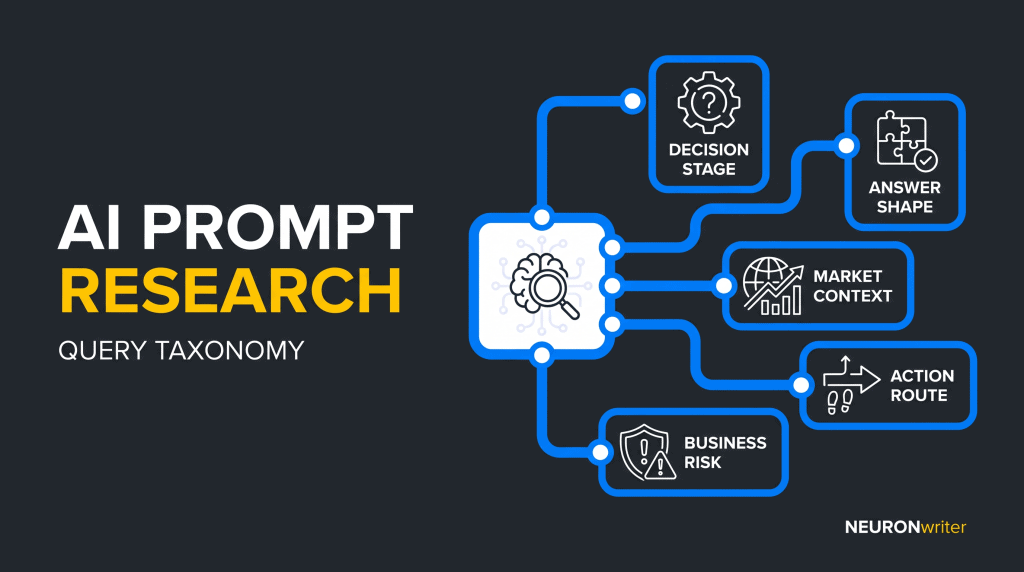
Summary: Build a small, repeatable AI search query taxonomy around five fields decision stage, prompt shape, market context, business risk, and handling route. It turns AI-powered research into a stable workflow: observe a prompt, classify it, verify important evidence, assign an owner, choose the smallest justified action, and review the same prompt again later.
Related reads:
AI Visibility Measurement Framework for Content Teams
AI Visibility Data Governance: How to Store, Audit and Defend AI-Answer Evidence
How to Get Cited by AI: From Citation Gap to Content Brief
AI prompt research is not a list of clever instructions for ChatGPT, Gemini, Perplexity, or another AI tool. For a content team, it is a way to understand the natural-language questions that surround a buying decision, then place each question in a clear operating structure.
That distinction matters. AI search conversations usually contain more context than a traditional keyword: a role, a market, a desired outcome, an objection, or a constraint. A short prompt such as “best AI visibility tool” may signal category exploration. A longer prompt such as “which AI visibility platform supports reporting for a UK agency with enterprise clients?” signals an evaluation task, a market context, and a likely product-marketing review.
Google explains that generative search experiences can use related searches, sometimes called query fan-out, to gather information for a response. A team should therefore focus on the decision a prompt represents rather than trying to publish a separate page for every wording variation. The goal is better content and product decisions, not more pages.
What AI Prompt Research Means for Content Teams.
AI prompt research means studying the questions people use in AI search and turning their underlying decisions into an actionable system. It combines the curiosity of keyword research with a more complete view of context, constraints, and desired output.
Traditional keyword research remains useful. It tells a team how people describe a topic in search engines and which language appears around demand. But an AI prompt can be a multi-step research request written in conversational language. It may ask an LLM to compare tools, generate ideas, summarize a complex category, or recommend an approach for a specific market.
A useful working definition is:
AI prompt research is the systematic analysis of real or representative AI-search prompts to identify the decisions, evidence needs, contexts, and next actions behind them.
This is different from prompt engineering. Prompt engineering focuses on how to ask an AI system for a stronger output. AI prompt research focuses on what a market is asking, why it is asking, and what your team should do with that signal. Both practices can support each other, but they solve different problems.
A team can use an AI tool such as ChatGPT, Gemini, or Perplexity to summarize notes into bullet points, create a brief summary, and surface key findings from a large prompt list. That AI-assisted output is useful for a business research process, but it is not an academic research paper, a literature review, or a substitute for a qualitative study. The methodology here is operational: define a research question, build a small research plan, check the source context, and route a decision to the right owner.
| Practice | Primary question | Typical output | Common pitfall |
| Keyword research | What language and topics indicate demand? | Keyword clusters and page opportunities. | Reducing a complex user decision to a head term. |
| Prompt engineering | How can we ask an LLM for a better answer? | A clearer instruction, context, and format. | Treating a better model answer as market evidence. |
| AI prompt research | What does the person behind this AI prompt need to decide or do? | A classified prompt portfolio and action route. | Collecting prompts without a repeatable methodology. |
| AI visibility monitoring | Does a brand, source, or competitor appear for stable prompts? | Mentions, citations, gaps, and observations. | Reacting to one volatile answer without verification. |
The most useful AI prompt research begins with questions your organisation already hears: sales calls, product demonstrations, support issues, customer interviews, search-query data, site search, community discussions, and selected AI-search conversations. It does not require claiming access to every private conversation people have with AI.
Why a Prompt Taxonomy Matters in AI Search.
A prompt taxonomy makes a prompt portfolio comparable, reviewable, and easier to act on. Without one, a team sees a long list of questions but cannot confidently distinguish an editorial opportunity from a product-truth issue, a market-localisation gap, or a low-priority observation.
A raw prompt inventory quickly becomes messy. One analyst may call a question “commercial”; another may call it “mid-funnel”; a third may mark it as a comparison. All three labels may be reasonable, but they do not create a shared workflow. A taxonomy gives the team a controlled vocabulary with definitions, examples, and simple decision rules.
The benefit is not bureaucracy. It is clarity. The taxonomy should make it easier to give a stakeholder a brief summary of the prompt landscape, key findings, and the small number of actions that deserve attention.
| Without a taxonomy | With a taxonomy |
| Similar prompts are grouped only by keywords. | Prompts are grouped by the underlying decision and contextual differences. |
| A missing brand mention automatically becomes a content request. | The team first checks risk, evidence, owner, and the best handling route. |
| One big prompt produces a broad, hard-to-verify summary. | Stable core questions are reviewed in a consistent prompt set. |
| Every answer triggers urgency. | Low-confidence or low-risk observations can be marked “observe only.” |
| Teams create duplicate content. | Teams improve the most relevant canonical page, source, or documentation. |
This approach also supports passage-level writing. When a taxonomy shows that users repeatedly need a definition, procedure, comparison criterion, or evidence request, content teams can strengthen the relevant section on a canonical page. That is more useful than producing many thin URLs for tiny variations.
The Five Fields of an AI Search Query Taxonomy.
A practical AI search query taxonomy needs only enough fields to change ownership, review cadence, or action. The following five-field conceptual framework is deliberately small enough to use in a spreadsheet, a content brief, or an AI visibility workflow.
1. Decision Stage: What Is the Person Trying to Decide?
Decision stage identifies the job behind the prompt. It should describe the user’s goal, not the page format your team wants to produce.
| Decision stage | The person wants to… | Example AI prompt | Likely first route |
| Explore | Understand a category or problem. | “What is AI visibility for a SaaS company?” | Foundational educational content. |
| Frame | Identify criteria before a future choice. | “What should a content team measure in AI search?” | Strategy, research, or enablement. |
| Evaluate | Compare approaches, vendors, or capabilities. | “Which AI visibility tool works for agencies?” | Product marketing or comparison-page review. |
| Validate | Check a feature, price, policy, integration, or claim. | “Does this tool track Google AI Mode?” | Product truth or documentation owner. |
| Implement | Complete a task after choosing a direction. | “How do I audit an inaccurate AI answer?” | Documentation or workflow owner. |
| Resolve | Fix a problem after purchase or adoption. | “Why is a feature described incorrectly in AI search?” | Support, product, or brand team. |
| Expand | Increase value after initial adoption. | “How can an agency package AI visibility reporting?” | Customer success or services enablement. |
A comparison can be an Evaluate question even if the text includes implementation details. A prompt about an existing customer’s adoption can be Expand, not Evaluate. These distinctions reduce confusion when teams analyse data at scale.
2. Prompt Shape: What Kind of Answer Does the Person Need?
Prompt shape records the answer pattern that the person expects. It is not about whether an AI prompt is “good” or “bad.” It shows whether the answer must define, compare, instruct, contextualise, or substantiate something.
| Prompt shape | The answer should provide… | Example |
| Definition | Meaning, boundaries, and a plain-language explanation. | “What is prompt research?” |
| Comparison | Criteria, trade-offs, and a decision lens. | “AI prompt research vs keyword research.” |
| Procedure | Ordered steps, prerequisites, and acceptance conditions. | “How do I classify a prompt portfolio?” |
| Use case | A role, outcome, industry, or constraint. | “AI prompt research for an enterprise agency.” |
| Objection | Limits, risks, costs, or reasons not to proceed. | “Do we need hundreds of prompts to track AI visibility?” |
| Evidence request | Sources, method, proof, example, or benchmark. | “How can I verify an AI visibility claim?” |
| Entity expansion | Related tools, roles, concepts, or systems. | “What should an AI visibility analyst use besides content briefs?” |
A prompt may have one primary shape and a short secondary note. Do not add five labels to a single sentence simply because AI prompts make several requests. Good taxonomy design helps a reviewer decide; it should not slow every review down.
3. Market Context: Where and for Whom Must the Answer Work?
Market context captures the conditions that change what a useful answer looks like. The same question can have a different answer depending on language, country, industry, buyer role, company maturity, technology stack, or commercial stage.
For example, an agency owner may ask for client-reporting workflows while a product marketer may need decision criteria for an internal programme. A pricing or availability question may depend on a specific country. These are not cosmetic differences; they can change the evidence source, review owner, and appropriate action.
| Context dimension | Example values | Why it matters |
| Language and market | English–US, English–UK, German–DACH, Polish–PL. | Terms, sources, availability, and local expectations can vary. |
| Industry | SaaS, e-commerce, agency, healthcare, education. | Evidence standards and core questions change. |
| Buyer role | Content lead, SEO manager, product marketer, agency owner. | Each role needs a different output and decision lens. |
| Company maturity | Founder-led, growth-stage, mid-market, enterprise. | Governance, workflow, and approval needs differ. |
| Technology context | WordPress, headless CMS, multilingual site, integrated CRM. | This can change implementation and ownership. |
| Commercial context | Trial, procurement, renewal, expansion, services engagement. | It changes urgency and the accountable reviewer. |
Use general when no context changes the answer. Adding a market label to every prompt creates noise. Add context only when it changes the route, the evidence requirement, or the content decision.
4. Business Risk: What Happens if the Answer Is Wrong or Missing?
Business risk turns AI prompt research into a prioritisation method. It records the likely impact if an AI answer is inaccurate, incomplete, misleading, or dominated by a competitor.
| Risk level | Example signal | Appropriate response |
| Low | A broad definition does not name the brand. | Monitor directionally and improve a hub only if it serves a real user need. |
| Medium | A buyer-stage comparison omits an important capability. | Check product facts, sources, and the relevant canonical page. |
| High | An answer misstates a plan, integration, policy, eligibility, or material feature. | Preserve evidence and route it to the approved product-truth owner. |
| Critical | The claim could create serious customer harm, a compliance problem, or a material reputation issue. | Follow the organisation’s existing incident and escalation process. |
Risk is not the same as revenue potential. A broad category question may be valuable but low risk. A narrow product question can be high risk if the answer is wrong. This is why a taxonomy should not rank prompts only by apparent commercial intent.
5. Handling Route: Who Reviews the Finding First?
Handling route translates an AI-search observation into accountable work. It names the function that makes the first decision, not necessarily the person who completes every task.
| Handling route | Use it when the gap concerns… | First reviewer |
| Content coverage | An important decision is not explained clearly by an owned page. | Content strategist or editor. |
| Product truth | Product capabilities, plans, integrations, or limitations are wrong or unclear. | Product owner or product marketing. |
| Brand narrative | Category language, positioning, or comparison framing is misleading. | Brand or product marketing lead. |
| Market localisation | A market-specific offer, source, language, or requirement needs review. | Regional marketing or localisation owner. |
| Customer support | The question concerns setup, adoption, troubleshooting, or service experience. | Customer success or support lead. |
| Risk escalation | The evidence needs compliance, legal, security, or senior brand review. | Approved internal escalation owner. |
| Observe only | The evidence is weak, the prompt is low risk, or no action is justified yet. | AI visibility owner with a review date. |
This field prevents the reflex that every gap should become new content. In many cases, the correct action is to clarify a product page, update a help article, improve an internal-link path, correct an evidence source, or simply wait for more stable observations.
A Multi-Step Workflow for Classifying an Existing Prompt Portfolio.
The most reliable taxonomy starts with prompts your team already has and improves through calibration. Do not wait for a perfect master list. Start with a manageable portfolio, agree on the rules, then iterate.
Start With a Stable Prompt Inventory.
Collect 25 to 40 prompts from relevant sources and keep the wording intact. Include category questions, comparisons, implementation questions, market-specific prompts, objections, and known high-risk cases. Preserve the original natural language because it often contains the contextual clues that a short keyword removes.
This inventory is not training data for a model. It is a governed research asset. Save where the prompt came from, when it was observed, whether it is a direct customer question or a research hypothesis, and which AI platforms it will be checked on. The AI Visibility Data Governance guide explains how to keep an evidence register and change history for material findings.
Calibrate the Labels Before You Scale.
Ask two reviewers to classify the same small set independently. Then compare the results. When they disagree, do not force a quick consensus. Identify whether the definition, example, or decision rule needs improvement.
For example, a prompt such as “best AI visibility tools for enterprise agencies” might initially receive both Evaluate and Expand labels. Your decision log can establish a testable rule: use Evaluate when the prompt represents a pre-purchase choice; use Expand only when the question concerns an existing customer’s adoption or service value.
This calibration is a form of qualitative, thematic review. You are not conducting an academic study; you are building a usable business methodology. The point is a consistent route for similar cases, not a complicated scoring model.
Apply the Five Fields and Add an Evidence Note.
For each prompt, assign one primary value in every field. Add a short note only where it changes the decision. Then record whether the observation is verified, partially verified, or not yet verified.
| Prompt ID | Prompt | Stage | Shape | Context | Risk | Route | Evidence note |
| Q-001 | “What is AI visibility?” | Explore | Definition | General | Low | Content coverage | Stable category question; review quarterly. |
| Q-014 | “Which AI visibility tool fits a UK agency?” | Evaluate | Comparison | English–UK; agency | Medium | Brand narrative | Check current feature and pricing sources. |
| Q-027 | “Does the platform monitor AI Mode?” | Validate | Evidence request | Product evaluation | High if inaccurate | Product truth | Verify against current documentation before action. |
| Q-041 | “How do I report AI visibility to a client?” | Implement | Procedure | Agency | Medium | Content coverage | Check whether one guide already serves the job. |
| Q-055 | “Why is this feature unavailable in my market?” | Resolve | Objection | Named market | High | Market localisation | Retain source and re-check after resolution. |
Turn Patterns Into the Smallest Justified Action.
Once the taxonomy is in place, analyse data by pattern rather than by isolated answer. If several prompts are definition variations of one decision, strengthen one authoritative guide. If several evaluation prompts expose unclear product language, route a consolidated finding to product marketing. If an answer is unstable and low risk, mark it observe only.
This is where AI-powered research can streamline work. An AI tool can help generate ideas, summarize a large prompt set, or surface likely key themes. But it cannot decide on its own whether an observation is trustworthy, whether the source is authoritative, or whether a page should be published. Always verify the important claims, source context, and product facts before a team treats model output as evidence.
The Prompt Research Brief: A Practical Template.
A prompt research brief turns the taxonomy into a shared operating document. It gives every stakeholder enough context to understand why a cluster matters without forcing them to read a raw export of prompts and answers.
| Brief field | What to record | Why it helps |
| Research question | The decision or market question the prompt set should clarify. | Keeps the portfolio focused on a useful outcome. |
| Core questions | The stable prompts checked repeatedly across selected AI platforms. | Makes comparisons over time more meaningful. |
| Prompt taxonomy | The five-field labels plus examples and edge-case rules. | Creates a repeatable structure. |
| Evidence requirement | What must be captured: answer, cited source, date, locale, reviewer, confidence. | Prevents unsupported claims based on a single output. |
| Handling route | The first accountable owner and expected response. | Moves insight into a defined workflow. |
| Review cadence | Event-based or periodic re-check timing. | Prevents both neglect and unnecessary workload. |
| Decision log | What changed, why it changed, and what will be re-checked. | Preserves learning across the research process. |
A good brief uses plain language. It should answer: what are we trying to learn, which prompts matter, what evidence will count, who reviews it, and what action is possible. It should not promise that an LLM will deliver a permanent ranking or a causal explanation for every AI answer.
Quality Control: How to Verify AI Prompt Research.
Quality control means separating an AI response from a defensible insight. AI platforms can change their sources, wording, and answer structure. A useful taxonomy gives teams a method to observe change without overreacting to it.
Start with a stable set of core questions. Keep the wording, market, language, logged-in state where relevant, and observation date clear. Record the exact answer and any visible citations or sources. If an answer makes a product claim, verify important details against an approved source of truth. If it references an external claim, use open access or primary sources where possible, then note limitations.
| Check | Ask this before acting | Example response |
| Prompt stability | Did we use the same wording and context as the previous review? | If not, label it a new observation not a trend. |
| Source context | Does the cited source actually support the AI’s statement? | Read the source before treating the citation as proof. |
| Product truth | Is the feature, plan, or policy current and approved? | Route an unclear claim to the source-of-truth owner. |
| Decision relevance | Does the prompt affect a real buyer or customer decision? | If not, retain it only as exploratory research. |
| Action proportionality | Is a new page really the smallest justified action? | Prefer strengthening an existing canonical asset where possible. |
This process supports critical analysis without making every observation slow. Your team can use AI to analyze data, synthesize a recurring pattern, and shorten a long evidence log into a clear summary. However, the final interpretation should remain human-led, contextual, and traceable.
What AI Prompt Research Should Not Become.
AI prompt research should make your content strategy more selective, not more frantic. The biggest pitfall is translating every phrase, answer variation, or competitor mention into a new content task.
Google advises publishers to focus on people-first, helpful content and not create pages primarily to capture query variations in generative search.
A taxonomy gives you a practical way to follow that principle. If multiple prompts represent the same decision, strengthen the canonical page. If a prompt reveals inaccurate documentation, improve the source. If the gap is merely exploratory, record it and revisit later.
Avoid these three mistakes:
| Mistake | Why it fails | Better practice |
| Publishing for every prompt | It creates duplicate, thin, or semantically overlapping content. | Group equivalent decisions and improve one strong destination. |
| Treating one AI answer as a verdict | A single answer can be contextual, incomplete, or temporary. | Use stable prompt checks, evidence notes, and re-check dates. |
| Letting AI-generated content replace expertise | Generic output may lack first-hand facts, source quality, and nuance. | Add product truth, demonstrated experience, clear sourcing, and human review. |
The phrase “knowing how to ask” matters, but it is not the whole system. The stronger capability is knowing how to classify what was asked, what source is needed, who owns the outcome, and when to re-check it.
How NEURONwriter Supports Prompt Taxonomy Operations.
NEURONwriter helps teams observe selected AI-search discussions; the taxonomy gives those observations an internal decision system. The AI Visibility module is designed to help teams track visibility across Google AI Overviews, AI Mode, ChatGPT, and Perplexity, including brand mentions, citations, competitors, opportunities, and AI readiness.
Use the platform to maintain a focused set of questions rather than a disconnected collection of searches. A content lead can inspect a missing mention; a product marketer can validate an incorrect feature description; and an agency can produce a concise client summary. The taxonomy tells each person whether the observation is a content coverage issue, a product-truth issue, a market-localisation issue, or simply a point to observe again.
When a citation gap becomes a well-supported content opportunity, use the citation-gap-to-content-brief workflow to create a source-backed brief. When an observation requires an audit trail, use the AI Visibility Data Governance guide rather than relying on screenshots or memory.
Frequently Asked Questions.
What is AI prompt research?
AI prompt research is the process of studying the questions people ask AI tools and AI search platforms, then classifying the decisions, constraints, and evidence needs behind them. For content teams, it is most useful when it becomes a repeatable research process rather than a one-time list of prompts.
How is AI prompt research different from keyword research?
Keyword research focuses on the words and topics associated with demand. AI prompt research preserves more of the user’s natural-language context, such as buyer role, market, objection, and desired output. The two methods work together: keywords help map topic demand, while prompts reveal the decision paths inside conversational search.
What is a prompt taxonomy?
A prompt taxonomy is a controlled system for labelling prompts consistently. This article recommends five fields: decision stage, prompt shape, market context, business risk, and handling route. The purpose is to make findings comparable and easier to route to the right team.
What are the four parts of a good AI prompt?
A useful AI prompt often contains a goal, relevant context, constraints, and a requested output format. That is a prompt-engineering structure. A prompt taxonomy is different: it classifies the business decision behind an existing prompt after it has been collected.
Should content teams use one big prompt for AI research?
Usually, no. One big prompt can be useful for exploratory work or to generate ideas, but it is difficult to compare over time and easy to overinterpret. Use stable core questions for monitoring, then use broader AI prompts for exploratory research with clear human review.
How many prompts should an AI visibility programme monitor?
Start with a calibration set of roughly 25 to 40 prompts that represent the decisions your business actually needs to understand. Add prompts only when they reveal a materially different decision, market condition, risk, or handling route. Quality and repeatability matter more than a large count.
Can AI prompt research help with ChatGPT and Perplexity visibility?
Yes. A taxonomy lets teams use a consistent set of questions across ChatGPT, Perplexity, and other AI platforms, then compare observations without mixing unrelated decisions. It does not guarantee visibility, but it makes gaps and changes easier to interpret and act on.
How often should a team update its prompt taxonomy?
Review the vocabulary when repeated edge cases expose a missing rule, and review the prompt portfolio when the product, market, customer language, or strategic priorities change. Keep a decision log so that changes are deliberate and the historical research remains understandable.