The Semantic Debt Audit: Finding Contradictory Claims and Orphan Content
Semantic Summary
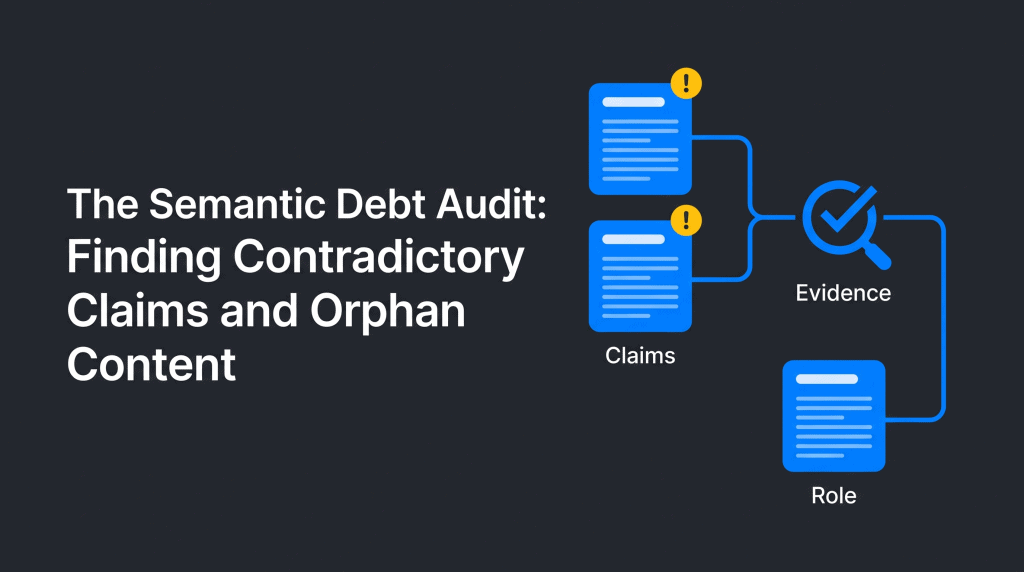
Idea: A semantic debt audit finds pages that describe the same thing in conflicting ways or no longer have a clear job in your content system.
Challenge: Content teams often use traffic alone to judge a page. That can miss a wrong product claim, an outdated definition, or an apparently linked page that serves no useful reader question.
Summary: Use this content audit checklist to create a small content inventory, compare important claims with approved facts, check each page’s cluster role, and choose a documented next action.
Related Reads: Content Optimization Workflow for SEO: Research, Brief, Write, Refresh, Measure · Entity SEO: The Missing Link Between Content and AI Rankings · Using NEURONwriter to Map Entity Clusters ·
What Is Semantic Debt in Website Content?
Semantic debt is the future cost of unclear, conflicting, or unconnected content. It grows when pages describe the same product, service, process, or topic differently, or when a page no longer has a clear job in a topic cluster.
A semantic debt audit asks: does this page still help people and systems understand the same thing correctly?
A content audit is not only a traffic report
A broad content audit can review URLs, organic traffic, metadata, user experience, broken links, and content quality. Those checks do not prove that a page agrees with the rest of your website content. Two pages can both receive traffic while making opposite claims about the same feature.
Google Search Console provides clicks, impressions, click-through rate, average position, query, and page data. Use it as context, not proof that a page is accurate, useful, or safe to delete.
Two forms of semantic debt: contradictory claims and orphan content
A contradictory claim is an incompatible statement about the same entity, such as a capability, audience, process, date, or limitation. Orphan content can also be editorial: a page may have links but no distinct reader question, cluster role, or reason to exist beside a stronger page. A link alone does not give a page a purpose.
Content Audit Checklist: Build a Content Inventory and Content Map
Start with one topic, product area, service line, or cluster before creating new content. A small scope finds a content gap in current content.
Choose scope, content types, owner, and audit question
Write one audit question, then name the person who can confirm facts or approve changes. Include the hub, key guides, product pages, help pages, and old content that influences the same reader decision. Start with the shared entity or task, not traffic data.
Build a simple content audit spreadsheet
For this qualitative audit, your inventory needs only enough detail to show why a URL exists and what the reviewer found. Use a content audit template or shared document.
| Field | What to record | Why it matters |
| URL, content type, and meta description | The address, format, and current page summary. | It creates a clear inventory of reviewed pages. |
| Reader question | The one question the page should answer. | It reveals pages that repeat the same job. |
| Primary entity | The product, service, process, or topic the page explains. | It makes claim comparison possible. |
| Approved claim and evidence | The statement that should be true, plus a source or named owner. | It separates evidence from remembered wording. |
| Cluster role | Hub, supporting guide, definition, comparison, help page, or another defined role. | It exposes editorial orphan content. |
| Internal-link context | Where a reader can find the page and where it should lead next. | It shows whether the page is connected meaningfully. |
| Risk, content audit data, and next action | Low, medium, or high risk; then correct, clarify, link, re-scope, merge, retain, or retire. | It turns audit results into accountable work. |
Use a sitemap for URLs, but it does not guarantee crawling or indexing. Google says properly linked important pages are usually discoverable. Treat it as an inventory signal, not proof of purpose.
Content Audit Process: Find Contradictory Claims
Compare statements with approved facts and other pages about the same entity. Start with claims that could change a reader decision, not harmless wording differences.
Check claims that can change a reader decision
Review the sections that describe a product, service, process, requirement, price, audience, limitation, or evidence. Ask whether the wording is current, specific, and compatible with other owned pages.
| Claim type | Example of a possible conflict | First check |
| Capability | One page says a feature is included; another says it is planned. | An approved product or service source. |
| Audience | One guide targets small teams; another implies the service is only for enterprise users. | Positioning and sales guidance. |
| Process | A guide gives three steps while a help page requires a different order. | The current operating process. |
| Limitation | A page promises a result without stating a meaningful condition. | The policy, support, or legal owner where needed. |
| Date or evidence | An old statistic or event is presented as current. | The original source and publication date. |
A contradiction does not always mean the older page should disappear. It may need a correction, a date label, a clearer audience statement, or a link to the page that contains the full answer. The key is to record what conflicts, what evidence resolves it, and who approves the change.
Separate a contradiction from a necessary difference in context
Two pages can use different wording without disagreeing. A product overview may give a short, general explanation. A help page may describe a detailed exception. That is useful if both pages clearly signal their context.
Treat the difference as semantic debt when a reasonable reader could reach opposite conclusions. If you cannot explain why both statements are true at the same time, pause publication updates and ask the fact owner to resolve the claim. This protects content quality better than rewriting each URL independently.
Website Content Audit: Find Orphan Content by Role
An internal link matters, but a page can receive links and still be editorially orphaned. The test is whether the page has one clear reader job and contributes something that another page does not already do better.
Map every page to one reader question and cluster role
Give each page one main reader question and one role. A hub page gives the broad answer and routes readers to deeper pages. A supporting guide answers a narrower question. A comparison helps a decision. A help page explains a specific task or problem.
If two URLs have the same reader question, entity, and answer, they may be duplicate content in purpose even when their wording differs. If a page cannot be placed in the cluster at all, it may need a new role, a clearer internal link, a merge, or retirement.
Check internal links, sitemap presence, and duplicate content separately
Keep three checks separate. First, see whether a page has useful internal links from relevant context. Second, see whether the URL appears in a sitemap and can be checked in Search Console. Third, decide whether the page duplicates another page’s editorial role.
Google’s URL Inspection information can help you understand crawl, index, and serving details for a specific URL. It is one of the free audit tools for a site audit. It cannot decide whether two pages make the same promise to readers. That decision still needs a human reviewer who understands the topic and approved facts.
Use the Semantic Debt Ledger to Decide What Happens Next
Use the ledger to document audit results and the smallest safe action. Do not delete a low-traffic page or ignore a serious contradiction simply because a dashboard looks reassuring.
| Audit finding | Safe next action | Minimum evidence before acting |
| A material claim conflicts with an approved fact. | Correct the page and add a review note. | The approved fact, source, and responsible owner. |
| The claim is true only for a specific audience, date, or condition. | Clarify the context. | The condition that makes the claim accurate. |
| The page has a distinct question but readers cannot find it from the cluster. | Link it from the relevant hub or supporting page. | A logical reader path and meaningful anchor text. |
| The page is useful but tries to answer too many unrelated questions. | Re-scope it and move excess material to a better page. | A revised reader question and cluster role. |
| Two pages serve the same question and one can absorb the useful material. | Merge the content into the stronger canonical page. | Topic overlap, retained URL choice, content-transfer plan, and approval. |
| The page still has a clear role, accurate claims, and useful links. | Retain it and set a review date. | A documented purpose and current evidence. |
| The page has no useful role and no justified replacement value. | Retire or redirect it after review. | Stakeholder approval, replacement destination if relevant, and impact check. |
Canonical tags and redirects are technical ways to indicate a preferred URL when pages are duplicate or very similar. They should follow an editorial decision, not replace one. Google describes redirects and rel=”canonical” as stronger canonicalization signals than sitemap inclusion, and advises consistent internal linking to the preferred URL.
Content Audit Template: A 60-Minute Semantic Debt Routine
Use one focused set of current content, not the entire site. Spend 10 minutes defining the entity, question, scope, and owner. Spend 30 minutes recording URLs, comparing claims, and checking cluster roles. Use the final 20 minutes to prioritize the highest-risk issue, assign a next action, and set a review date.
Add Google Analytics or Google Search Console data only after the editorial review. Low organic traffic does not prove a page should go, and high traffic does not make an outdated claim safe.
Common Mistakes That Create More Semantic Debt
Do not treat low organic traffic as a removal order. Check the reader question, internal-link role, content quality, and business purpose first. Do not correct one URL and leave the same wrong claim elsewhere.
Search the cluster for the entity, old wording, price, process, or statistic. Do not use a redirect to avoid a content decision. Decide what the retained page must say before choosing a canonical URL or redirect.
How NEURONwriter Fits After the Audit
Use NEURONwriter after the audit question, approved facts, and page action are clear. It can support research and an update brief; it cannot decide whether a claim is true or a page should be removed. Audit first, confirm evidence, choose the action, then write.
FAQs About a Semantic Debt Audit
What is semantic debt in content?
Semantic debt is the cost of unclear, contradictory, outdated, duplicated, or disconnected content. It slows updates and confuses readers.
How is a semantic debt audit different from a content audit?
A broad content audit checks performance, SEO, metadata, and user experience. A semantic debt audit checks whether claims match approved facts and pages have a clear role.
What should a content audit checklist include?
Include the URL, content type, reader question, entity, approved claim, evidence, cluster role, link context, risk, owner, and next action.
How often should I perform a semantic debt audit?
Audit whenever a product, policy, positioning statement, or core process changes. Stable clusters may be checked quarterly or twice yearly; high-risk claims need faster review.
Is an orphan page always a page with no internal links?
No. A page can have links and still be editorially orphaned if it has no distinct question, cluster role, or value beside a stronger page.
Should I merge pages that target the same keyword?
Not automatically. Compare their reader question, entity, evidence, and role. Merge only when their purpose overlaps and one retained URL can give the better answer.
Can a sitemap prove that a page is important?
No. A sitemap can support discovery, but it does not prove a page is useful or will be crawled and indexed. Use it as one inventory source.
What should I do after finding a contradictory claim?
Record the wording, affected URLs, evidence, risk, and owner. Correct or clarify the claim across the cluster; pause when the evidence is unclear.