
AI Visibility Experiment Design: How to Test One Content Change at a Time
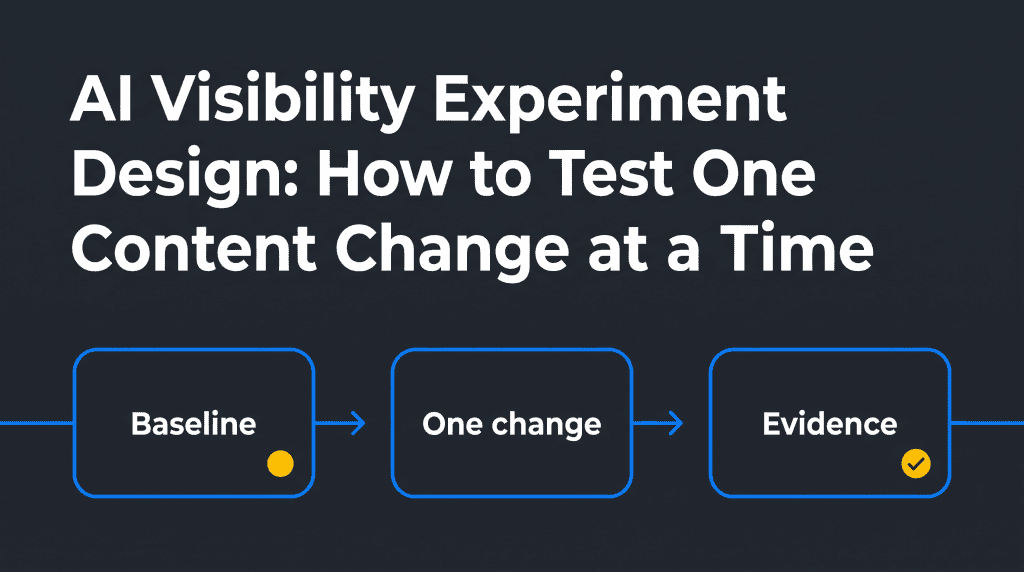
Idea: A useful AI visibility experiment changes one clear part of a page, records the starting point and checks what happens over time.
Challenge: Search and AI answers can change for many reasons. If a team edits headings, links, copy and schema at once, it cannot tell what helped.
Summary: Use a short experiment brief with one hypothesis, one change, a fixed observation window and a pre-agreed next step for a positive, flat or negative result.
Related Reads
- AI Visibility Measurement Framework: What Content Teams Should Track
- AI Visibility Data Governance: How to Store, Audit and Defend AI-Answer Evidence
- AI Content Provenance Audit: How to Verify Claims, Sources and Product Facts Before Publishing
What Is an AI Visibility Content Experiment?
An AI visibility content experiment is a small, planned process of testing one content change. You start with a specific buyer question and a page. You record what the page says now, make one purposeful update, then observe the same question again over an agreed period.
It does not promise a changed AI answer, citation or ranking. Content experiment design replaces guesswork with a documented next decision.
A measurement framework tracks AI visibility over time. A content experiment asks one narrower question: did this one change appear to improve defined evidence without creating a problem elsewhere?
Why Test One Content Change at a Time?
Testing one change at a time makes the result easier to understand. When a team changes the headline, adds a new table, rewrites a product claim and changes internal links on the same day, it may see a better answer later but it cannot know why.
A classic experimental design changes conditions across different groups. That is hard with one live, indexed web page, so most SEO content testing is an observational before-and-after check not proof of a causal relationship.
The change, the baseline and the observation window
Before changing anything, save the page URL, date, exact passage, buyer question, current answer and visible source links. This is your baseline.
Then define one independent variable, meaning the one thing you intend to change. It might be a plain-language definition, comparison table, update date or missing product limitation. Keep all other conditions stable.
Set an observation window before publishing. Google explains that changes can take a few days or several months to show an effect in Search, and that changes do not guarantee a noticeable result. A short window can still show whether the new page is live and understood, but it may be too soon for a business decision.
What a confounding factor means in plain language
A confounding factor is another change that could explain the outcome. A product launch, a major news story, a new review, a site-wide template change or a search-system update may all affect visibility at the same time as your edit.
You cannot remove every confound. You can record important ones. This keeps teams from claiming experimental data delivered a desired result when another factor could explain the change.
Write a Small, Testable Hypothesis
A good hypothesis is a clear expectation that can be checked. It says what you will change, why you expect it to help and what evidence would support or challenge the idea.
Use this simple sentence:
If we change [one page element] on [one URL] to answer [one buyer question] more clearly, we expect to see [one defined signal] during [one observation window].
For example: If we add a short, sourced definition of a product limit to the pricing page, we expect the answer to the related buyer question to describe that limit more accurately during the next four checks.
This is better than “optimize the page for AI.” It gives the content creator, editor and reviewer a shared decision to test.
Choose one question and one page
Start with a real user question, not a vague topic. “What does this service include?” is testable. “Improve our brand reputation” is not specific enough for a first content experiment.
Choose a page that should own the answer. A product page, policy page, support article or FAQ may be more appropriate than a new blog post. Check the facts first. A clear answer built on an unverified claim is not an improvement.
Choose one primary signal and one safety check
Pick one primary metric. For an AI visibility experiment, that may be the accuracy and completeness of a repeated AI answer, the appearance of the page as a source, or a documented change in how a defined question is answered.
Then add a safety check. For example, make sure the revised page still answers the original customer need, keeps the product claim accurate and does not reduce clear information elsewhere. Search Console can help you compare clicks, impressions, click-through rate and average position across pages, queries and date ranges.
Use a Practical Experiment Design for Live Pages
For most teams, the safest design is one-factor-at-a-time: make one visible change, log it and recheck. It is less statistically powerful than a randomized trial, but it is realistic for a live page where every visitor sees the same published content.
Before-and-after observation
A before-and-after observation compares the documented baseline with later checks. Use the same question, language and general location where possible. Record the date because an AI answer can change between checks.
This approach can suggest that a change is worth keeping, revising or studying again. It cannot confirm that the page update alone caused the difference. Search results depend on many signals, and Google notes that it does not guarantee crawling, indexing or serving a page even when the page follows its guidance.
When to repeat the check
Repeat the same check. Replication means seeing whether the signal appears again under similar conditions. It reduces the risk of treating one unusual answer as a lasting pattern.
If you have sufficient traffic and a split-testing set-up, formal A/B testing may use statistical methods, randomization, statistical significance and confidence intervals. Do not present a few checks of one SEO page as a randomized trial.
Create an AI Visibility Experiment Brief
An experiment brief keeps the team aligned before the page changes. It also prevents a convenient story from being written after the result is known. Use the table as a simple shared record, not as bureaucracy.
| Brief field | What to write | Example |
| Business goal | The decision the team needs to support | Help qualified buyers understand a plan limit |
| Research question | One clear reader or buyer question | “Does the plan include exports?” |
| Baseline | Current page wording and observed answer | The page lists exports but does not explain limits |
| One change | The only intentional edit | Add a short limit statement below the feature list |
| Hypothesis | What you expect and why | Clear wording will reduce an incomplete answer |
| Primary signal | The main observation to record | Accuracy in repeated answers to the defined question |
| Safety check | What must not get worse | The limit remains correct and easy to find on mobile |
| Owner and dates | Who approves and when to review | Product owner; edit 4 Sep; review 18 Sep |
| Decision rule | What happens after each outcome | Keep, revise or repeat the experiment |
Decide what each outcome means before the change
Set the response in advance. A positive signal may mean “keep the update and check again next month.” A flat result may mean “leave the useful update in place, but do not claim it changed visibility.” A negative result may mean “review the wording, page purpose and other changes before reverting.”
This matters when linking content work to business goals, conversion or return on investment (ROI): one short experiment rarely quantifies its full commercial effect.
Run the Test Without Changing the Rules Halfway Through
Once the brief is approved, publish only the planned change. This keeps experiment results and experimental conditions clear. If an urgent factual correction is needed, make it but record that the original test conditions changed.
Keep a simple change log
Log the date, URL, edited passage, approver, reason and baseline evidence. Keep the original wording. Also note unrelated events, such as a product release, campaign, redesign or search update, that could affect the observation.
Use a realistic observation window
Avoid checking every hour. That creates noise and anxiety. Choose a first technical check to confirm that the page is available and indexable. Then choose a later content review that gives crawling, indexing and normal market changes time to happen.
Google Search Console provides Search Analytics and URL Inspection features that can help you review how Google sees a URL and compare search performance. Use these as supporting evidence, not as proof that an AI answer was caused by one page change.
Collect Evidence, Not a Convenient Story
A useful test record contains both signals that support the hypothesis and signals that do not. Preserve the original and later answer, the question used, the date, language, location, cited pages where visible, and any search-performance context.
Do not copy only the best answer into a report. That is how content experimentation becomes a success story rather than a learning process.
Watch leading signals and slower outcomes
A clear product statement, a more complete answer or a source appearance can be a leading signal. Clicks, qualified visits, demos or revenue are slower outcomes and may sit further down the funnel.
Keep those levels separate. Do not say an update increased conversion unless the data collection and analysis support that conclusion.
Note changes beyond your page
AI visibility may move because of other pages, sources, reviews, user behavior, or changes in the systems that produce answers. Add these notes to the brief. A transparent limitation makes a data-driven conclusion more credible, not less useful.
Interpret the Outcome Carefully
The best result of an experiment is a better next decision. It may support your hypothesis, leave it uncertain or show that the change did not help. All three outcomes can save a team from repeating unhelpful work.
A positive signal is not final proof
If a repeated answer improves after your edit, keep the useful content and document the signal. Then check whether it holds after more time or on a related page. Avoid calling it a causal result unless you used a design that can support that claim.
A flat or negative result is still useful
A flat result may mean the change was too small, the answer was already adequate, the observation window was short or another factor mattered more. A negative result may show that your new wording created confusion or removed a needed detail.
Do not rush to delete a helpful page section. Review the original study design, compare the performance fairly and decide whether to revise, revert or try to replicate the test under clearer conditions.
Common Content Experiment Mistakes
The most common mistakes are easy to avoid once a team uses a brief.
Changing several things at once
A full rewrite may be the right editorial decision, but it is not a clean experiment. Treat it as a broader update and do not attribute the outcome to one heading or one paragraph.
Declaring success after one AI answer
One answer is one observation. Recheck later and record what changed. This reduces the chance of a false positive a result that looks meaningful but does not repeat.
Treating a weak signal as a promise
Do not promise a higher ranking, a guaranteed citation or a specific revenue result. Good content can improve clarity and usefulness, but visibility remains influenced by many conditions outside one page.
Turn One Test into a Better Content System
When an experiment closes, store the brief with the page record. Teams that run experiments should use simple data analysis to note what was tested, observed, remains uncertain and should happen next. If your team uses NEURONwriter, use it after the hypothesis and facts are approved. It can help prepare a clear update, but does not replace the brief, fact-checking or careful interpretation.
FAQs About AI Visibility Experiment Design
What is a content experiment?
A content experiment is a planned test of one content change against a documented starting point. It helps a team learn whether a specific change appears useful, rather than changing a page based only on opinion.
Why should I test one content change at a time?
One change at a time makes the evidence easier to interpret. When several changes happen together, you cannot reliably tell which change was related to a later result.
Can I run an A/B test for AI visibility?
A formal A/B test is possible only when you can randomly assign comparable visitors or pages to different conditions. Most published SEO pages do not work that way, so a logged before-and-after observation with repeat checks is more realistic.
How long should an AI visibility experiment run?
Choose the review window before editing and allow time for the page to be crawled and indexed. The right period varies, so avoid a fixed promise; Google says some changes may take days while others can take months to show an effect in Search.
What should I record before changing a page?
Save the URL, original wording, buyer question, exact baseline answer, date, location or language, any visible sources, planned change, owner and review date. A simple experiment brief keeps these facts together.
What is a confounding variable in content testing?
It is another event that could influence the result at the same time as your update. A site redesign, product release, new review, campaign or search-system change can all be confounding factors.
Can one AI answer prove that a page change worked?
No. One answer is one observation at one time. Repeat the same check and review other evidence before deciding whether the signal is useful enough to keep or expand the change.
What should I do when an experiment result is inconclusive?
Keep the record, check whether the page still helps readers and review the observation window and possible confounds. You may revise the hypothesis, repeat the check or test a different clear change; do not force a conclusion.