
AI Reputation Incident Response: Triage Harmful Claims and Coordinate Corrections
Semantic Summary
Idea: Treat a harmful or false AI answer about your brand as a documented incident, not as a reason to publish a rushed new page.
Challenge: AI search can repeat incomplete, outdated or misleading information from several sources. A fast reaction without evidence can make the problem worse.
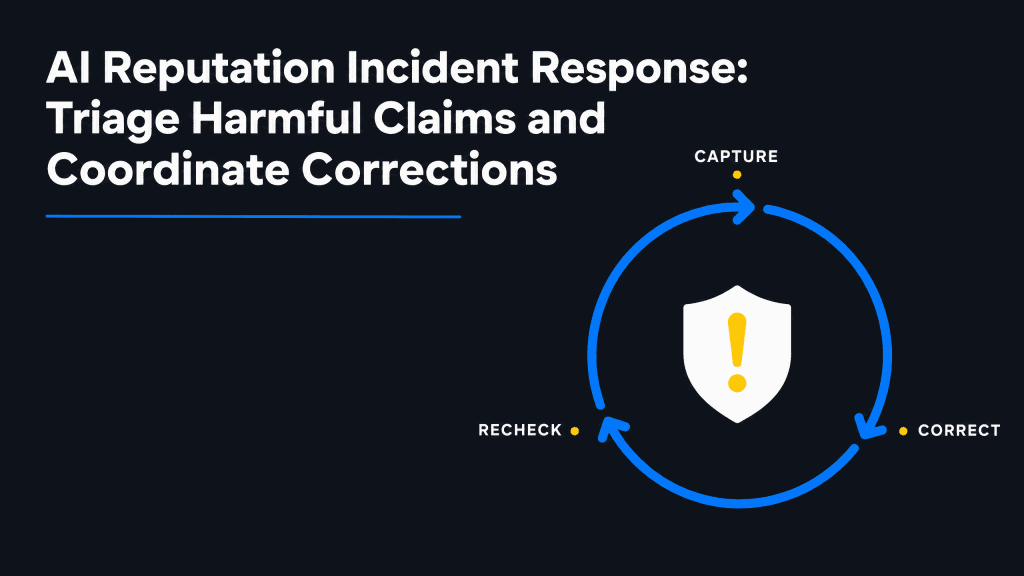
Summary: Capture the exact answer, verify the claim, rank the risk, fix the underlying evidence, assign an owner and recheck the same question on a set date.
Related Reads
- AI Brand Monitoring: How to Audit and Correct Wrong Brand Descriptions
- AI Citation Source Maps: How to Trace Which Pages Influence an Answer
- AI Visibility Data Governance: How to Store, Audit and Defend AI-Answer Evidence
AI Search Reputation Management: What Counts as an Incident?
An AI reputation incident is a confirmed AI answer that makes a false, harmful or seriously incomplete claim about your business, product, people or customers. It is not every negative opinion. It needs a clear record, owner and correction path.
AI search engines, AI platforms and other AI systems can summarize information from multiple sources: your site, listings, old articles, review sites, review platforms and third-party pages. Unlike traditional search, AI-powered search summaries, including AI Overviews, and AI-generated answers may combine this context before a buyer clicks. This is why AI search reputation management starts with evidence, not panic.
Separate a harmful claim from a normal negative opinion
A customer who says they disliked a product has shared an opinion. You may respond, investigate the experience and improve the service. But you should not label that review as misinformation simply because it is negative.
An incident is different. For example, an AI answer may say that a product has a feature it does not have, that a business is no longer operating, that a former policy is still active, or that an unverified accusation is a proven fact. These statements can affect trust before a buyer visits your site.
Use a simple test: is the claim specific, verifiably wrong or dangerously incomplete, and likely to change a reader’s decision? If the answer is yes, create an incident record.
Use a clear evidence record before acting
Do not rely on memory or a screenshot without context. Record the full prompt, the date and time, the exact response, any visible sources, the location or language used, and the approved fact that conflicts with the answer.
A structured record is a practical version of established AI-risk practice. NIST’s AI Risk Management Framework describes four connected functions Govern, Map, Measure and Manage for handling AI risks. Its Generative AI Profile helps organizations identify risks that are specific to generative systems. For incident reporting, CSET recommends consistent documentation of the incident type, harm and severity, affected parties and context.
Triage the Claim Before You Try to Fix It
Not every incorrect AI answer needs the same response. Triage means deciding how serious the issue is and what must happen first. It protects your team from spending days on minor wording problems while a high-risk claim is still visible.
Start with four questions: What is wrong? Who could be harmed or misled? How often or where does the answer appear? How certain are you that the claim is false?
| Risk level | Typical example | First owner | Initial action | Review timing |
| Critical | A false safety, legal, security or eligibility claim | Executive owner plus legal/product review | Preserve evidence, pause conflicting claims and use the fastest approved correction path | Same day |
| High | A wrong product capability, pricing, availability or customer-protection statement | Product or brand owner | Verify the approved fact, repair the strongest source pages and assess third-party corrections | Within one business day |
| Medium | An outdated description, category label or incomplete comparison | Content owner | Update authoritative pages and add the issue to the next review cycle | Within one week |
| Low | A vague or subjective summary with little decision impact | Content owner | Log it, watch for repetition and avoid a rushed response | Monthly review |
Score harm, reach, confidence and urgency
A strong response does not need a complex scoring system. Give each factor a simple low, medium or high label.
- Harm: Could the statement create safety, legal, financial, privacy or serious trust problems?
- Reach: Does it appear in a high-visibility branded question, a major search result, or several AI systems?
- Confidence: Can you prove it is wrong with current product facts, policies or records?
- Urgency: Is someone making a decision now, such as a buyer, customer, partner or applicant?
If harm and confidence are both high, escalate immediately. If confidence is low, do not issue an emotional public rebuttal. Investigate first. A team should correct facts, not argue with a summary it has not understood.
Choose the right owner and review path
The person who discovers the issue is rarely the only person who should fix it. Give one person responsibility for moving the incident forward, but involve the right reviewers.
A content owner can correct a stale product description. A product owner should confirm capabilities and limitations. A customer-experience owner should handle a pattern in customer feedback or a negative review. Legal review is appropriate when a claim involves regulation, rights, privacy or a potentially defamatory statement. The goal is not to build a large committee. It is to prevent an unverified correction from becoming a second problem.
A Five-Step AI Reputation Incident Response
The response process should be repeatable. A short checklist helps small businesses, multi-location brands and B2B teams act with the same care when AI reputation is at risk.
1. Capture the exact answer and prompt
Save the exact user question, the full AI response and the date. Include enough context for another colleague to repeat the check later. If the answer links to sources, capture those too.
Do not rewrite the claim in a more dramatic form. For example, record “the answer stated X” rather than “AI is spreading lies about us.” Neutral records make it easier to choose the right next action.
2. Verify the claim against approved facts
Compare the answer with an approved source of truth: a current product page, documented policy, official listing, contract language or product owner confirmation. Check dates. An old fact may have been true when published but wrong now.
This is also the point to separate customer sentiment from factual accuracy. Do not erase or dismiss genuine feedback; fix the factual error and route the underlying experience to the right team.
3. Stabilize pages, listings and third-party sources
Correct the strongest source first. Often, update clear product descriptions or policy pages in plain language. You can also correct a listing, such as a Google Business Profile, or ask a publisher to review inaccurate third-party content.
Avoid several thin pages that repeat the same defensive message. Use one authoritative page with the current fact, relevant limits and supporting proof where appropriate.
For AI search, clarity matters more than clever wording. Use direct headings, short explanations, defined terms and visible update dates. Your goal is to improve the information environment, not to promise that a particular AI answer will change on command.
4. Coordinate corrections without making unsupported promises
Decide what you can honestly say. You can say that you have corrected your published information, supplied a clarification to the relevant publisher, or are reviewing a customer issue. Do not say AI models or AI platforms removed a claim without verification.
Routine AI reputation management is part of online reputation management. It may include review management, review responses, customer feedback, customer experience improvements and ongoing visibility checks. An incident response is the temporary, evidence-led process for one defined harmful claim.
If the issue came from a real service failure, correct the source information and fix the operational problem. A polished AI-powered response cannot replace a real customer solution.
5. Recheck, document and close the incident
Set a recheck date that matches the risk. Use the same prompt, language and location where possible. Compare the new answer with the evidence record rather than relying on a general impression.
Close the incident when the team has documented what changed, what remains uncertain and whether further monitoring is needed. Add a short lesson: Was the source page unclear? Were listings inconsistent? Did old content remain live? This turns one incident into a better brand reputation strategy.
The Incident Record Your Team Needs
The table can sit in a shared document or workflow board. It helps a team move from concern to a recorded decision. It also makes handovers easier when a response lasts more than one day.
| Field | What to record | Why it matters |
| Incident ID and date | A unique label and discovery date | Prevents duplicated work and preserves a timeline |
| Exact prompt and answer | Full wording, language, location and visible sources | Makes the observation repeatable |
| Claim type | Product fact, policy, availability, listing, customer sentiment or other | Guides the correct reviewer |
| Approved fact and proof | Current URL, policy, document or product-owner confirmation | Stops opinions from being treated as corrections |
| Risk rating | Harm, reach, confidence and urgency | Sets the response speed |
| Owner and reviewers | One accountable owner plus named reviewers | Avoids unclear handoffs |
| Corrective action | Page update, listing update, publisher request or service improvement | Links the decision to action |
| Recheck and outcome | Date, same prompt and result | Shows what changed and what still needs work |
A content governance routine is helpful here. The goal is not to track every mention forever. It is to keep enough reliable evidence to explain the decision and response.
What Not to Do During an AI Reputation Incident
The fastest reaction is not always the best response. Avoid actions that can damage trust, create duplicate content or hide a genuine customer problem.
Do not hide a real customer problem
A false AI claim and a real customer complaint can exist together. If customer feedback reveals a real issue, the response must include operational improvement. Trying to bury valid feedback can make brand reputation worse.
Do not treat one answer as proof of a wider trend
One AI response is evidence of one answer at one moment. It is not proof that every search engine, AI platform or customer sees the same story. Record it, assess its reach and recheck it. Then expand the review only when the evidence justifies it.
Do not publish rushed claims or create duplicate pages
Do not create a new page just to deny an answer unless it adds durable, useful information. Update the canonical product, policy or FAQ page when that is the true source of the missing context. Every public correction should be accurate, calm and useful to someone who has never seen the incident.
Build a Small Response Routine Before the Next Incident
Decide ownership before a problem appears. A small routine makes AI search reputation management less stressful and more reliable.
Create a one-page response note: who opens the incident, who approves factual changes, when legal or executive escalation applies, and the normal recheck schedule. Review it after meaningful cases.
If your team uses NEURONwriter, use the content workflow only after the facts are approved. It can help turn a verified correction into a clear page update, but it should not decide whether a claim is true. That decision belongs to the people who own the product facts and customer commitments.
A monthly practice review is enough for many teams. Check whether the record is complete, the right owners responded, and the updated pages give buyers a plain answer. Good preparation protects search visibility, digital presence and customer experience.
FAQs About AI Reputation Incident Response
What is AI reputation incident response?
It is a documented process for handling a confirmed, harmful or seriously inaccurate claim in an AI answer about a brand, product or person. The process captures the evidence, ranks the risk, assigns an owner, corrects the underlying facts and checks the result again.
How is AI reputation incident response different from AI reputation management?
AI reputation management is the wider ongoing practice of managing how a brand appears across AI search, search results, listings, reviews and other sources. Incident response is the focused process used when one verified claim needs urgent, controlled action.
When should a wrong AI answer be treated as high risk?
Treat it as high risk when it can materially affect safety, privacy, legal status, product eligibility, pricing, availability or an important buyer decision. The team should also be able to show clear evidence that the claim is wrong or dangerously incomplete.
Can a business directly change an AI answer?
Usually, no. This applies to AI Overviews, AI Mode and other AI search results. A business can improve its pages, correct listings and request corrections from publishers when facts are demonstrably wrong, but cannot guarantee every answer changes.
Should a negative review trigger an AI reputation incident?
Not automatically. A negative review is customer feedback and may describe a real experience. Treat it as an incident only when an AI answer turns it into a false or materially misleading factual claim, or when it reveals a serious issue that needs an escalation path.
Who should own an AI reputation incident?
Give one person responsibility for coordinating the response, often a brand, content or communications owner. Product, customer-experience, legal and executive reviewers should join only when the claim falls within their area of responsibility.
How long should a team monitor a corrected claim?
The recheck date should match the risk. A critical claim may need a same-day or next-day review, while a medium-risk description can be checked during the next weekly cycle. Always record the result and decide whether continued monitoring is justified.
Should we create a new article to respond to every false AI claim?
No. First update the page that should already contain the correct information, such as a product page, policy page or FAQ. Create a new article only when it gives a lasting, useful explanation that serves readers beyond the immediate incident.