
SaaS Positioning: Align Category, Use Case and Proof Across Buyer Pages
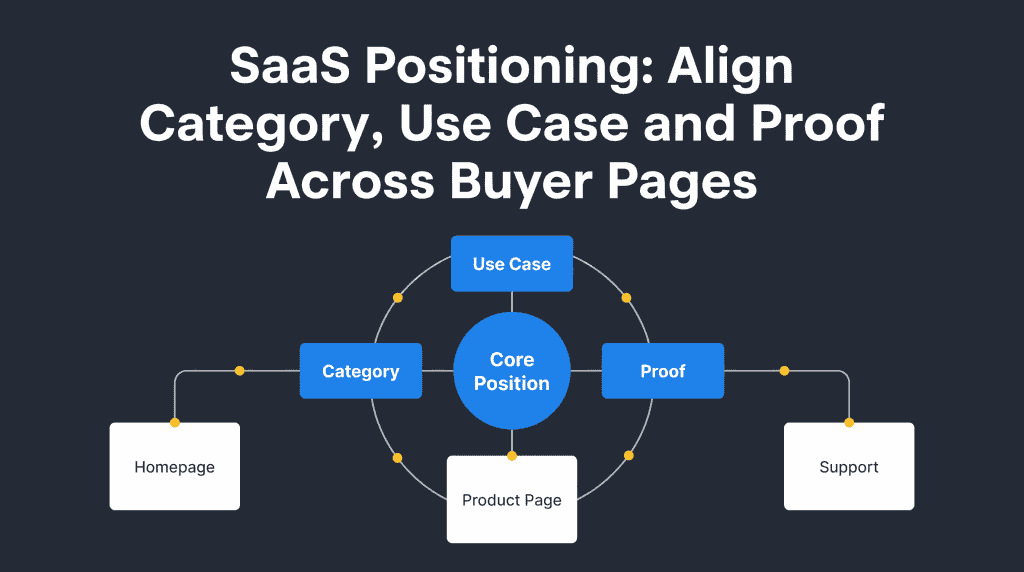
Semantic Summary
Idea
SaaS positioning is the shared story that tells the right buyer what your product is, when to use it and why its promise is believable.
Challenge
Teams often agree on a positioning statement but let homepage, product, pricing, documentation and sales pages describe the product in different ways.
Summary
Choose a clear category, one main use case and proof for every important claim. Then use a Buyer-Page Narrative Map to give each buyer page its own job without changing the core story.
Related Reads
- SEO Content for SaaS in 2026: How to Create Content That Sells in B2B
- Product-Led SEO: Stop Writing for Traffic and Start Writing for Buyers
- First-Party Data Content Strategy: What AI Cannot Copy
B2B SaaS positioning works when a buyer can quickly understand the product, the situation it helps with and the reason to trust it. It is not a clever slogan. It is a practical decision that should guide product marketing, sales conversations, documentation and every important buyer page.
Buyers experience positioning through search results, pages, demos and support content—not a private slide deck. When these moments conflict, the product feels harder to understand.
This guide shows how to carry a clear SaaS positioning decision across buyer pages with a Buyer-Page Narrative Map. The map gives each page its own job without contradicting the category, use case or proof.
What Is SaaS Positioning?
SaaS positioning is the decision about how a software product should be understood by a specific audience in a specific market. A clear position answers five connected questions: who the product is for, what category it belongs to, what problem it helps solve, what buyers use instead and why its value is credible.
Positioning places a product in a familiar category. The best category is not always the most inventive one; it is the one that helps the intended buyer understand the product accurately.
SaaS positioning vs. product messaging vs. brand positioning
These terms are related, but do different jobs. Product positioning is the strategic choice about the product’s place in the market. Product messaging is the language used to explain that choice. Brand positioning is broader: the company’s overall identity.
For example, a B2B SaaS product may be positioned as a workflow platform for finance teams, while its messaging focuses on approval delays. The ideas should support one another, but they are not interchangeable.
| Term | Main question it answers | Where a buyer sees it | Common mistake |
| SaaS positioning | What is this product, for whom, and why this choice? | The whole buyer journey | Treating it as a short tagline |
| Product messaging | How do we explain the product and its benefits? | Homepage, product pages, demos, campaigns | Changing the main message on every page |
| Brand positioning | What does the company stand for more broadly? | Company pages, reputation, communications | Using brand language instead of a product explanation |
| Value proposition | What useful outcome can a buyer expect? | Key page sections and sales enablement | Promising an outcome with no proof |
Why category, use case and proof must stay connected
A category tells a buyer what kind of product they are evaluating. A use case explains the situation where it helps. Proof gives the buyer a reason to believe the claim. Good positioning connects all three.
A category without a use case can feel vague. A use case without a category can make a product sound like a one-off service. A benefit without proof can sound like a promise that any SaaS company could make. When these elements are aligned, a buyer can move from recognition to evaluation with less effort.
Start with the Buyer and the Current Alternative
Clear positioning begins with a defined buyer, not a list of product features. Start by deciding whose problem you are trying to solve and how that person or team handles the problem now. The current alternative may be another product, a spreadsheet, an internal process or simply doing nothing.
This step prevents a common positioning problem: trying to appeal to every possible customer at once. A broad target audience often leads to broad claims. Broad claims may attract attention, but they make it harder for the right buyer to recognise their own situation.
Identify the ideal customer and the pain points that matter
An ideal customer is a group with a similar situation, need and reason to act not only a company size or job title.
Use customer interviews, support conversations, implementation notes and sales reviews. Ask people to describe the work in their own words. Customer research helps a business understand target groups and reasons behind decisions; feedback and interviews are practical evidence sources.
Do not begin with: “Which feature do buyers like most?” Start with questions such as these:
- What was difficult or slow before the buyer looked for help?
- What did the buyer try first?
- What changed after they adopted a product or process?
- Which outcome mattered enough to justify a purchase?
- Which concern almost stopped the decision?
The answers help you define a useful persona and separate a true differentiator from a basic expectation.
Ask what buyers used before your product
The real alternative may be a manual routine, shared inbox, generic tool or internal workaround. Buyers compare your product with this familiar path.
Ask “What did you use before?” It reveals the change a buyer wants and improves sales conversations. You do not need to name alternatives on every page, but you need to understand them before deciding what the product should stand for.
Choose a SaaS Positioning Strategy: Category, Use Case or Both
A useful SaaS positioning strategy chooses the category that makes the product easiest for the right buyer to understand, then explains the relevant use case. Category positioning is not about inventing a label; it reduces confusion at the start of the buyer journey.
A familiar category helps when buyers already know how to evaluate that software. A narrower category helps when the product solves a clearly different problem for a clearly different audience. In either case, it must be accurate enough for product, sales and customer success teams to support.
Category positioning and use-case positioning
Category positioning answers “What type of product is this?” Use-case positioning answers “When would I use it?” Many strong SaaS companies need both.
Imagine a fictional product called ClearRoute. Calling it “workflow software” gives a buyer a starting point. Saying it helps regional operations teams prepare handovers during shift changes explains the use case. Adding that it records decisions, exceptions and next steps gives a practical reason to consider it.
| Positioning element | Weak version | Clearer version | Why the clearer version helps |
| Category | “A modern platform” | “Workflow software” | Gives the buyer a familiar frame |
| Target audience | “Teams everywhere” | “Regional operations teams” | Shows who should keep reading |
| Use case | “Work better together” | “Prepare reliable shift handovers” | Names the situation where value appears |
| Difference | “Built differently” | “Records decisions and exceptions in one handover view” | States a checkable product capability |
| Proof | “Trusted by leading teams” | “Shows completed, pending and escalated handover items” | Connects the claim to evidence |
The goal is not to write the longest label. The goal is to create precise positioning that a buyer can repeat accurately.
Check product-market fit before naming a new category
A new category is useful only when it reflects a real change in how buyers solve a problem. Check product-market fit: can buyers explain it, does the product deliver a meaningful difference, and can documentation, pricing and support use the same definition accurately? If not, use a clear existing category and let the use case carry the differentiation strategy.
Create a SaaS Product Positioning Statement from Evidence
A product positioning statement is a short internal sentence that keeps strategy and execution aligned. It should be based on customer research, product facts and a realistic understanding of the market. It is not required to appear word-for-word on your homepage.
A useful statement gives product marketing, sales and writers one shared starting point.
The five parts of a clear positioning statement
A strong SaaS positioning statement usually contains five parts. It identifies the target audience, the product category, the use case or problem, the meaningful difference and the proof or reason to believe.
Use this editable template:
For [target audience] who need to [complete a specific job or solve a problem], [product name] is a [clear category] that [delivers a practical, specific benefit]. Unlike [current alternative], it [states a credible difference supported by proof].
A fictional example might read: “For regional operations teams who need to prepare reliable shift handovers, ClearRoute is workflow software that records decisions and open issues in one shared handover view. Unlike a scattered inbox and spreadsheet process, it shows ownership and escalation status beside each item.”
The statement creates boundaries: what not to promise, which buyer questions matter and which value needs evidence.
Use a positioning framework as a decision record
A positioning framework is a working decision record, not a worksheet completed once. Keep the target market, competitive alternatives, category, main use case, important product features and proof for each claim in one place. Treat it as part of the company’s strategy.
It helps marketing and sales compare new pages, product-launch copy and sales enablement with the company’s positioning. It also guides go-to-market work, marketing efforts, product development and focused SaaS growth.
Positioning statement vs. value proposition
A unique value proposition focuses on a buyer benefit. A positioning statement puts that benefit inside a market context.
“Prepare reliable shift handovers with a clear owner for every exception” is a value proposition. The longer statement also includes audience, category and alternative, making it better for internal alignment.
Use the statement as a source of truth, then adapt it for each page without changing the core position.
Build a Buyer-Page Narrative Map
A Buyer-Page Narrative Map links the approved positioning to the real pages a buyer uses. It stops positioning from becoming a document that no one checks after the workshop ends.
Every important page should answer its own reader question while reinforcing the same category, use case and evidence.
Define the role of each buyer page
Start with pages buyers see before and during evaluation: the homepage, core product pages, high-value solution pages, pricing, documentation and support pages.
The homepage sets category and audience. Product pages explain capabilities. Solution pages show a use case. Documentation makes claims concrete. Pricing explains scope. Support content must not define a different product.
Record the approved category, use case and proof
Put the agreed narrative in a shared table. Its purpose is to make contradictions visible before they spread.
| Page type | Reader question | Category language | Use-case message | Proof needed | Owner | Review date |
| Homepage | “What is this and who is it for?” | Clear product category | Main high-value use case | Product overview, concise customer evidence | Product marketing | Quarterly |
| Product page | “How does it work?” | Same category, more precise capability | Workflow or task supported | Screens, feature detail, limitations | Product team + marketing | After major release |
| Solution page | “Does this fit my situation?” | Same category with relevant context | Specific buyer problem | Use-case example, process evidence | Marketing | Quarterly |
| Pricing page | “What will I receive?” | Same product definition | Purchase and rollout context | Package detail, terms, implementation scope | Commercial owner | When packages change |
| Documentation | “Can the product really do this?” | Accurate technical wording | Real task and conditions | Instructions, requirements, limits | Documentation owner | With product changes |
| Support page | “What happens when I need help?” | Consistent product terms | Adoption or issue-resolution context | Support process and current guidance | Customer success | Monthly spot check |
This table is your Buyer-Page Narrative Map. It becomes more useful when a page changes, a new product launches or a sales team notices the same buyer question repeatedly.
Align the Story Across the Buyer Journey
Pages should not repeat identical copy, but they must not force buyers to rebuild the product story at every step. Alignment means the category, central use case and evidence remain compatible while the depth changes for the reader’s need.
Each important page must work on its own. A buyer who reads several pages should gain confidence, not find a different message at every turn.
Homepage and product pages
Use the homepage to establish category, target audience and main problem in everyday language.
Product pages should explain the capabilities behind that promise, not hide it in a long feature inventory.
Check whether a reader can move from homepage to product page and answer “What is this product for?” in nearly the same words. If not, there may be a positioning problem or a page-writing problem.
Solution pages, documentation and support pages
Solution pages can adapt the story to a target market or use case, but should not make the product a different category for every persona.
Careful buyers read documentation and support pages for limits and setup steps. If they cannot explain a marketing promise, narrow the promise or add context.
Review new terms and common limitations across buyer-facing content.
Pricing pages, demos and sales enablement
Pricing pages should explain what each option includes in the context of the use case.
Demos and sales enablement should use the same core story; examples may change, but the category and supported promises should not. Use the narrative map before a product launch or campaign.
Match Every Important Claim with the Right Proof
Proof turns a positioning claim into something a buyer can evaluate. It does not need to be dramatic. It needs to be relevant, current and accurate.
A capability claim needs product proof. An outcome claim needs customer evidence. A process claim needs process documentation. Do not use a generic quote to prove a detailed feature or one screen to prove a broad business outcome.
Product proof, customer proof and process proof
Product proof shows what the product can do. Customer proof shows how a customer used it. Process proof explains onboarding, data handling or support coverage.
A small amount of specific proof is stronger than unconnected praise.
Use evidence that fits the claim
Use this table to decide whether a claim is ready for a buyer page.
| Claim | Suitable proof | Best page location | Avoid without evidence |
| “Built for regional operations teams” | Audience-specific workflow, terminology and use-case detail | Homepage or solution page | A generic claim that it works for every team |
| “Makes handovers easier to review” | Product flow showing ownership, status and next steps | Product page and documentation | A promise to eliminate every delay |
| “Supports controlled rollout” | Setup requirements, roles and onboarding process | Pricing, implementation or support page | A claim that rollout needs no planning |
| “Helps teams act on open issues” | Clear escalation or task-management capability | Product page | A claim that every issue will be resolved automatically |
| “Used in complex workflows” | Approved customer story with context | Solution page | An unnamed logo wall as the only evidence |
A claim that cannot be supported is not always wrong. It may simply need a different page, a clearer condition or a smaller promise. This is how effective positioning becomes more credible over time.
Test and Refine SaaS Positioning
Test SaaS positioning by checking whether real buyers understand the category, use case and difference in their own words. Do this before rewriting every page. A clear answer from a small number of relevant conversations can be more useful than a large internal debate.
Testing is ongoing. Products, target markets and buyer priorities change; the goal is to keep the company’s positioning current without changing it whenever someone suggests a new phrase.
Questions to ask in interviews and sales reviews
Ask buyers to explain their own situation rather than approve your wording. Listen for repeated language.
Useful questions include:
- What problem were you trying to solve when you started looking?
- How were you handling it before?
- What made this product seem relevant to you?
- What did you think the product would help you do?
- Which part of the product’s explanation was unclear?
- What proof did you need before you felt confident?
Review answers with marketing and sales. Look for a pattern, not one memorable quote. The same evidence can improve positioning, messaging, product marketing and sales enablement.
Signs your positioning problem is really a page-alignment problem
Sometimes the core position is sound but the website is inconsistent. Look for buyers asking what the product is after several pages, different category labels, documentation that contradicts a benefit claim or unrelated solution-page problems.
Do not write a new tagline first. Compare pages with the Buyer-Page Narrative Map; a high-traffic page may simply use outdated language or lack proof.
When to update positioning after a product change
Update positioning when the audience, category, core use case or meaningful difference changes. A minor feature release usually needs a page update, not a new position.
When you do update, review the narrative map, statement, key buyer pages, documentation, sales materials and support guidance—not only the homepage.
Common SaaS Positioning Mistakes
Most positioning mistakes are failures of clarity, evidence or follow-through. A simple, specific explanation is more useful than a clever phrase that needs several paragraphs of interpretation.
Treating a tagline as the whole strategy
A tagline may be memorable, but cannot carry the audience, category, use case, alternative and proof. Use it as an expression of a position, not the position itself.
Giving each team a different category story
If marketing calls a product a platform, sales calls it a service and support calls it a tool, buyers receive conflicting signals. Agree on one accurate category description, then add relevant detail by context.
Claiming a benefit that documentation or support cannot explain
A strong message must survive contact with the real product. If no one can show how a benefit works, narrow the claim or add evidence.
How NEURONwriter Supports a Positioning Update
NEURONwriter can support the content work that follows an approved positioning decision. Use it to research buyer questions, prepare a page brief, check whether an updated page covers relevant topics and organise a content workflow.
It does not decide what your product is, who the ideal customer is or which claim is true. Those decisions need product knowledge, customer research and a shared source of facts.
Frequently Asked Questions About SaaS Positioning
What is SaaS positioning?
SaaS positioning is the shared decision about what a software product is, who it is for, what problem it helps solve and why that choice is credible. It gives product marketing, sales and content teams one accurate starting point for buyer-facing communication.
What is the difference between positioning and messaging?
Positioning is the strategic decision about the product’s place in the market. Messaging is the language used to explain that decision on a page, in a demo or in a campaign. Good messaging changes by context, while the core positioning remains consistent.
What should a SaaS positioning statement include?
A SaaS positioning statement should name the target audience, product category, use case or problem, meaningful difference and reason to believe. Keep it specific enough that a product team and sales team can both verify it.
How do I choose a category for my SaaS product?
Choose a category that helps the right buyer understand the product quickly and accurately. Use a familiar category when it reduces confusion; use a narrower category only when it reflects a real and provable difference.
Can a SaaS company change its positioning after launch?
Yes. A company should revisit positioning when the target audience, core use case, category or meaningful difference has changed. A minor feature release usually needs a page update, not a new positioning strategy.
How can I check whether buyer pages are aligned?
Create a Buyer-Page Narrative Map for the homepage, product, solution, pricing, documentation and support pages. Check whether each page supports the same category, use case and proof while answering its own reader question.
What proof should support a SaaS value proposition?
Use product proof for capability claims, customer proof for outcome claims and process proof for claims about onboarding, support or delivery. The proof should be current, specific and appropriate for the page where the claim appears.
Who should own SaaS positioning?
Product marketing commonly coordinates the work, but positioning should use input from product, sales, customer success and leadership. The final owner must be able to keep the approved story current across teams and buyer pages.
How often should a SaaS team review positioning?
Review the narrative map when there is a meaningful product, audience or market change. A light quarterly review of core buyer pages can catch inconsistent language before it becomes a wider messaging problem.