
14 content changes SEO teams are making for AI search [expert quotes]
AI search has not made content strategy less important. It has made weak content easier to ignore.
A basic explanation can now appear directly in an AI Overview. A quick definition may answer the searcher’s first question before they reach a website. That leaves content teams with a more demanding job: create pages that are clear enough to be understood quickly, but useful enough that people still want the full answer.
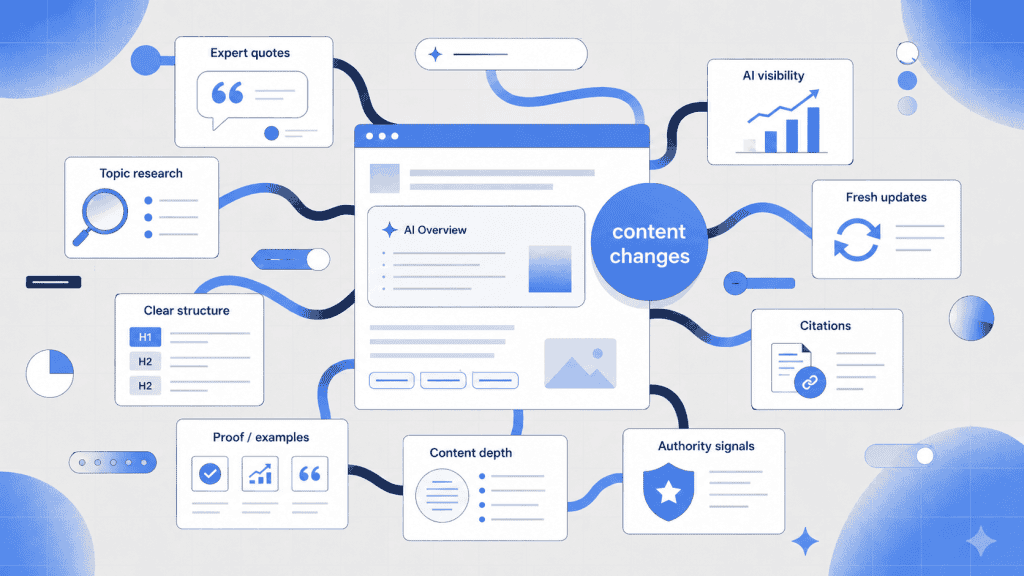
The agencies adapting best are not chasing one magic AI-search format. They are changing how they research topics, structure pages, update old content and decide what proof belongs on the page.
This is what that work looks like in practice.
TL;DR
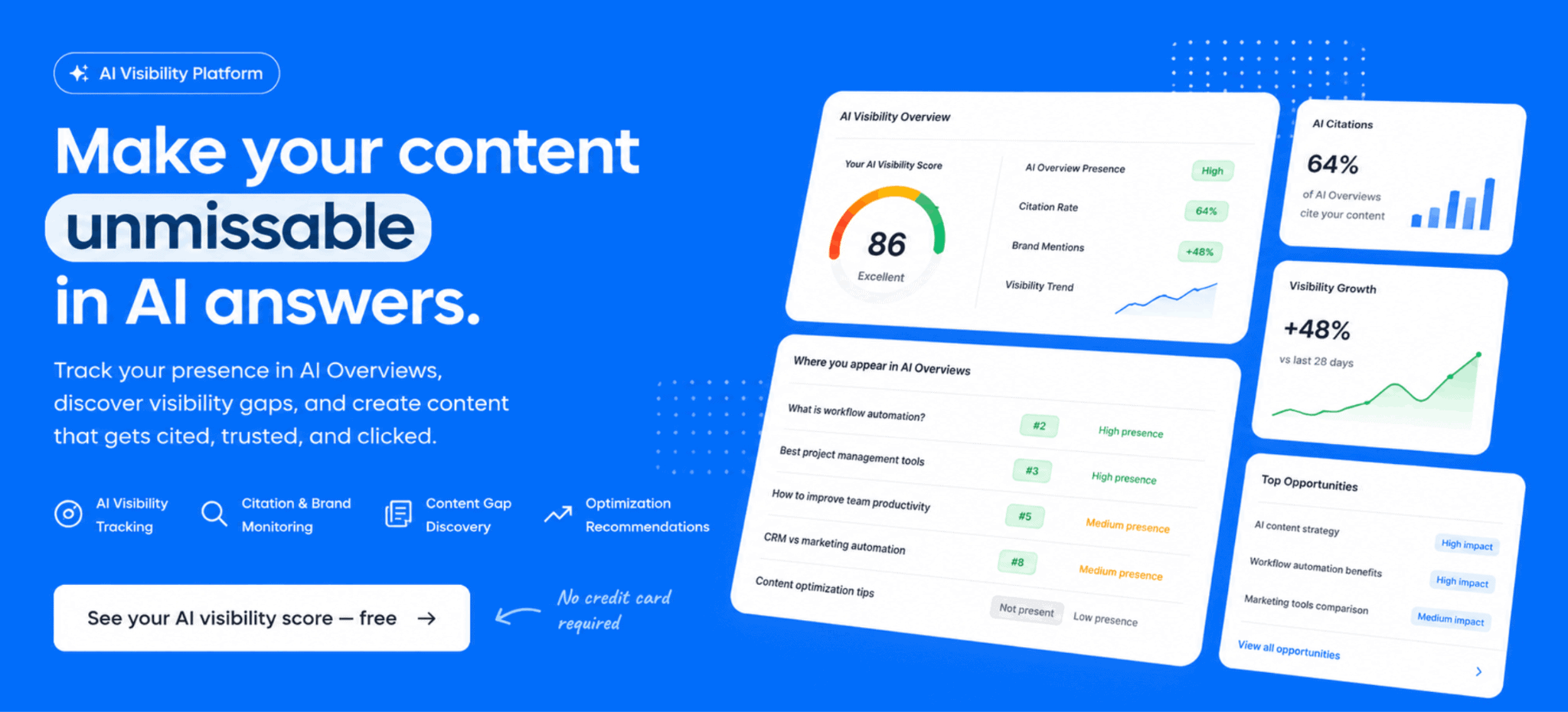
SEO teams adapting to AI search are making practical changes across the full content workflow:
- reviewing the live SERP before creating a brief;
- building around customer questions and decision points;
- rewriting old pages instead of publishing endless new ones;
- putting direct answers and comparison logic closer to the top;
- adding original proof, expert context and real examples;
- treating AI visibility as something to monitor and improve over time.
The pattern is consistent: the page needs to answer faster, explain better and give readers something an AI summary cannot flatten into a paragraph.
Before the draft: change what informs the brief
1. Review the live SERP before deciding what the page should be
Many briefs still begin with a keyword, estimated volume and a suggested word count. That may be enough for a simple topic. It is not enough when the search result already reveals the type of answer Google is rewarding.
Rusty Rich, President at Latitude Park, says his team reviews live SERPs for every target keyword before deciding how to structure a page.
“That tells us exactly how to structure new content so it can still surface inside AI Overviews.”
The agency then uses passage-level targeting on service pages. Instead of one page trying to broadly cover “franchise marketing” or “location SEO,” each section answers a layered sub-question.
That is a more useful way to begin the research phase.
Before writing, look at what currently ranks and ask:
- Is the SERP dominated by definitions, comparisons or practical guides?
- Are AI Overviews showing up?
- Which questions appear in headings, People Also Ask results and related searches?
- What does every ranking page repeat?
- Where do those pages remain vague?
The point is not to copy the winning format. It is to understand what job the page needs to do, then build a better version of it.
2. Build a knowledge base before building the article
A keyword tool can show demand. It cannot show the details customers bring into a sales call, the objections that appear during onboarding or the language people use when they are genuinely stuck.
Aaron Traub, New Orleans SEO Specialist and Web Designer at Geaux SEO, changed his process by building a knowledge base before writing for clients.
“Instead of jumping straight into writing articles, I started collecting customer FAQs, notes from sales calls, reviews, service information, and insights from the business owners themselves.”
That material gives writers a much stronger starting point than generic keyword variation lists.
A useful content knowledge base can include:
- customer questions from sales calls;
- support tickets;
- notes from onboarding;
- recurring review themes;
- service details that never appear on competitor pages;
- subject-matter expert input;
- examples of common misunderstandings;
- screenshots, calculations or process documents.
Once this exists, the brief becomes more grounded. You are no longer trying to reverse-engineer intent from a phrase alone. You are writing from the actual problems people bring to the business.
3. Replace broad topics with action questions
AI can explain what something is. It has more trouble helping someone decide what they should do next in their own situation.
That changes the kind of question a page should target.
Madeline Jack, Chief Client and Operations Officer at Blink Agency, says the agency has moved away from articles built around one broad keyword. Instead, the team builds content around the decision a patient, donor or customer is trying to make.
“Google is now rewarding content that answers what comes next, not just what something is.”
For a healthcare client, that meant moving from “What is depression treatment?” to “How do I know which type of care I need?”
The difference may look small on paper. In practice, it changes the entire article.
The first topic creates a general explainer. The second creates a decision-support page. It opens space for context, warning signs, trade-offs and next steps that a short AI summary cannot resolve safely.
When planning new content, look for questions that include movement:
- How do I choose?
- What should I do first?
- What changes if?
- Is this right for my situation?
- What happens after?
- What should I compare before deciding?
Those are the questions that make a page harder to replace.
4. Target commercial questions from real sales conversations
Not every commercially useful keyword looks like a classic buying query.
Some of the strongest topics come from questions that buyers ask long before they request a demo, quote or proposal. They may be trying to understand a process, evaluate a trade-off or work out what a bad decision would cost them.
Jose Escalera, CEO at The Idea Farm by VM Digital, says his team now targets keywords built around “specific commercial questions clients ask during sales cycles.”
“A recent adjustment was formatting articles with tight decision frameworks right after the core answer, pulling from sales psychology to show trade-offs that tie back to a client’s actual numbers.”
That can mean turning a broad article into something more commercially useful.
Instead of:
What is marketing attribution?
Try:
How should a SaaS team choose an attribution model when sales cycles run longer than six months?
The second version gives the writer somewhere to go. It can cover the core answer, where attribution models fail, what data a team needs and what a buyer should compare before choosing a setup.
The page becomes more useful because it speaks to a real decision that appears in the sales process.
In the draft: change how the answer appears
5. Add a best-answer block to pages that already earn impressions
Not every AI-search update requires a full rewrite.
Some of the fastest wins come from pages that already appear for relevant queries, but fail to earn the click because the answer is buried or unclear.
Nick Mikhalenkov, SEO Manager at Nine Peaks Media, says his team added short answer sections to the top of articles, alongside clearer subheadings and comparison tables where they made sense.
For one SaaS SEO article, the agency added a “best answer” section near the beginning, including a practical example, a use case and a short FAQ based on real search queries.
“The article saw increased long-tail traffic along with better user engagement.”
The principle is simple: do not discard an underperforming page just because it is not converting well today.
First, check whether it already has impressions. Then review the opening:
- Does it answer the core query in the first 100 words?
- Does it tell the reader what they will learn?
- Does it include a concrete example?
- Does it leave enough unanswered that the reader has a reason to continue?
A short answer block can act as the bridge between search intent and the deeper content below.
6. Rewrite comparison pages for the question people are really asking
Comparison content has always carried commercial value. AI Overviews make that value more visible.
A reader searching “X vs Y” is rarely looking for a dictionary definition. They are trying to understand fit, cost, trade-offs or risk.
Oksana Famuliak, Co-Founder and SEO Specialist at Octopus Agency, says her team reworked high-traffic comparison pages so the direct answer appears in the first 150–200 words. The agency also turned buried sections into standalone FAQ blocks, each focused on one self-contained question.
The important detail is that the answer does not try to declare one winner for everyone.
A useful comparison page needs to clarify:
- which option suits which team;
- what each option makes easier;
- where each option creates friction;
- what the buyer should consider before choosing;
- what changes as the business grows.
The goal is not to create a generic “pros and cons” list. It is to help someone choose with more confidence.
That is why comparison content can still earn strong clicks in AI search. The summary may name the options. The deeper page helps the reader understand which one is right for them.
7. Cut the unnecessary introduction, then add evidence
For years, SEO writing rewarded the long warm-up: an introductory anecdote, a definition, a few broad facts and then, eventually, the answer.
That sequence no longer serves most readers.
Lorenzo Mariani, SEO Specialist at Mediaboom, says AI Overviews pushed his team away from the “longer is better” mindset.
“The new structure starts from answering the posed question, then proceeds with providing relevant information, comparing data through tables, quoting experts’ opinions and additional literature, and, finally, listing actionable steps.”
That creates a better article rhythm:
- Give the reader the answer.
- Explain why it is true.
- Add evidence, comparison or expert perspective.
- Show what the reader should do next.
The important point is that shortening the opening should not mean making the content thinner.
The answer comes first. The evidence follows. That is what makes a page easy to scan but still worth reading.
8. Add “before you decide” sections to high-value pages
A basic answer often helps a searcher understand the category. It does not always give them the confidence to move forward.
That confidence usually comes from seeing the conditions that change the recommendation.
Jason Hennessey, CEO at Hennessey Digital, says his agency has been adding short “before you decide” sections near the top of priority articles.
“Readers were not only looking for facts, they were looking for confidence, and that section delivered a reason to click deeper.”
This is a useful format for high-intent content. It can sit just below the opening answer and frame the decision before the article goes deeper.
For example, a “before you decide” box on a CRM comparison could cover:
- the team size where complexity starts to become a problem;
- the setup work required before the tool becomes useful;
- the data quality issues that can derail adoption;
- the signs that a buyer needs a simpler platform.
This type of section gives readers an immediate sense of fit. It also makes the rest of the article more focused, because the writer can explain the logic behind each point.
9. Add short summary boxes, but make them specific
Summary boxes can easily become cosmetic. A generic “Key takeaways” section that repeats the introduction adds little value.
The best summary boxes do a different job. They help a reader quickly see the answer, the caveat and the next decision.
Sasha Berson, Co-Founder and Chief Growth Executive at Grow Law, says the agency changed how it structures content by putting the most important information upfront, then adding context, examples and expert commentary.
“Instead of making people scroll for answers, we give them the most important information upfront.”
A useful summary box can include:
- the direct answer;
- who the answer applies to;
- one important exception;
- the main factor that changes the outcome;
- a short prompt that leads into the deeper section.
For a legal service page, that may mean explaining the basic legal position, the type of case where the rule changes and the point at which someone should seek professional support.
The format works because it respects the reader’s time. It also creates a clean, self-contained explanation that can sit above the deeper analysis.
In the proof layer: change what makes the content valuable
10. Replace “more content” with stronger frameworks and examples
A longer article does not automatically become a better article.
That is especially true when the additional length comes from restating common knowledge that an AI summary can already produce.
Arsh Sanwarwala, Founder and CEO at ThrillX, says his team has updated conversion rate optimisation and landing page content with direct answer sections, practical frameworks and examples from real client projects.
“Rather than creating longer content, we focused on making the content more useful and easier to extract information from.”
That is a useful filter for every content update.
Before adding another subsection, ask:
- Does this give the reader a practical decision framework?
- Does it explain a trade-off?
- Does it show how the advice works in a real situation?
- Does it include evidence from first-hand work?
- Does it answer a follow-up question the reader will have?
If the answer is no, the section may only be adding length.
A strong framework does more work than five generic paragraphs. It helps someone apply the idea to their own situation.
11. Add screenshots, test results and original observations
AI can summarise a well-known process. It cannot recreate the observations your team made while doing the work.
David Lange, Digital Marketing Strategist at The Query Post, says his team has shifted from treating information alone as enough.
“AI can summarize information. What it struggles to replicate are original observations, real-world examples and firsthand experience.”
That shift led the team to add more screenshots, test results and opinions based on what they were seeing across their own websites.
This is not an argument for adding visuals for decoration. It is an argument for showing evidence.
Useful proof might include:
- a screenshot of a workflow;
- a before-and-after content structure;
- an anonymised campaign result;
- a chart from internal research;
- an example of a failed approach;
- an expert note explaining a decision;
- a customer scenario that reveals where the advice changes.
The best proof makes the page more credible and more difficult to replace. It gives the reader a reason to trust the source behind the answer.
12. Turn proprietary experience into a visible point of view
Many pages sound interchangeable because they are built from the same public information.
They list features, repeat common benefits and explain the category in a way that could apply to almost any business.
Scott Brazdo, CEO at Black Tie Digital Marketing, says his agency moved clients away from generic keyword-driven articles toward content that reflects “genuine business authority.”
“Things only they could say.”
For one client, that meant building content around product decisions and the reasoning behind them, instead of generic feature lists.
This is a useful content test: could another company publish the same article with only a few brand names changed?
If the answer is yes, the page probably needs more original perspective.
That perspective can come from:
- internal methodology;
- the mistakes customers repeatedly make;
- a contrarian point of view;
- a process your team developed;
- a set of decision criteria you use in client work;
- a realistic explanation of where the category disappoints buyers.
The point is not to be controversial for attention. It is to make the page recognisably yours.
After publishing: change what gets updated and measured
13. Refresh old content around new customer questions
Old content does not always need to be replaced. Sometimes it needs a new reason to exist.
Stephen Taormino, Founder and CEO at CC&A Strategic Media, says one effective change involved updating older posts to address new questions the team identified in analytics.
“We shifted article structure to lead with direct responses to those questions, followed by supporting details pulled from client input rather than broad keyword lists.”
This is a better refresh model than changing dates, adding a few paragraphs and hoping the page looks fresh enough for search.
A meaningful content refresh can include:
- a revised opening answer;
- a new question-led section;
- an updated comparison;
- recent customer language;
- a clearer recommendation;
- an expert quote;
- a new example or screenshot;
- internal links to newer supporting content.
The core question is not “How can we make this article longer?”
It is “What does the reader need today that this page did not answer before?”
14. Make small, high-impact updates before rewriting everything
AI-search changes can make teams feel as though every page needs to be rebuilt.
That is rarely the best use of time.
Brandie Young, Co-Founder of RankWriters, describes a more focused approach: “minimum viable content updates” on existing articles.
For her team, that meant adding structured FAQs, on-page calculators and natural question-based headers to pages that already had a foundation.
That is a practical way to prioritise work.
Start with pages that have:
- strong impressions but weak click-through rates;
- high commercial value;
- outdated opening sections;
- thin answers to important questions;
- no comparison or decision support;
- limited proof;
- incomplete internal linking.
Then make the smallest change that gives the page a clearer job.
A refreshed answer block, stronger subheading, calculator, comparison section or updated example can make more difference than publishing another broad article from scratch.
How NEURONwriter helps turn those changes into a system
The biggest challenge is not understanding the ideas in this guide. It is applying them consistently across a large content library.
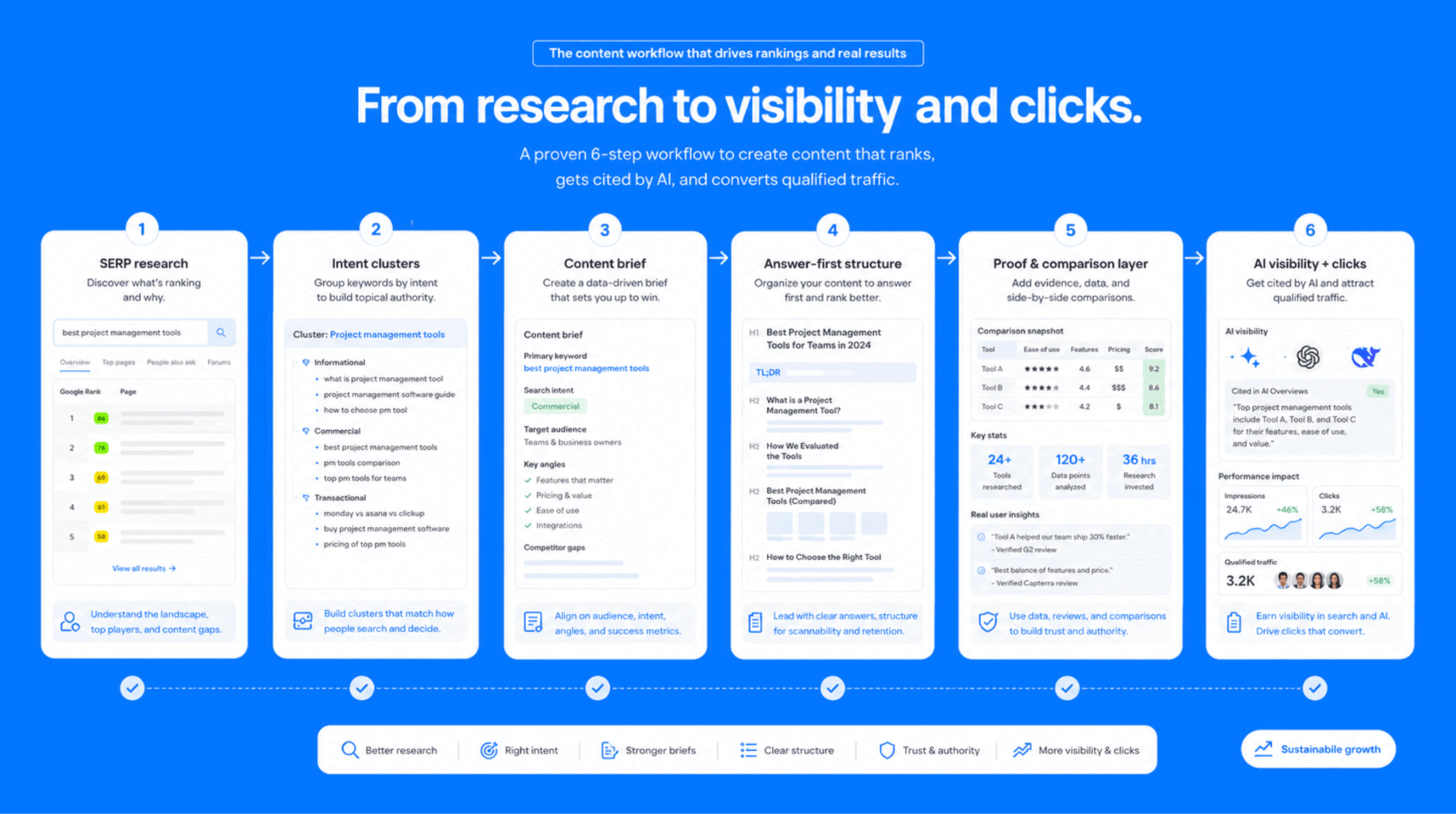
NEURONwriter can help teams start with the current search landscape, identify topics and questions that shape a SERP, then turn those findings into a more focused brief. Its Content Designer can use search-result and topic analysis to suggest questions, terms and content directions for an article. Its AI Visibility add-on is designed to track how brands appear in AI-generated responses, including mentions and cited sources across tools such as ChatGPT, Perplexity and Google AI Overviews.
That creates a practical loop:
- Review what people search for and what currently ranks.
- Find the decision points and coverage gaps.
- Create or refresh the page around a clearer answer.
- Add the proof, examples and comparison logic that make the click worthwhile.
- Monitor where the brand starts to appear in AI-generated answers.
- Improve the pages that still have the strongest opportunity.
AI search does not reward a one-off content trick. It rewards teams that can research, structure, improve and measure content with more discipline.
Final thought
The old content model asked one question: can this page rank?
The new model asks a harder one: if AI gives the short answer first, why should anyone still choose this page?
The best response is not panic and it is not filler.
It is a stronger workflow: start with the real question, answer it early, prove the answer, show the trade-offs and give the reader something useful enough to take with them.
That is how content remains visible when the easy answer is already on the page.