Topical Authority: The Complete Guide to Becoming the Go-To Source in Your Niche.
There is a quiet revolution happening in search. For years, SEO professionals optimized individual pages for individual keywords a logical, if increasingly outdated, approach. Today, the rules have fundamentally changed. Google’s algorithms no longer evaluate pages in isolation; they evaluate entire content ecosystems. The question is no longer “Does this page rank for this keyword?” but rather “Does this website own this topic?”
This shift has elevated topical authority from an abstract concept to the most critical factor in long-term SEO success. It is the foundation upon which E-E-A-T signals are built, and the prerequisite for visibility in AI-generated answers. Websites that demonstrate deep, comprehensive expertise on a subject are rewarded with rankings, trust, and increasingly citations in AI-generated answers. Those that don’t are being quietly displaced, regardless of how many backlinks they have accumulated.
This guide explains the theory behind topical authority, how Google and AI search engines measure it, and provides a practical, step-by-step framework for building it systematically.
What Is Topical Authority?
Topical authority is the degree to which a website is recognized as a trusted, comprehensive source on a specific subject. It is not about a single viral blog post or a handful of well-optimized pages. It is about demonstrating to search engines that your website covers a topic so thoroughly, from so many angles, that it becomes the definitive resource for that subject.
“Topical authority means becoming the absolute go-to, trusted source on a specific subject in the eyes of search engines. It is not about writing one lucky, viral blog post. It is about proving to Google that your website completely covers your industry’s core topics, related subtopics, and common customer questions.”
This is a significant departure from traditional SEO thinking. In the era of keyword-first optimization, a page about “content marketing” could rank well simply by including the phrase “content marketing” at the right frequency in the right places. Today, that same page must exist within a broader ecosystem of related content — pages about content strategy, content distribution, content measurement, content repurposing, and dozens of related subtopics for Google to consider the site a genuine authority.
The distinction matters because it changes the fundamental unit of SEO strategy. The unit is no longer the page; it is the topic cluster.
Why Topical Authority Has Replaced Keyword Targeting.
The shift toward topical authority is not arbitrary. It reflects a deeper evolution in how search engines understand language and intent.
In the early days of search, algorithms were relatively simple. They matched keywords in a query to keywords on a page. This created an arms race of keyword stuffing, exact-match domains, and thin content designed to game the system rather than genuinely help users.
Google’s response, over many years of algorithm updates, was to build a more sophisticated understanding of meaning. The introduction of the Knowledge Graph in 2012 allowed Google to understand entities real-world people, places, and concepts and the relationships between them. The BERT update in 2019 brought natural language understanding to query interpretation. The MUM model expanded this further, enabling Google to understand information across multiple formats and languages simultaneously.
The result is a search engine that no longer simply matches keywords; it understands topics. When a user searches for “how to reduce churn,” Google understands that this query is related to customer retention, SaaS business models, customer success, and product-market fit. A website that has published comprehensive content across all of these related areas will be seen as more authoritative than one that has published a single, well-optimized post on the exact phrase.
“Modern SEO has evolved beyond isolated keyword targeting to focus on semantic, entity-based topical coverage that demonstrates comprehensive expertise across entire subject areas.”
This is the core logic of topical authority: depth and breadth of coverage signal expertise in a way that individual keyword optimization never could.
How Google Measures Topical Authority.
Understanding how Google evaluates topical authority is essential for building it effectively. While Google does not publish a specific “topical authority score,” research and analysis of ranking patterns reveal several key signals.
Content Depth and Topic Coverage.
The most fundamental signal is the comprehensiveness of your content. Google rewards websites that cover a topic from multiple angles, addressing the full range of questions a user might have. Shallow content posts that skim the surface of a topic without providing genuine depth does not build authority, regardless of how well it is technically optimized.
This does not mean every piece of content must be exhaustive. It means that across your content ecosystem, every significant subtopic should be addressed. A website about email marketing should cover not just “what is email marketing” but also segmentation, automation, A/B testing, deliverability, list hygiene, re-engagement campaigns, and every other meaningful subtopic within the domain.
Content Clusters and Pillar Pages.
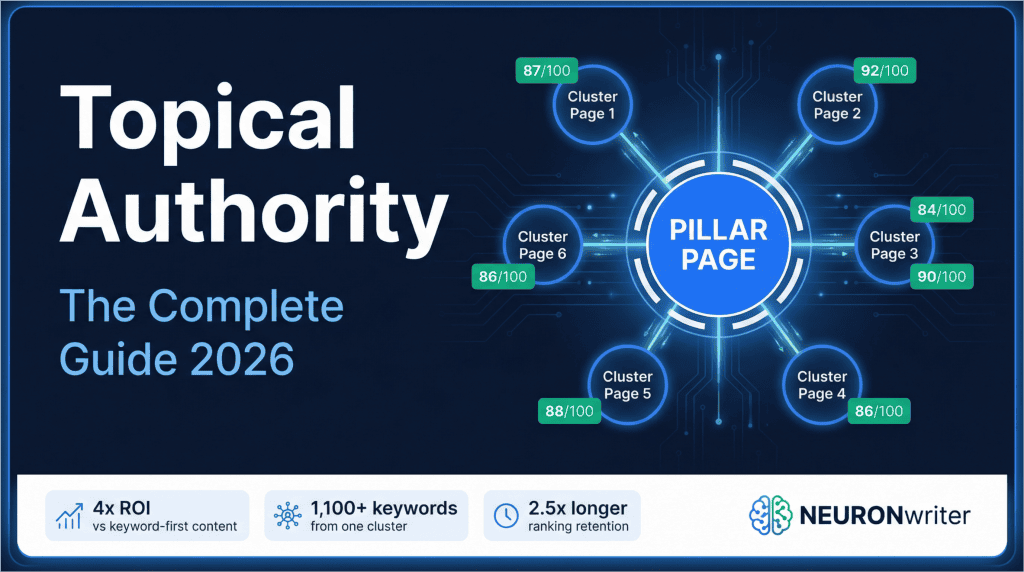
The architectural expression of topical authority is the content cluster a hub-and-spoke model of content organization in which a central “pillar” page covers a broad topic at a high level, while a series of “cluster” pages explore related subtopics in depth.
The pillar page defines the main entity and establishes the scope of the topic. Cluster pages provide the depth and specificity that signals expertise. The connective tissue between them — strategic internal links with descriptive anchor text helps Google understand the semantic relationships between the content and assess the site’s overall expertise on the topic.
“Topic clusters function as semantic ecosystems interconnected pages built around a central idea that work together to solve a user’s problem from start to finish.”
Research supports the effectiveness of this approach. Studies suggest that clustered content drives lower bounce rates and higher conversions compared to standalone keyword pages, and that evergreen content organized into clusters can generate up to 4x ROI compared to short, keyword-first posts.
One case study documented a single topic cluster ranking for over 1,100 keywords and generating approximately 100 organic clicks per weekday a level of performance that would be impossible for an isolated, standalone page.
Entity Recognition and Semantic Relationships.
Beyond the structure of your content, Google evaluates the entities your content references and the relationships between them. Entities are the real-world concepts people, places, organizations, products, ideas that give meaning to text. When your content consistently references the right entities in the right contexts, it signals to Google that you have genuine expertise in the domain.
This is why schema markup has become increasingly important. By explicitly labeling the entities in your content using structured data, you provide Google with clear, unambiguous signals about what your content is about and how it relates to other content on your site.
E-E-A-T Signals.
Google’s E-E-A-T framework Experience, Expertise, Authoritativeness, and Trustworthiness is closely intertwined with topical authority. Well-organized topic clusters with comprehensive, accurate content tend to earn more backlinks, generate longer dwell times, and receive better inclusion in AI-generated summaries. These signals, in turn, reinforce Google’s assessment of the site’s authority.
The relationship is self-reinforcing: topical authority builds E-E-A-T signals, and strong E-E-A-T signals reinforce topical authority.
Content Freshness.
Authority is not static. Google favors websites that actively maintain and update their content, reflecting the evolving state of knowledge in a given domain. A comprehensive guide published in 2022 that has not been updated since will gradually lose authority to a competitor who publishes a more current, accurate version of the same content.
This is why content decay the gradual erosion of a page’s relevance and rankings over time is a critical concern for any website building topical authority. Regular content audits and updates are not optional; they are a fundamental part of the authority-building process.
Topical Authority vs. Domain Authority: What Matters More.
For years, Domain Authority (DA) a metric developed by Moz to estimate a website’s overall ranking potential based on its backlink profile was treated as a proxy for SEO strength. A high DA was seen as a reliable predictor of ranking ability.
In 2026, this assumption is increasingly challenged. The rise of topical authority has demonstrated that a website with a relatively modest DA can outrank a high-DA competitor in a specific niche, provided it has built deeper, more comprehensive coverage of that niche.
| Dimension | Domain Authority | Topical Authority |
| What it measures | Overall site strength (backlinks, age) | Niche expertise on a specific subject |
| How it’s built | Link acquisition campaigns | Comprehensive content clusters |
| Scope | Site-wide | Topic-specific |
| Relevance to AI search | Low | High |
| Time to build | Years | 6-18 months (niche-dependent) |
| Transferability | Applies across all topics | Topic-specific |
| Best for | Broad, multi-topic sites | Niche specialists |
The practical implication is significant: a small, focused website that publishes comprehensive content on a narrow topic can compete effectively with much larger, more established sites. This is particularly true in the age of AI search, where AI engines like Perplexity, ChatGPT, and Google’s AI Overviews prefer to cite sources that demonstrate clear, verifiable expertise on a specific subject.
“If SEO had PageRank, AI systems now have an implicit SourceRank — a sense of which sites are safe, structured, and authoritative enough to cite.”
Topical Authority in the Age of AI Search.
The rise of AI-powered search has added a new dimension to topical authority. AI engines do not simply rank pages; they synthesize information from multiple sources to generate comprehensive answers. The sources they choose to cite are those they have determined to be authoritative, accurate, and trustworthy.
This means that topical authority is no longer just a factor in traditional search rankings it is a prerequisite for visibility in AI-generated answers. Our Complete Guide to AEO explores how to optimize content specifically for AI citation. A website that has built genuine topical authority is far more likely to be cited by AI engines than one that has not, regardless of its overall domain authority or backlink profile.
The implication for content strategy is clear: building topical authority is not just about ranking in Google’s traditional search results. It is about establishing the kind of deep, verifiable expertise that AI engines trust enough to cite in their answers.
A 5-Step Framework for Building Topical Authority with NEURONwriter.
Building topical authority is a systematic process. The following framework provides a practical roadmap for establishing your website as the go-to source in your niche.
Step 1: Define Your Core Topic (The Pillar)
Begin by identifying the primary topic you want to be known for. This should be a subject that is central to your business, has meaningful search volume, and is specific enough to be achievable. “Marketing” is too broad; “B2B content marketing for SaaS companies” is a viable starting point.
NEURONwriter SERP analysis is invaluable at this stage. By analyzing the top-ranking pages for your core topic, you can understand the scope and depth of coverage that Google currently rewards, giving you a clear benchmark for your own content.
Step 2: Map Your Subtopics (The Cluster)
Once you have defined your core topic, the next step is to map the full landscape of related subtopics. These are the specific questions, use cases, and related concepts that fall under your core topic’s umbrella.
NEURONwriter NLP analysis is particularly powerful here. By analyzing the semantic entities and related terms that appear in top-ranking content for your core topic, it reveals the full scope of what Google considers relevant to that topic. This prevents the common mistake of building a cluster that is either too narrow (missing important subtopics) or too broad (including topics that dilute your focus).
A well-mapped cluster for “B2B content marketing for SaaS” might include subtopics such as content strategy for SaaS, SaaS blog best practices, case study creation, product-led content, content distribution for B2B, measuring content ROI, and content repurposing among many others.
Step 3: Create a Comprehensive Pillar Page.
The pillar page is the cornerstone of your topic cluster. It should provide a comprehensive, high-level overview of your core topic, covering the most important subtopics at a summary level while linking out to the cluster pages for deeper exploration.
Effective pillar pages are typically long-form often between 2,000 and 4,000 words because they need to establish the full scope of the topic.
However, length is a means to an end, not a goal in itself. The objective is comprehensive coverage, not word count.
NEURONwriter Content Editor provides real-time guidance as you write, ensuring that your pillar page achieves the semantic completeness needed to signal authority to Google. The Content Score provides a quantitative measure of how well your content covers the topic compared to the top-ranking competitors.
Step 4: Build Your Cluster Pages.
Each cluster page should provide deep, focused coverage of a specific subtopic within your core topic. Unlike the pillar page, which covers the topic broadly, cluster pages are designed to be the definitive resource on their specific subtopic.
The key discipline at this stage is maintaining focus. Each cluster page should address one subtopic comprehensively, rather than attempting to cover multiple subtopics in a single post. This focus is what allows cluster pages to rank for specific, long-tail queries while simultaneously contributing to the overall topical authority of the cluster.
Step 5: Build a Strategic Internal Linking Architecture.
The internal linking structure of your topic cluster is what transforms a collection of individual pages into a coherent semantic ecosystem. Every cluster page should link back to the pillar page using descriptive, keyword-rich anchor text. The pillar page should link out to each cluster page. And where relevant, cluster pages should link to each other.
“Descriptive anchor text helps search engines understand what the linked page is about, strengthening topical relevance across your site. Linking with keyword-rich phrases signals how different pages relate, which can help both pages rank better for their target terms.”
NEURONwriter internal linking suggestions help you identify the most relevant linking opportunities within your existing content, ensuring that your cluster is as well-connected as possible.
Measuring Your Topical Authority Growth.
Building topical authority is a long-term investment, and measuring progress requires tracking the right metrics over time.
Organic traffic growth across your topic cluster is the most direct measure of authority growth. As Google recognizes your expertise, your rankings should improve not just for your target keywords but for a widening range of semantically related queries.
Keyword ranking breadth is equally important. A sign of growing topical authority is ranking for an increasing number of keywords related to your core topic including long-tail queries you did not explicitly target. This “halo effect” is one of the most powerful benefits of the cluster approach.
AI citation frequency is an emerging metric that will become increasingly important. Tools that track how often your content is cited in AI-generated answers provide a direct measure of the authority that AI engines assign to your site.
Backlink acquisition to your cluster pages is a lagging indicator of authority. As your content becomes recognized as the definitive resource on a topic, other websites will naturally link to it a virtuous cycle that further reinforces your authority.
Conclusion: From Keywords to Ecosystems
The shift from keyword-first to topic-first SEO is not a trend it is a structural change in how search engines understand and reward content. Websites that continue to optimize individual pages for individual keywords, without building the broader topical ecosystem that signals genuine expertise, will find themselves increasingly displaced by competitors who have made the investment.
Building topical authority requires a different kind of discipline: the patience to build comprehensively rather than opportunistically, the rigor to maintain and update content over time, and the strategic clarity to define a core topic and pursue it systematically.
“When Google trusts your expertise, your rankings improve across the board. It is the digital equivalent of being the most recommended consultant in the room.”
NEURONwriter provides the analytical foundation for this work the ability to see what comprehensive coverage looks like, to measure how close your content comes to achieving it, and to identify the gaps that need to be filled. The NEURONwriter Manual provides a complete workflow for putting these principles into practice. The strategy is yours to define; the tools are ready to support it.
FAQ.
How long does it take to build topical authority?
Building meaningful topical authority typically takes between 6 and 18 months, depending on the competitiveness of your niche, the quality of your content, and the consistency of your publishing cadence. However, the benefits compound over time: a well-built topic cluster continues to generate traffic and authority long after the initial investment.
How many cluster pages do I need?
Most effective content clusters include between 5 and 20 supporting pages, though some comprehensive topics may warrant more.
The focus should always be on quality and completeness rather than volume. A cluster of 10 genuinely comprehensive pages will outperform a cluster of 30 thin, superficial ones.
Can I build topical authority in a competitive niche?
Yes, but the strategy requires a more focused approach. In highly competitive niches, the most effective path to topical authority is to niche down — to identify a specific segment of the broader topic where you can build comprehensive coverage more quickly. Once you have established authority in that segment, you can expand into adjacent areas.
Does topical authority replace the need for backlinks?
No. Backlinks remain an important signal of authority and trust. However, topical authority changes the relationship between content and backlinks. A website with genuine topical authority tends to attract backlinks more naturally, because its content is recognized as the definitive resource on a topic. The two signals are complementary, not competing.