How to Build a Content Moat: Defending Your Rankings in the AI Era.
The age of AI has unleashed a content flood. With generative AI tools making it easier than ever to produce text, the internet is being inundated with a tidal wave of generic, uninspired, and often indistinguishable content. For businesses that rely on organic search, this presents a critical threat. As one expert aptly put it, “AI didn’t kill SEO. It killed average content”.
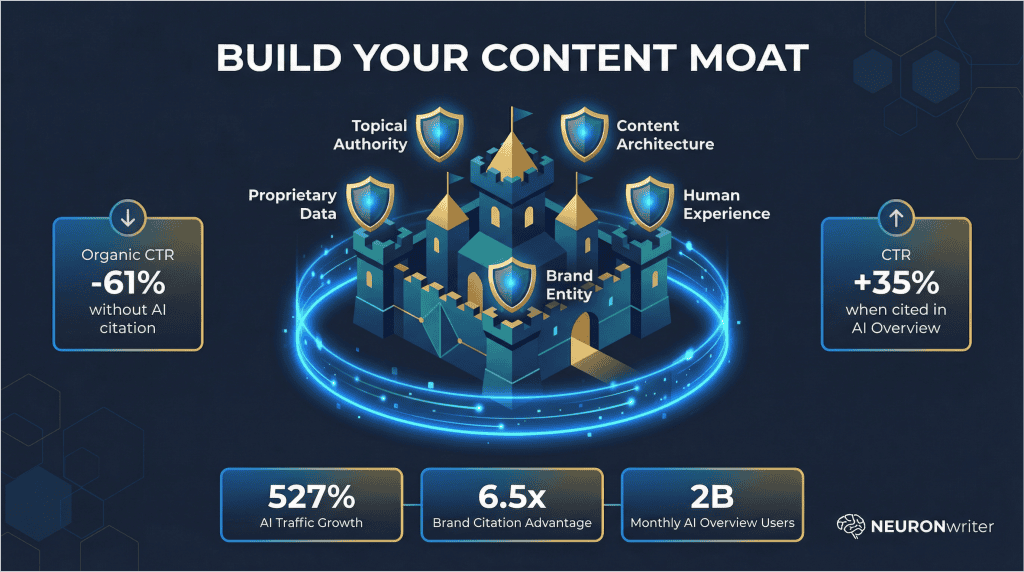
This new reality is reflected in stark numbers. With over 2 billion monthly users now engaging with Google’s AI Overviews, the search landscape is fundamentally changing. For queries where an AI Overview is present, organic click-through rates have plummeted by 61% 2. Your content is no longer just competing with other websites; it’s competing with the AI itself.
However, there is a silver lining. The same data shows that when a brand is cited in an AI Overview, its organic CTR is 35% higher. This reveals the new imperative for SEO in 2026: you cannot win by being average. You must build a Content Moat a set of defensible, long-term competitive advantages that protect your rankings from both competitors and the homogenizing force of AI.
This article will outline a five-pillar framework for building a robust Content Moat, ensuring your brand not only survives but thrives in the AI era.
What Is a Content Moat?
A Content Moat is the strategic accumulation of unique, authoritative, and hard-to-replicate assets that create a durable competitive advantage in organic search. It’s the difference between renting your audience through fleeting rankings and owning your niche through undeniable authority.
In the past, a moat might have been a large backlink profile or a massive volume of content. But in the AI era, where links can be artificially inflated and content can be generated instantly, these traditional moats are crumbling. As one strategist noted, “In the AI era, defensibility is no longer about what you build – it’s about what you accumulate”.
The new moat is built on a foundation of authenticity, expertise, and unique value that AI cannot replicate.
The 5 Pillars of a Modern Content Moat.
Building a defensible Content Moat requires a multi-faceted strategy. It’s not about a single tactic, but about weaving together five distinct yet interconnected pillars.
Pillar 1: Deep Topical Authority.
Topical authority is the foundation of any content moat. It’s the act of proving to search engines that you are a comprehensive expert on a specific subject. This goes far beyond targeting a few high-volume keywords. It means covering a topic in its entirety addressing every question, exploring every sub-topic, and demonstrating a depth of knowledge that no competitor can match.
This is achieved through a hub-and-spoke model, where a central “hub” page provides a broad overview of a topic, and multiple “spoke” pages dive deep into specific niches. This structured approach creates a dense network of interconnected content that signals deep expertise to search engines, making your site the go-to resource for that topic.
Pillar 2: Proprietary Data & Original Research.
If topical authority is the foundation, proprietary data is the reinforced steel. In a world of regurgitated AI content, original data is the ultimate differentiator. It is information that you own, that no one else has, and that provides unique value to your audience.
As the experts at Brafton note, Google algorithms are designed to reward “information gain” content that adds something new to the conversation. When you publish findings from your own surveys, case studies, or internal data analysis, you are providing a piece of the puzzle that no one else can.
“When you reveal a data point gleaned from analyzing thousands of customer interactions, you’re adding a puzzle piece the rest of the SERP is missing.” Brafton 4
This unique data becomes a magnet for high-quality backlinks from news outlets, academic institutions, and industry blogs, further strengthening your moat.
Pillar 3: A Strong Brand Entity & Third-Party Citations.
In the world of AI search, your brand is your currency. AI models are increasingly looking for trusted, authoritative sources to cite in their answers. The data is clear: brands are 6.5 times more likely to be cited through third-party sources than their own domains.
This means that building a strong brand entity is a critical component of your content moat. This involves:
- Earning brand mentions across the web (podcasts, news articles, forums).
- Securing citations in authoritative publications.
- Building a strong presence on platforms that AI models trust, such as Wikipedia and Reddit.
Every time your brand is mentioned in a positive context by a reputable third party, you are adding another layer of defense to your moat.
Pillar 4: Deliberate Content Architecture.
Your content architecture is the internal scaffolding that supports your entire moat. It’s how you structure your content and guide both users and search engines through your site. A strong architecture ensures that authority flows to your most important pages and that the semantic relationships between your content are clear.
Key components of a strong content architecture include:
- A logical site hierarchy: Organizing your content into clear categories and subcategories.
- Strategic internal linking: Using internal links to connect related pieces of content and distribute authority.
- Comprehensive schema markup: Using structured data to explicitly tell search engines what your content is about, leaving no room for ambiguity.
This deliberate structure makes your site easier for AI to understand and classify, increasing your chances of being featured in rich results and AI Overviews.
Pillar 5: Genuine Human Experience (E-E-A-T)
In the face of AI-generated sameness, genuine human experience has become a powerful differentiator. As one Optimizely article states, “The best defense against AI sameness is human difference”.
This is the essence of Google’s E-E-A-T (Experience, Expertise, Authoritativeness, Trustworthiness) guidelines. Search engines are actively looking for content that demonstrates real, first-hand experience. This can include:
- Personal stories and case studies.
- Unique insights and opinions from subject matter experts.
- User-generated content (UGC), such as reviews and comments.
- Content that shows you have actually used a product or visited a place.
This is the one thing that AI cannot fake. By infusing your content with genuine human experience, you create a layer of authenticity that builds trust with both your audience and search engines.
How NEURONwriter Helps You Build a Content Moat.
Building a Content Moat requires a strategic, data-driven approach NEURONwriter is designed to provide the tools you need to construct each of the five pillars.
| Pillar | How NEURONwriter Helps |
| 1. Topical Authority | Plan and execute content clusters with SERP-based analysis to ensure you cover every relevant sub-topic. |
| 2. Proprietary Data | While you provide the data, NEURONwriter helps you structure it within a high-ranking article format, optimized with NLP terms. |
| 3. Brand Entity | By helping you create authoritative, comprehensive content, NEURONwriter increases your chances of earning natural brand mentions and citations. |
| 4. Content Architecture | Use the internal linking suggestions to build a strong, semantically relevant internal link structure that supports your content clusters. |
| 5. Human Experience | NEURONwriter AI writing tools can create a data-driven first draft, freeing up your human experts to focus on adding their unique experience and insights. |
Measuring Your Moat: KPIs for the AI Era
How do you know if your moat is getting stronger? You need to track the right KPIs.
- Branded Search Volume: An increase in people searching directly for your brand is a strong signal of a growing brand entity.
- AI Overview Citations: Track how often your domain is cited in Google’s AI Overviews for your target keywords.
- Topical Coverage Score: Use tools to measure what percentage of a given topic you have covered compared to your competitors.
- Share of Voice: Monitor your overall visibility in the SERPs for your most important topics.
Conclusion: Your Moat Is Your Future.
The rise of AI search is not a death sentence for SEO; it’s a call to evolve. The era of
average, easily replicated content is over. The future belongs to those who build deep, defensible moats around their content.
By focusing on the five pillars Topical Authority, Proprietary Data, Brand Entity, Content Architecture, and Human Experience you can create a strategic asset that is resilient to algorithm changes and immune to the threat of AI-generated mediocrity. Your content moat is not just a defensive strategy; it is your primary offensive weapon for winning the future of search.
FAQ
Is it too late to start building a content moat?
No. While the best time to start was yesterday, the second-best time is today. The sooner you shift your strategy from producing generic content to building a defensible moat, the more secure your long-term search visibility will be.
How much does it cost to build a content moat?
The investment is more in strategy and effort than in direct costs. It requires a commitment to in-depth research, data analysis, and expert-led content creation. While tools like NEURONwriter are an investment, the primary cost is the time and expertise of your team.
Can I build a moat with AI-generated content alone?
No. AI-generated content, by itself, is a commodity. It lacks the unique insights, proprietary data, and genuine experience that form the core of a defensible moat. AI should be used as a tool to assist your human experts, not replace them.
How long does it take to see results from building a content moat?
Building a moat is a long-term strategy. You may see early wins from publishing original research or improving your content architecture, but the full effects of deep topical authority and a strong brand entity typically take 6-12 months to materialize. This is a marathon, not a sprint.
What is the single most important pillar of the content moat?
While all five are interconnected, Proprietary Data & Original Research currently offers the most significant and immediate competitive advantage. It is the hardest element for competitors (and AI) to replicate and provides the clearest “information gain” signal to search engines.